- Maybe you missed it? LattePanda IOTA Review (Full hands-on review).
- HUSKYLENS 2 Review: Exploring DFRobot’s newest AI Machine Vision sensor board.
HUSKYLENS 2: An advanced AI-powered machine vision camera perfect for AI and robotics applications.
Part I: Introducing the Product
[Launched at 9:00 PM (Beijing Time) on October 30, 2025] Following the launch of the original HUSKYLENS on July 28, 2019, DFRobot has now unveiled the upgraded HUSKYLENS 2 board, an easy-to-use SBC featuring an integrated AI vision sensor, perfect for robotics, automation, and AI education projects.
Powered by the Kendryte K230 AI RISC-V chip, this device features a built-in 2.4-inch IPS display, enabling users to train, interact with, and monitor the camera without needing an external PC. It offers capabilities like face recognition, object tracking, object recognition, line following, color detection, and QR code scanning, making it easier to develop embedded products without requiring advanced coding skills.
A full up-close view of the product
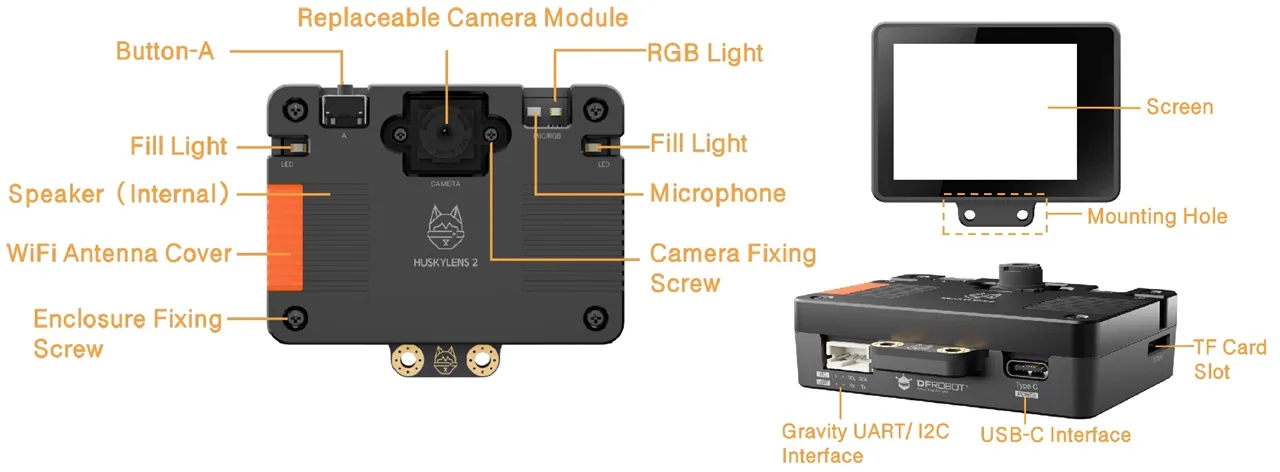
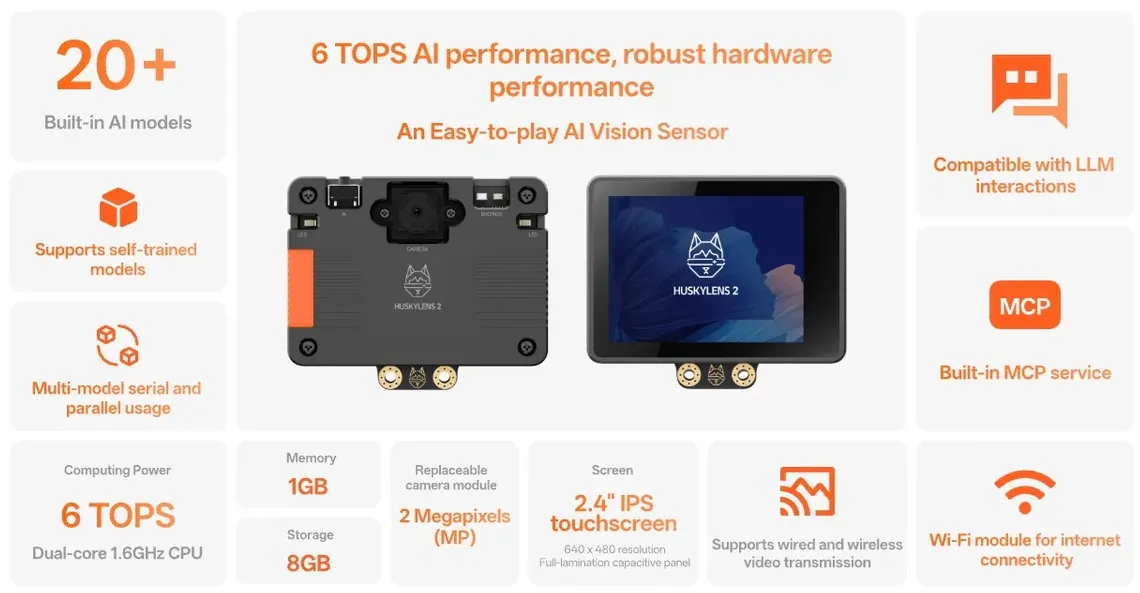
This product integrates three key components into a single piece of hardware: a low-power microcontroller (the K230), a camera sensor, and an integrated display, making it ideal for creative AI, DIY, and robotics projects. Powered by the Kendryte K230 processor, this Edge AI camera excels in object tracking and precise face recognition without requiring any coding. Its built-in screen provides instant feedback, perfect for students creating line-following robots or other smart devices.
Key Features
- Powered by a RISC-V processor: Built on the Kendryte K230 Processor chip, it offers fast on-device processing, making it perfect for real-time applications with low latency and very low power consumption.
- AI computing performance: The Neural Processing Unit (NPU) offers a performance of up to 6 TOPS, making it perfect for light AI applications.
- Storage and memory: Featuring 1GB of LPDDR4 RAM and 8GB of eMMC storage, it also supports TF card expansion for additional storage.
- Integrated Camera: Feature a 2MP camera (GC2093 sensor) for sufficient resolution and dependable identification tasks.
- Built-in speaker (1W) & Microphone – Included.
- Wireless connectivity: Wi-Fi is available through a slot-in module.
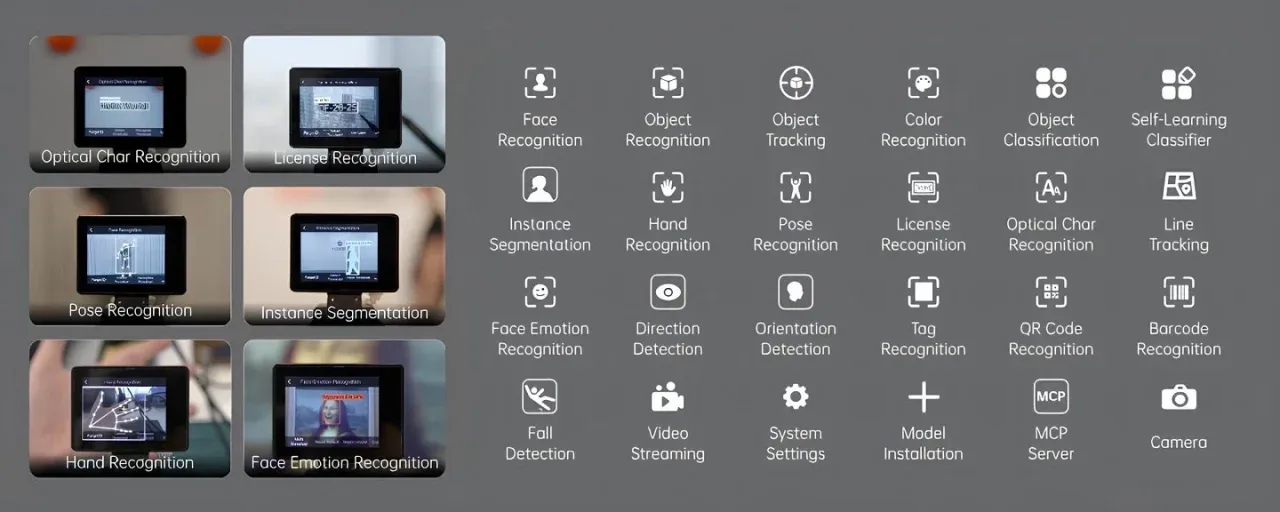
- 20+ recognition algorithms: Include over 20 recognition algorithms to choose from, including face, object, color, line, and tag detection, everything is accessible and trainable with just a simple button press.
- Integrated Display: 2.4-inch IPS LCD (640×480) lets you view results and tweak settings directly on the device with an intuitive menu system.
- Learning button: A standalone “learning button” enables fast training of new objects, faces, colors, or lines without requiring any coding.
- Low power consumption: (230–320mA typical) and compatibility with 3.3–5V, it’s perfect for most hobby and educational projects.
- MCP server (Model Context Protocol server) support: By utilizing the MCP protocol, seamless real-time context synchronization is achieved between AI agents and their interactive tools.
- Compatibility with standard controllers and single-board computers: With standard UART and I2C interfaces, the board easily connects to a variety of microcontrollers and single-board computers, such as Arduino, micro:bit, Raspberry Pi 5, and ESP32.
- Real-Time Video Streaming: Live view for monitoring and debugging can be done either through a wired connection using USB-C or wirelessly via a Wi-Fi 6 module.
- Replaceable Camera Module: Swappable 2 MP GC2093 sensor featuring compatibility with various lenses, including microscope, telephoto, and night vision.
- Model Hub: Download and use both official and user-created models for various purposes like agriculture, retail, safety, and more.
- Mounting Options: It can be attached to a helmet, bicycle, car, motorcycle, airplane, bus, train, truck, boat, traffic light, tripod and more.
Model Context Protocol (MCP) support and large language models (LLMs)
The Model Context Protocol (MCP) built into the HUSKYLENS 2 AI camera enables it to connect to and utilize the power of a Large Language Model (LLM).
🧠 MCP (Model Context Protocol)
- MCP is a service integrated into HUSKYLENS 2, serving as a link between the camera’s built-in AI vision and external LLMs.
- It enables the camera not only to recognize objects, such as food or gestures, but also to grasp their meaning and context by leveraging the extensive knowledge base of the LLM.
🤖 Leveraging the LLM
- By using MCP, HUSKYLENS 2 can send visual recognition data to an LLM, which then interprets it in a more intelligent, contextual way.
- For example, if the camera sees your lunch, the LLM can go beyond just identifying “a sandwich” — it might analyze nutritional value, suggest dietary tips, or even recommend recipes.
🚀 Why It Matters
- This integration turns HUSKYLENS 2 from a basic vision sensor into a context-aware AI assistant, enabling real-world understanding and interaction.
- It’s a significant step toward enhancing AI vision systems, making them smarter, more versatile, and beneficial for fields like education, robotics, and automation.
🧠 What is LLM all about?
LLM, short for Large Language Model, is a type of computer program designed to understand and generate human language. It can perform tasks like answering questions, writing stories, translating text, or engaging in conversations.
📚 How It Works
- It’s trained on lots of text from books, websites, and articles.
- It learns patterns in language — how words and ideas connect.
- When you ask something, it uses those patterns to give a smart response.
- The LLM normally runs on powerful cloud servers, not on a local device.
- When a device like HUSKYLENS 2 sends a request (e.g., “What is this object?”), it:
- Captures and processes the visual data locally
- Sends structured context (via MCP) to the LLM server
- Receives a natural language response from the LLM
Specifications
| Feature | HUSKYLENS 2 Specification |
|---|---|
| Processor | Kendryte K230 Dual-core 21.6GHz 64-bit RISC-V CPU |
| Memory | 1GB LPDDR4 |
| AI Computing Power | 6TOPS |
| Camera | 2MP GC2093, 1/2.9″, 60 FPS (Replaceable) |
| Display | 2.4-inch IPS LCD, 640×480 pixels |
| Speaker | 1W |
| WiFi Module (Optional) | 2.4GHz WiFi 6 (Card based) |
| Interfaces for connectivity | Type-C, Gravity (I2C / UART), TF Card Slot |
| MEMS Microphones | ✔ |
| Other Components | 1x Button 1x RGB light 2x Fill light |
| Built-in Algorithms | ✔ Face Detection/Recognition ✔ Facial Feature Detection ✔ Object Recognition / Tracking ✔ Color Recognition ✔ Object Classification ✔ Self-learning Classification ✔ Instance Segmentation ✔ Hand Detection ✔ Hand Keypoint Detection ✔ Gesture Recognition ✔ Humen detection ✔ Humen keypoint detection ✔ Pose Recognition ✔ License Plate Recognition ✔ Text Recognition ✔ Line Tracking ✔ Expression Recognition ✔ Gaze Direction Detection ✔ Face Orientation Detection ✔ QR Code Recognition ✔ Barcode Recognition ✔ Tag Recognition ✔ Fall Detection |
| Operating Voltage | 3.3–5.0V |
| Power Consumption | 1.5W–3W |
| Dimension | 70mm x 58mm x 19mm |
| Weight | 90g (Without packaging) |
Product links and documentation.
- DFRobot Official Website: Website
- GitHub: DFRobot/DFRobot_HuskylensV2
- Product Wiki page: SEN0638
- HUSKYLENS 2 Official Website: Product Page
With over 20 built-in algorithms ready to use
HUSKYLENS 2 offers over 20 built-in AI models, featuring handy capabilities like object tracking, hand recognition, and instance segmentation, making it versatile for various applications. Users can also train and deploy custom AI models, enabling it to recognize anything they need.
Applications in education and AI project development.
HUSKYLENS 2 might look simple at first glance, but the product is actually quite complex and packed with tons of practical features. it’s ideal for educational and AI developmental use, especially in STEAM (Science, Technology, Engineering, Arts, and Mathematics) education. With its intuitive interface and preloaded models, it’s a fantastic tool for practical learning and creating complex projects that require minimal power consumption. Here are some example applications you could potentially use with this product.
- Robotics: Building robots that recognize and respond to gestures or facial expressions.
- Driving assistance: Creating fixed or mobile systems capable of tracking and categorizing objects in real-time.
- QA: Creating QA systems for analyzing colors and identifying surface damages on objects.
- Elderly assistance: Designing systems to monitor the elderly, prevent falls, and predict behavioral scenarios.
- Clinical dermatologic diagnosis: Diagnosing and identifying different skin diseases.
- Security systems: Human detection and risk hazards pose dangers.
- Surveillance: Streaming video feeds and observing environments.
Broad compatibility with popular controllers and SBCs
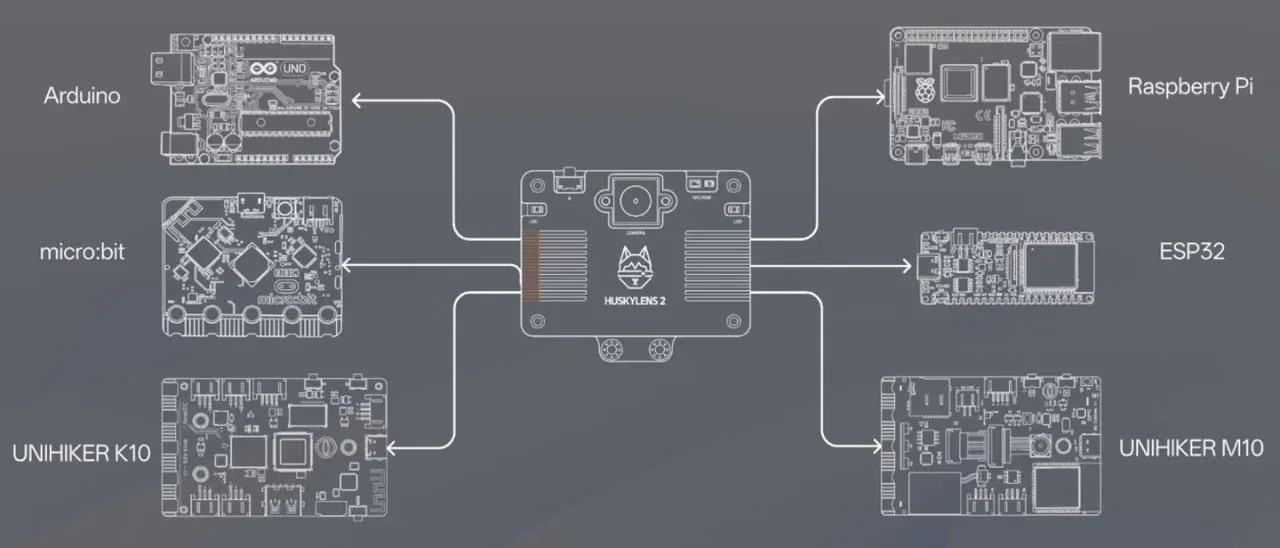
The hardware is highly compatible with popular controllers like Arduino, Raspberry Pi, and micro:bit, making it easy to integrate AI vision into various projects.
Wide Controller Support
Designed to integrate effortlessly with widely used microcontroller platforms:
| Controller | Compatibility Notes |
|---|---|
| Arduino | Plug-and-play via UART or I2C. Libraries and tutorials available for quick setup. |
| Raspberry Pi | Connects via UART or USB. Python libraries support advanced integration. |
| micro:bit | Compatible through I2C. Ideal for educational and beginner-friendly projects. |
| ESP32/ESP8266 | Supported via UART. Enables wireless AI vision applications. |
| UNIHIKER M10/K10 | Still not verified |
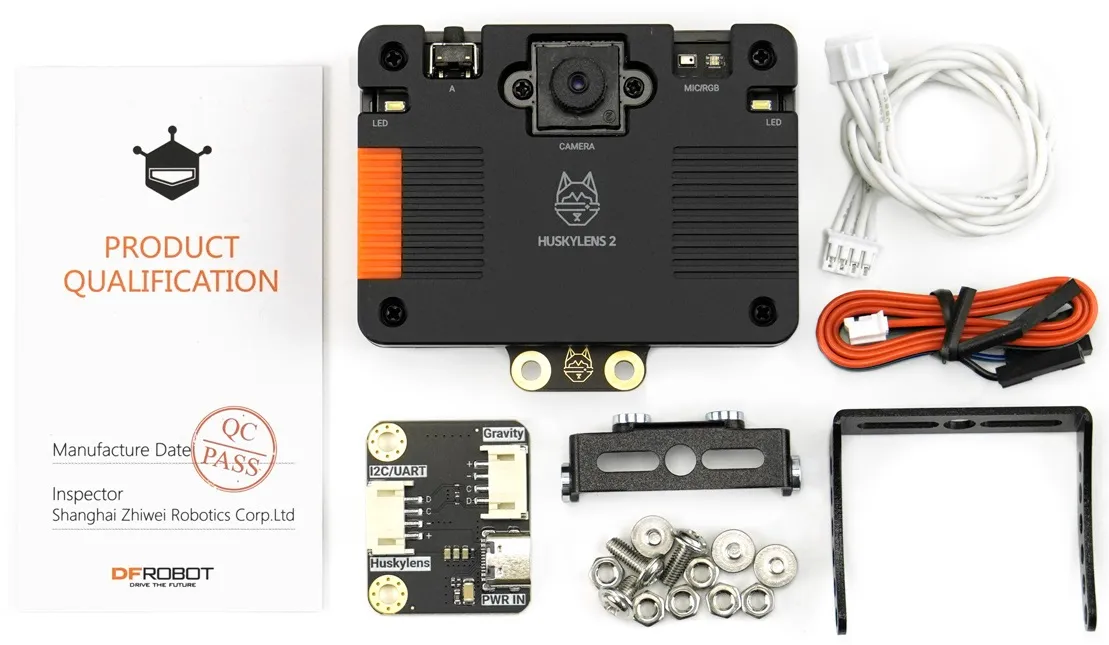
What’s included in the package?
| Item description | QTY |
|---|---|
| HUSKYLENS 2 AI Vision Sensor | x1 |
| M3 Screws | x6 |
| Mounting Bracket | x1 |
| Heightening Bracket | x1 |
| Gravity-4P Sensor Connector Cable (30cm) | x1 |
| Dual-Plug PH2.0-4P Silicone Cable (20cm) | x1 |
| Power Adapter Board | x1 |
Additional accessories
Along with the board, DFRobot team offers few extra accessories such as a Microscope Lens Module that you can purchase to build an electronic-based microscope. This interesting module comes with a camera sensor as well as lenses designed for close-up zoom capabilities. A WiFi module is available as an optional accessory and is great for projects or products that require wireless connectivity.