- Maybe you missed it? An In-Depth Look at the LattePanda IOTA.
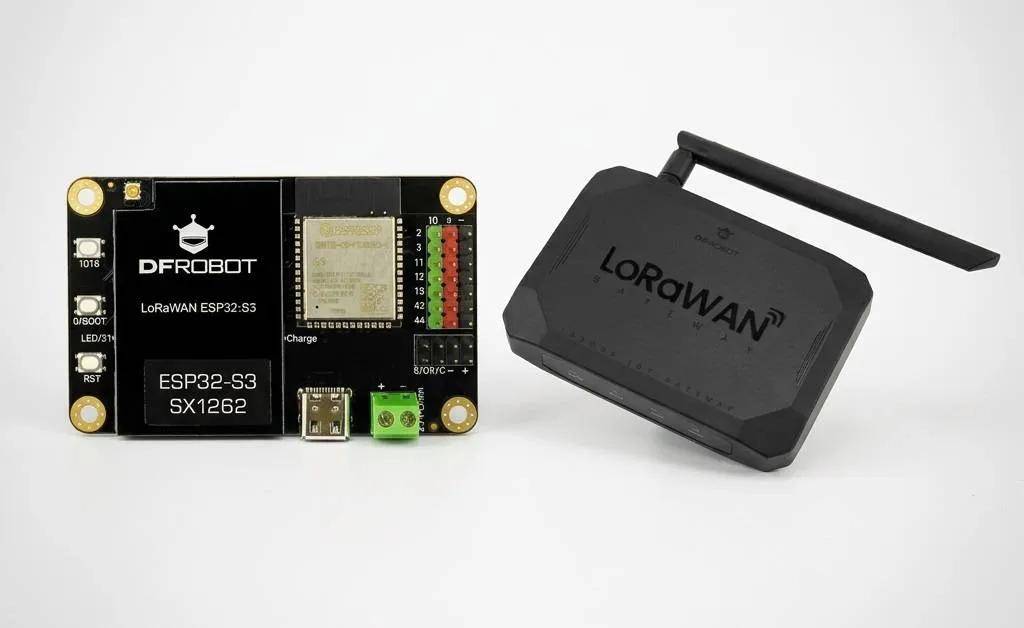
- Introducing DFRobot’s latest products: the DFR1195 ESP32-S3, showcased alongside an exclusive Private LoRaWAN Gateway.
DFRobot launched an all-in-one IoT solution with an ESP32-S3 board and a new Private LoRaWAN Gateway compatible with Node-RED, ideal for home automation and long-range IoT connectivity projects.
Part I: Overview of DFR1195 ESP32-S3 & Private LoRaWAN Gateway
Ever tried to connect a sensor in your backyard, only to watch your Wi-Fi signal give up halfway? Or dreamed of building a weather station on your cabin but worried about how to get the data back home? We’ve all been there.
In today’s rapidly evolving IoT landscape, developers need versatile hardware that bridges the gap between powerful processing and extended wireless reach. The new DFR1195 LoRaWAN ESP32-S3 development board emerges as a comprehensive solution, engineered to simplify long-distance communication projects while maintaining accessibility for creators at every skill level. Imagine it as the Swiss Army knife of wireless IoT solutions: intelligent, versatile, and poised to assist you in creating something extraordinary.
This integrated development board combines the robust capabilities of the ESP32-S3 microcontroller with the SX1262 LoRa transceiver, creating a unified toolkit for building smart sensors, environmental monitors, mesh networks, and home automation extensions that work reliably across hundreds of meters—even in challenging environments.
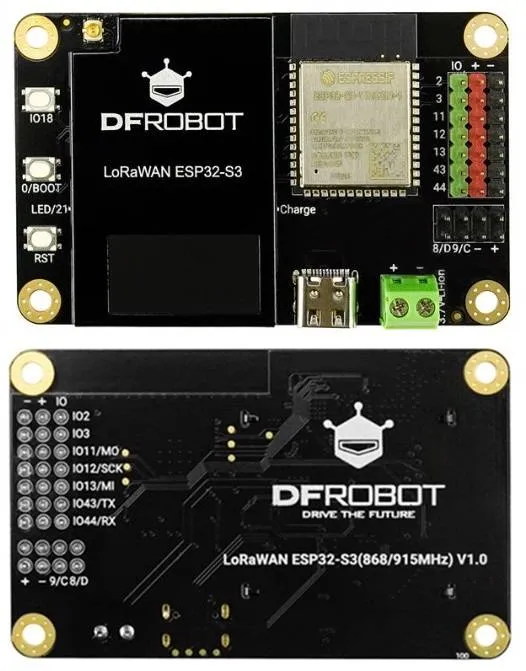
The LoRaWAN Interfaces for the ESP32-S3
Integrate an onboard IPEX1 Wi-Fi antenna socket for seamless connectivity to an external antenna, while also including reset functionality, a power interface, and GPIO and I2C connections. Furthermore, this development board perfectly integrates with the Arduino ecosystem, providing pre-built libraries and sample code to create an effortless experience for every user.
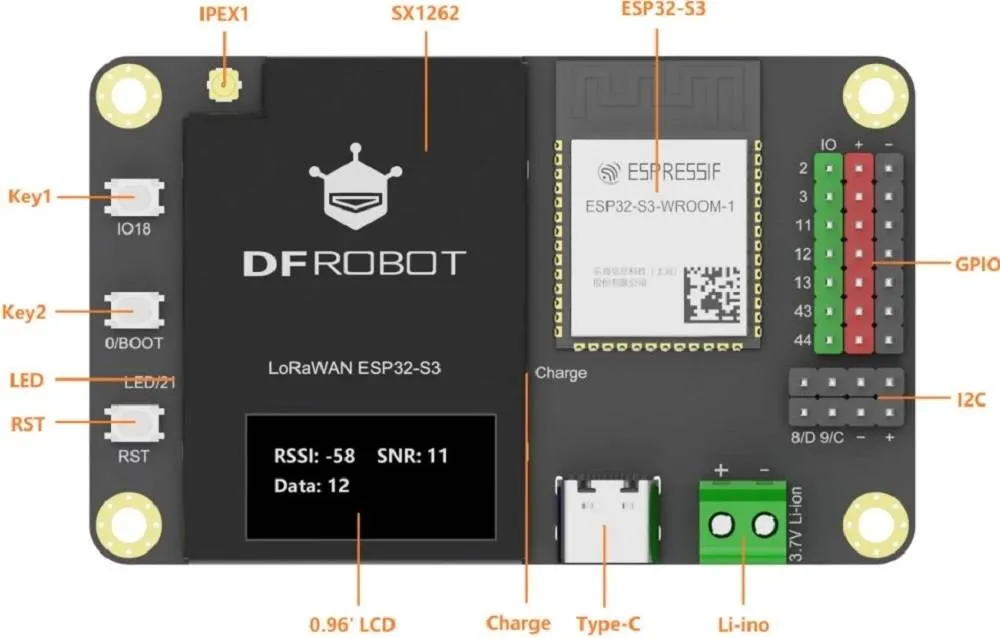
So, what features and capabilities does this board offer?
At its core, the DFR1195 is a compact board powered by the ESP32 microcontroller, featuring LoRa wireless modulation that facilitates message transmission over several kilometers, surpassing the constraints of short-range communication. It effortlessly integrates:
- A brainy ESP32-S3 chip (great for running code).
- A LoRa radio module (the secret to long-range communication).
- A cute color screen and buttons (so you can see what’s happening, no laptop needed).
- Convenient plug-in ports for sensors and soldering needed for basic projects!
What Sets This Board Apart?
Multi-Protocol Wireless Flexibility
Unlike single-purpose modules, this development board natively supports four distinct communication frameworks:
- Direct LoRa peer-to-peer messaging for simple point-to-point links
- Scalable LoRa one-to-many broadcasting for sensor networks
- Full LoRaWAN protocol compliance for integration with public or private networks
- Meshtastic compatibility for decentralized, off-grid text communication
This versatility means a single hardware platform can adapt to diverse project requirements without redesign or component swaps.
Completely Compatible with the Meshtastic Protocol
Is it compatible with the Meshtastic protocol?
Absolutely! The DFRobot DFR1195 LoRaWAN ESP32‑S3 Dev Board is officially endorsed for use with Meshtastic. Numerous retailers confirm in their product descriptions that it supports LoRa, LoRaWAN, and Meshtastic protocols. This positions it among the select few boards where compatibility with Meshtastic is not only community-verified but also explicitly promoted by the manufacturer.
What makes the DFR1195 compatible?
The essential components are as follows.
- ESP32‑S3 MCU — fully supported by Meshtastic firmware.
- Semtech SX1262 LoRa transceiver — the recommended radio chip for Meshtastic.
- 850–930 MHz band — covers 868 MHz (Israel/EU) and 915 MHz (US) variants.
Manufacturer confirmation
DFRobot clearly identifies Meshtastic as a supported protocol in the product description, a noteworthy detail that strongly suggests first-party compatibility.
Developer-Focused Hardware Design
Every physical feature prioritizes rapid prototyping and field testing:
Visual Feedback System: The integrated 0.96-inch color LCD display, featuring a resolution of 160×80 pixels, combined with tactile buttons, enables instant status monitoring without the need for a serial monitor or smartphone. Effortlessly switch between connection metrics, sensor readings, and debug information with just a simple press of a button.
Portable Power Architecture: An integrated JST connector expertly accommodates 3.7V lithium batteries featuring onboard charging circuitry. Effortlessly shift from bench testing to outdoor deployment without the hassle of rewiring or the need for external power banks.
Plug-and-Play Sensor Interface: The numerous Grove-compatible ports and standard 2.54mm headers facilitate effortless, tool-free connections for popular sensors, including temperature, motion, light, and gas detection. This eliminates the need for soldering during the proof-of-concept phase, allowing you to streamline your development cycle and accelerate progress.
Hardware Specfications
| Category | Specification |
|---|---|
| Core Processor | ESP32-S3-WROOM-1-N4 module with dual-core Xtensa® LX7 @ 240MHz |
| Memory | 512KB SRAM, 384KB ROM, 4MB Flash |
| Wireless | Wi-Fi 802.11 b/g/n, Bluetooth® 5 (LE), LoRa via SX1262 |
| RF Chip | SX1262 |
| LoRa Frequency | 850–930MHz (region-configurable: EU868/US915) |
| RF Performance | Up to 22dBm transmit power; -137dBm sensitivity @ SF12 |
| Display | 0.96″ RGB LCD, 160×80 pixels |
| Power | 3.3V logic; 5V USB-C input; 300mA max charge current |
| Operating Range | -10°C to +60°C |
| Dimensions | 73 x 45mm. |
Smart Home Ecosystem Expansion
Home automation enthusiasts can now make use of this board and break free from Wi-Fi range limitations with their HomeAssistant installations. Thanks to the ESPHome integration, this board operates as a long-range peripheral node, allowing for:
- Garden soil sensors are designed to provide data from remote plots.
- Garage door monitors to communicate through thick walls.
- Outdoor weather stations to feed real-time data indoors.
- Coverage for multi-story properties without the use of signal repeaters.
Real-World Application Scenarios
🏡Large-Property Home Automation
Overcome signal dead zones in villas, farms, or multi-building complexes. Deploy environmental sensors in greenhouses, pool monitors in backyards, or gate sensors at property entrances communicating reliably with your central HomeAssistant hub.
🌾Precision Agriculture & Horticulture
Monitor soil moisture, ambient temperature, and light levels across expansive fields. The board’s low-power capabilities enable battery-operated deployments that transmit periodic updates over kilometers, triggering irrigation systems or alerting farmers to changing conditions.
🏔️ Off-Grid Adventure Communication
When cellular connectivity vanishes, Meshtastic mode turns the board into a robust text-messaging node. Hikers, researchers, and emergency responders can establish self-healing mesh networks for sharing coordinates, providing status updates, or sending distress signals—all without the need for any existing infrastructure.
🏭 Industrial IoT Prototyping
Evaluate LoRaWAN sensor networks prior to large-scale deployment. The user-friendly visual interface streamlines the process of diagnosing signal strength, packet loss, and gateway registration issues during site surveys or pilot installations.
🌤️ Urban Environmental Monitoring
Create hyperlocal air quality, noise, or weather stations that upload data to community dashboards. The compact form factor allows discreet mounting on streetlights, building facades, or park infrastructure.
Streamlined Development Experience
Arduino IDE Ready
Get started in minutes with official library support. The DFRobot_LoRaWAN_ESP32S3 library abstracts complex protocol handling, providing simple functions for:
- Network joining (OTAA or ABP authentication methods)
- Uplink/downlink data transmission
- Power management and deep sleep scheduling
- LCD and button interaction handling
Ready-to-Run Code Examples
Accelerate learning curve with pre-built sketches demonstrating:
- Basic LoRa packet exchange between two boards
- LoRaWAN gateway registration and cloud data forwarding
- Sensor integration with SHT3x temperature/humidity modules
- Battery-conscious operation with timed wake cycles
- Meshtastic firmware flashing for instant mesh networking
Reasons to Choose This Board for Your Next Project!
The DFR1195 breaks the mold of conventional technology, seamlessly combining an expansive wireless range with efficient development. This all-in-one, well-documented board incorporates processing power, a multi-protocol radio, visual feedback, and portable power, enabling:
- Students eager to delve into the world of wireless communications without getting bogged down by unnecessary complexity.
- Passionate hobbyists eager to create innovative smart home extensions that go beyond the limitations of Wi-Fi connectivity.
- Engineers that are eager to swiftly develop prototype industrial IoT solutions using production-ready components.
- Researchers are dedicated to developing field sensors that provide reliable long-range telemetry capabilities.
Whether you’re transmitting a single sensor reading across a campus or creating a community mesh network to improve disaster resilience, this development platform provides the foundation to turn your connectivity goals into reality. It guarantees exceptional flexibility, remarkable performance, and seamless usability.