
TL;DR
HiWonder has launched the WonderLLM, a compact smart interaction module built around the ESP32-S3 microcontroller. Designed as an all-in-one perception and communication unit, it integrates a 2.
- Maybe you missed it? CamThink NE301 Review.
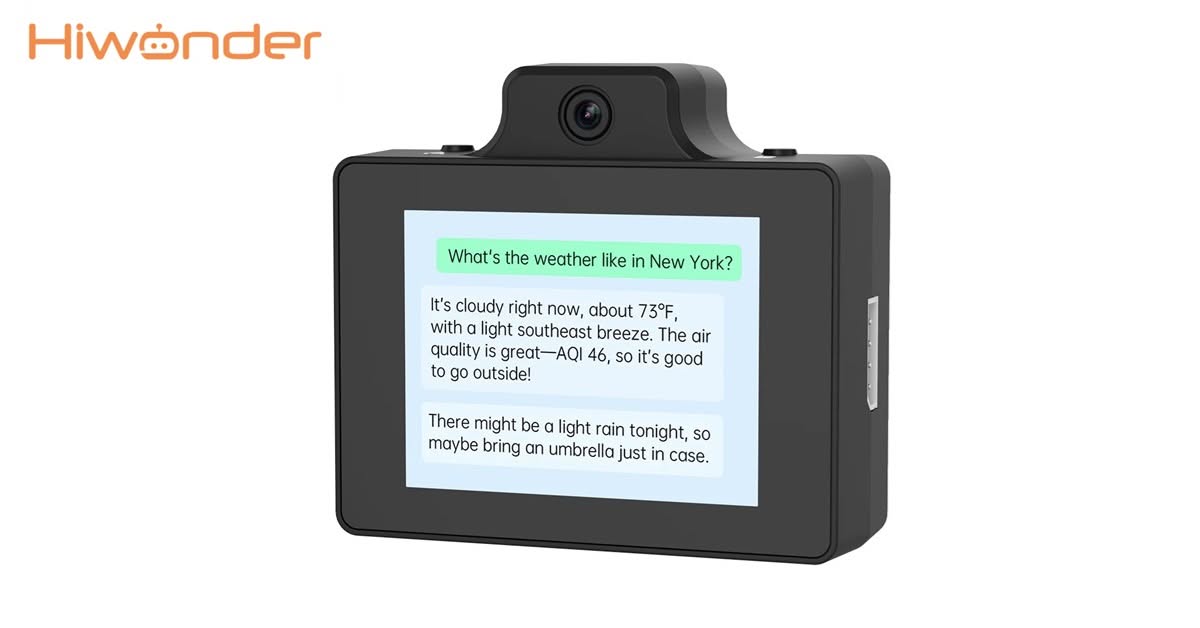
The HiWonder WonderLLM ESP32-S3 AI Camera features both vision and voice capabilities.
HiWonder has launched the WonderLLM, a compact smart interaction module built around the ESP32-S3 microcontroller. Designed as an all-in-one perception and communication unit, it integrates a 2.0-inch touchscreen display, a 2-megapixel camera with a 123° field of view, a built-in speaker, and a microphone array to enable both visual recognition tasks and conversational AI experiences.
For offline functionality, the WonderLLM supports several computer vision tasks directly on the ESP32-S3, including face detection, color tracking, and line following—making it suitable for robotics and educational projects without requiring constant internet connectivity.
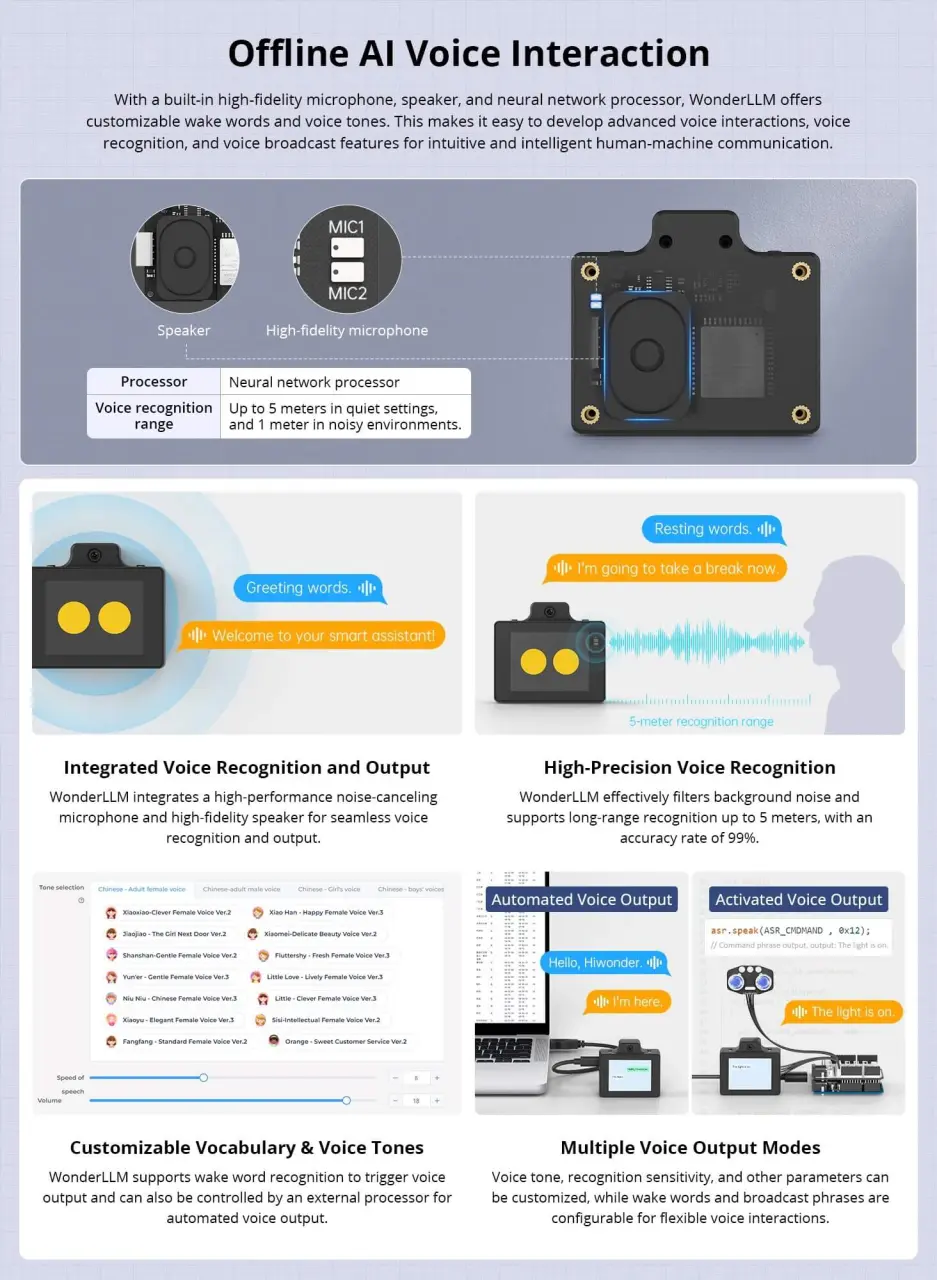
Integrated CI1302 voice processing chip with high-fidelity microphone
A key feature is its dedicated CI1302 voice processing chip, which provides low-power, always-on wake-word detection—allowing the device to respond to voice commands without constantly taxing the main processor. The module connects to cloud-based large language models through HiWonder’s XiaoZhi AI platform, though it’s important to note that the ESP32-S3 itself lacks sufficient memory to run substantial LLMs locally. Instead, it functions as an intelligent client: performing initial audio processing and wake-word recognition on-device before forwarding queries to cloud services for language model inference.
Hardware Specifications
| Parameter | Description |
|---|---|
| Main Processor | ESP32-S3-WROOM-1 module featuring a dual-core 240 MHz LX7 CPU with vector extensions for AI acceleration, 512KB SRAM. |
| Display | 2.0-inch LCD touchscreen |
| Camera | 2MP fixed-focus sensor |
| Audio | Integrated microphone, speaker, and CI1302 voice chip for wake-word detection |
| Connectivity | ✅ WiFi 4 ✅ Bluetooth LE 5.0 ✅ Two USB Type-C ports (one for ESP32-S3 programming/power, another dedicated to CI1302 firmware updates). |
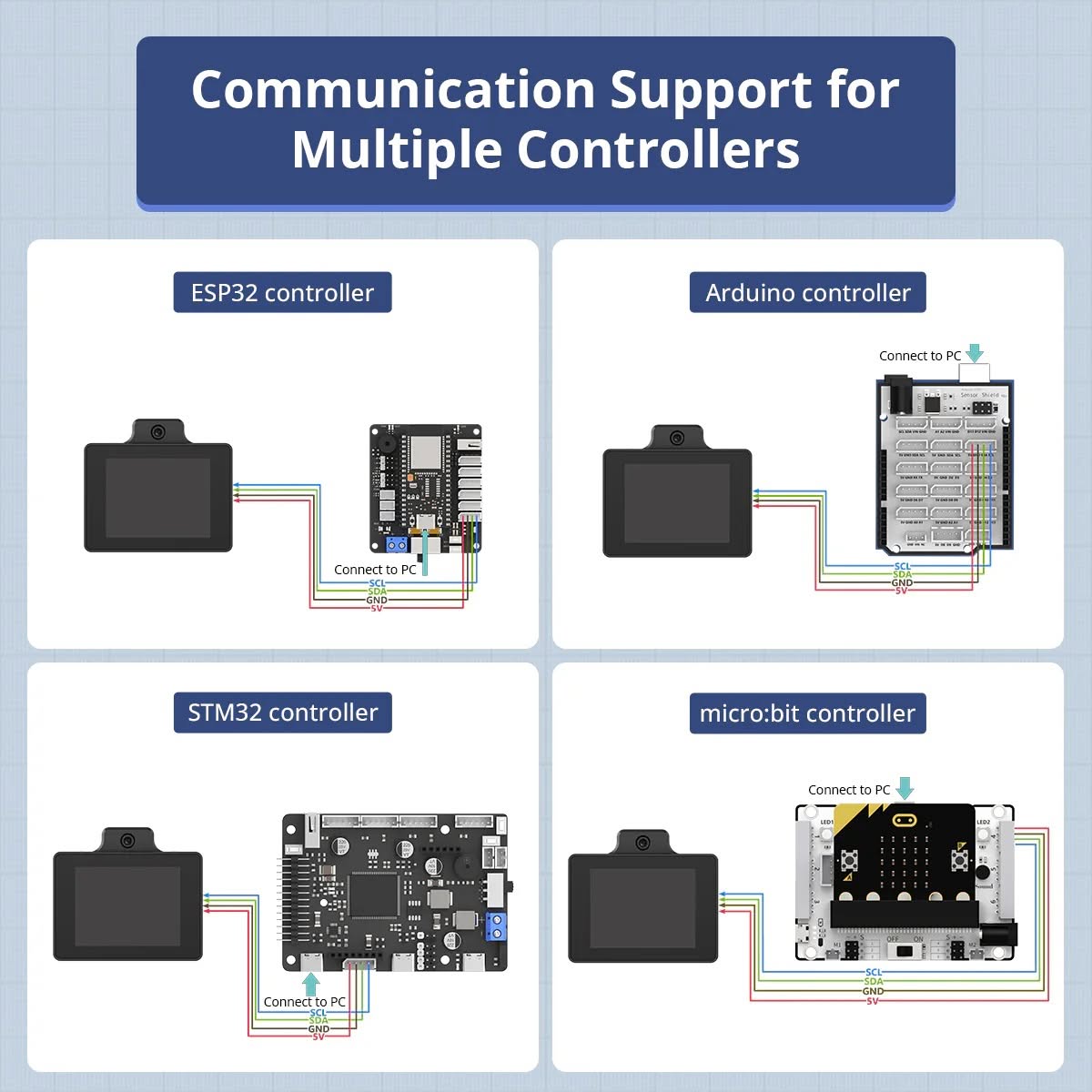
| Expansion | 4-pin I²C interface (HY2.0-4P connector) enabling the module to serve as a smart vision/voice sensor for external controllers such as Arduino, STM32, ESP32 boards, or BBC micro:bit |
| Power | 5V USB-C power |
| Physical | Dimensions: 60 × 54 × 22 mm Weight: 46g M3 mounting holes (34mm × 50mm spacing), |
Software & Development Support
The module ships with customizable firmware for both the ESP32-S3 and CI1302 chips, plus development tools for flashing, debugging, and integration. It supports offline speech recognition, local vision processing via Arduino libraries, I²C-based hardware control, and JSON-based Model Context Protocol (MCP) for cloud AI integration. Complete documentation, firmware images, and example projects are available through HiWonder’s GitHub repository.
Target Applications
Ideal for small robotics platforms, STEM education kits, interactive assistants, and vision-enabled DIY projects where the WonderLLM handles perception and user interaction while a separate microcontroller manages motion control or other system functions.
The device can easily connect to other embedded hardware, making it great for small robotics projects, STEM kits, interactive assistants, and vision-based DIY builds. In these setups, WonderLLM takes care of perception and user interaction, while a separate microcontroller handles motion control or other system tasks. It works with hardware like Arduino, ESP32, STM32, and micro:bit via the I2C (Inter-Integrated Circuit) communication protocol.
HuskyLens 2 versus WonderLLM
A big part of using a device like this is AI training and deployment, which often requires open-source third-party software. The HuskyLens 2 AI Camera module, however, stands out as it can communicate with certain SBCs like the Raspberry Pi 4 and 5 via the I2C protocol, and it has a built-in training feature that eliminates the need for extra software. This makes it especially handy for simple outdoor setups, though it’s not as cost effective as the WonderLLM device. There are more differences in the hardware and features, as shown in the tables below.
Core Architecture & Processing Power
| Feature | WonderLLM | HUSKYLENS 2 |
|---|---|---|
| Main Processor | ESP32-S3 dual-core 240 MHz LX7 CPU | Kendryte K230 dual-core 1.6 GHz |
| AI Acceleration | Vector extensions (lightweight CNN) | Dedicated 6 TOPS NPU accelerator |
| Memory | 512KB SRAM | 1GB LPDDR4 |
| Storage | ESP32-S3 internal flash (~16MB) | 8GB eMMC |
| Key Strength | Low-cost connectivity + voice interaction | Heavyweight on-device AI vision processing |
Vision & Camera Capabilities
| Feature | WonderLLM | HUSKYLENS 2 |
|---|---|---|
| Camera | Fixed 2MP, 123° FOV | Replaceable 2MP GC2093 sensor |
| Display | 2.0-inch LCD touchscreen | 2.4-inch IPS touchscreen (640×480) |
| Offline Vision | Face detection, color/line tracking | 20+ pre-installed models: face recognition, object tracking, gesture recognition, human keypoint detection, AprilTag, QR code www.dfrobot.com |
| Custom Models | Limited (ESP32 constraints) | Supports custom-trained model deployment via MCP protocol www.dfrobot.com |
Audio & Interaction
| Feature | WonderLLM | HUSKYLENS 2 |
|---|---|---|
| Voice Processing | Dedicated CI1302 chip for wake-word detection + cloud LLM chat | Basic microphone (no dedicated voice AI chip) |
| Speaker | Built-in | Built-in |
| Primary Interaction | Voice-first chatbot + vision | Vision-first sensor with gesture control |
Connectivity & Integration
| Feature | WonderLLM | HUSKYLENS 2 |
|---|---|---|
| Wireless | Wi-Fi 4 + Bluetooth LE 5.0 (built-in) | I²C only (Wi-Fi 6 module sold separately) www.dfrobot.com |
| Cloud Integration | XiaoZhi AI platform for LLM/chat services | Optional cloud connectivity via add-on module |
| Expansion | HY2.0-4P I²C connector for Arduino/STM32/micro:bit integration | Gravity I²C interface for robotics platforms |
Target Use Cases
- WonderLLM: Budget-friendly voice assistant projects, educational chatbots with basic vision, ESP32 ecosystem integration where cloud LLM access is acceptable www.cnx-software.com
- HUSKYLENS 2: Advanced robotics requiring robust offline vision (competitions, industrial inspection), gesture-controlled interfaces, projects needing 6 TOPS inference without cloud dependency hkstem.club
Price & Value
- WonderLLM: $29.99 (module only) – best for voice + vision projects on tight budgets.
- HUSKYLENS 2: ~$80-100 – premium pricing for serious on-device AI vision workloads www.aliexpress.com
Pricing and availability: Completely affordable
- The official HiWonder store offers the module for just $29.99, or $35.99 when bundled with mounting brackets and a USB cable.
- AliExpress listings currently show significantly higher prices at approximately $88.45 for the standalone unit
The WonderLLM device is a more budget-friendly option, similar to the previous Hiwonder WonderMK K230 model, which is based on RISC-V hardware. It shows promise in design, features, and price. It’s part of the growing range of ESP32-powered AI assistant development platforms emerging from China, alongside options like Espressif’s EchoEar kit and the ESP Private Agents framework.
About
Founded in 2015, Hiwonder Co. Ltd provides comprehensive solutions for STEAM education. They focus on expanding their product range, offering well-rounded courses, keeping products and curriculum up to date, and aligning with global standards and the latest educational concepts.