Close Menu
  • Home
  • About
  • Wearables
  • Earbuds
  • Computer Accessories
    • Routers
    • Remotes
  • Embedded
    • Single Board Computers
    • Addon Boards
    • Raspberry Pi
  • Wireless Routers
  • Contact
Facebook X (Twitter) Instagram Threads
Trending
  • Banana Pi BPI-R4 Pro Review: The Best WiFi 7 OpenWrt Router? We Checked!
  • AliExpress New Promotions: Country-specific Promo Codes
  • CamThink NeoEyes NE301: An Ultra-Low Power Edge AI Camera with STM32N6 MCU (Review)
  • Kickpi K7C RK3576 Edge AI SBC Launches with 6 TOPS AI Power & Dual Gigabit Ethernet
  • Raspberry Pi 5 vs Orange Pi 6: Which SBC is Best in 2026?
  • Ugoos SK4 Review (2025): The Best Mid-Range Android TV Box for Value & Features
  • Orange Pi 6 Unveiled: The Affordable, Slimmed-Down SBC Alternative to the 6 Plus
  • Orange Pi 6 Plus Review: A 12-Core SBC Powerhouse (Benchmarks, Specs, and Pricing)
AndroidPIMP
Facebook X (Twitter) Instagram
  • Home
  • About
  • Wearables
  • Earbuds
  • Computer Accessories
    • Routers
    • Remotes
  • Embedded
    • Single Board Computers
    • Addon Boards
    • Raspberry Pi
  • Wireless Routers
  • Contact
AndroidPIMP
Android TV Boxes

Ugoos SK4 Review (2025): The Best Mid-Range Android TV Box for Value & Features

By androidpimpDecember 6, 2025Updated:December 20, 2025No Comments18 Mins Read
Facebook Twitter Pinterest LinkedIn Tumblr Email
Follow Us
Google News Flipboard
Ugoos SK4 Review
Ugoos SK4 Review
Table of contents
  1. Part I: Ugoos SK4 Android TV Box
  2. Key hardware specs (highlights)
  3. Specifications
    1. What Is the Ugoos SK4?
    2. How Root Access Functions on the Ugoos SK4:
    3. Hardware Breakdown: Powered by a SoC built for solid mid-range performance
  4. Hardware Configuration
  5. Video decoding and display resolution
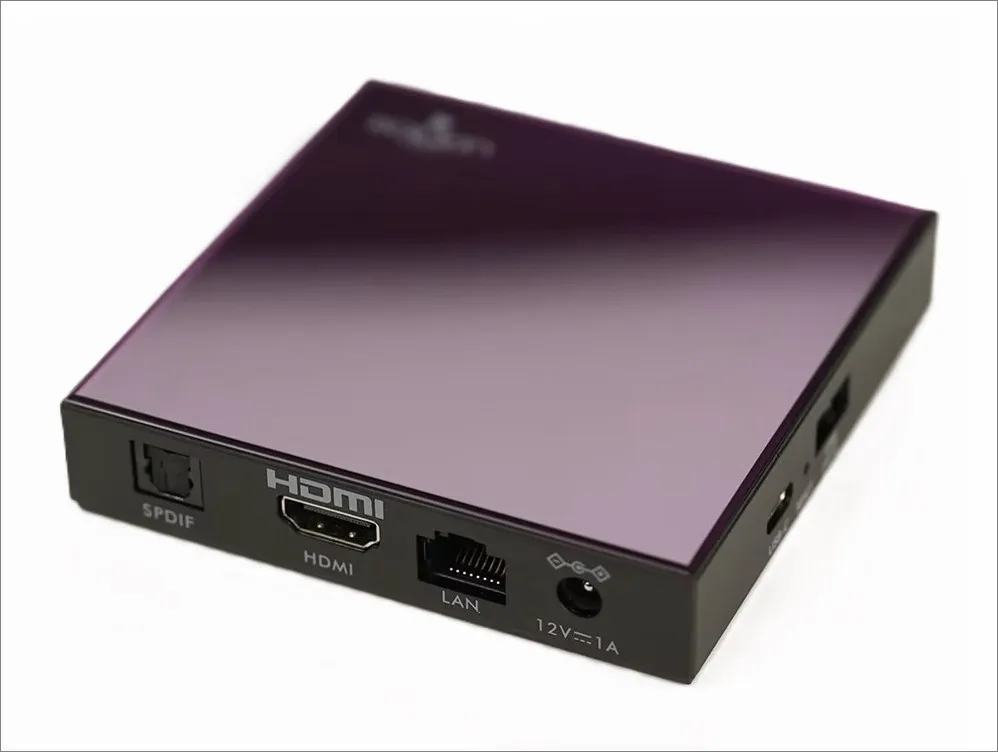
  6. Connectivity
  7. Part II: Ugoos SK4 Review
    1. The packaging for the SK4 product
    2. Unboxing All Items
    3. Package Contents
  8. Design-wise: what’s new?
  9. Software Experience: Clean, and Up to Date
    1. Bloat-free software
    2. User experience
    3. Frequent updates
  10. Hardware and Storage Space
    1. How much available storage space will you get?
  11. Remote Control
  12. Connectivity
  13. 3D graphics benchmarks
    1. What types of games can I play on the SK4?
    2. What was the temperature range during our test?
  14. The Kodi experience
  15. Performance in Real-World Use
    1. Who Is the Ugoos SK4 For?
    2. Final Verdict: Key Takeaways
      1. 📊 Price and specs comparison of the X5M Pro versus the SK4 (AliExpress).
  16. Business inquiry
  17. Pricing and Availability
    1. Ugoos SK4 AMAZON
    2. Ugoos SK4 AliExpress
  • Maybe you missed it? Review of the Ugoos SK2 Certified Google TV Box.
  • Ugoos SK4 Review: Hardware, performance, software, Kodi, and cost.
9Expert Score
A solid mid-range TV box designed for Kodi enthusiasts and home entertainment fans.
Overall Assessment of Ugoos SK4 (Pros & Cons)

The Ugoos SK4 is a solid budget-friendly TV box with great build quality and support for all the big streaming platforms like Netflix, Prime Video, Disney+, and Apple TV, all offering crisp 4K playback. It also performs well with Kodi, smoothly handling a wide range of video formats at up to 4K resolution. Here’s a quick look at its pros and cons:
  • Excellent Build Quality.
  • Dolby Vision/Atmos Support.
  • Wi-Fi 6.
  • Video decoding at up to 4K@60fps.
  • HDMI-CEC Support.
  • Good Kodi playback experience.
  • Good thermal design (No overheating)
  • Advanced software features.
  • Root access.
  • Frequent firmware updates.
  • Clean, bloatware-free interface.
  • 100 Mbps Ethernet port.
  • Not Google certified.
  • Slightly more expensive than entry-level boxes.

Part I: Ugoos SK4 Android TV Box

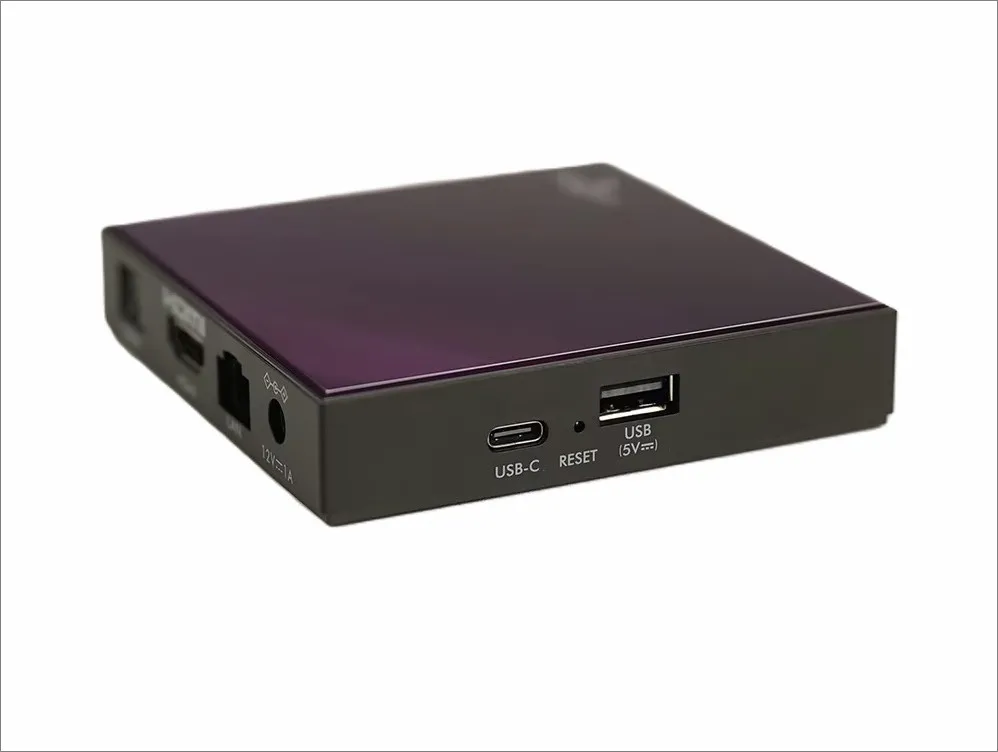
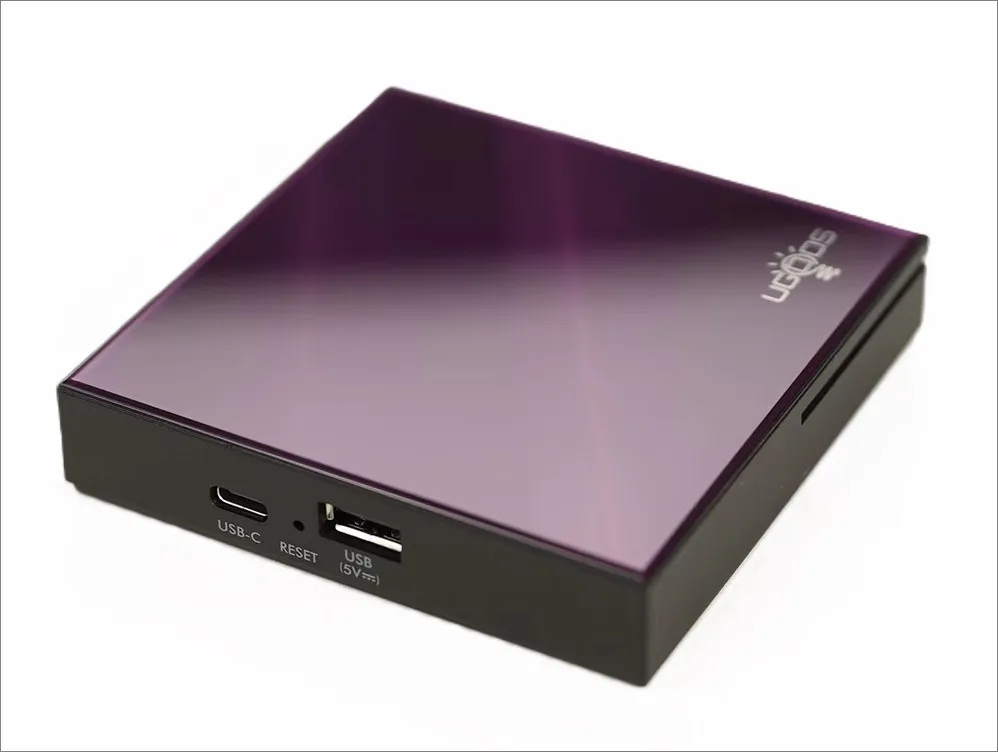
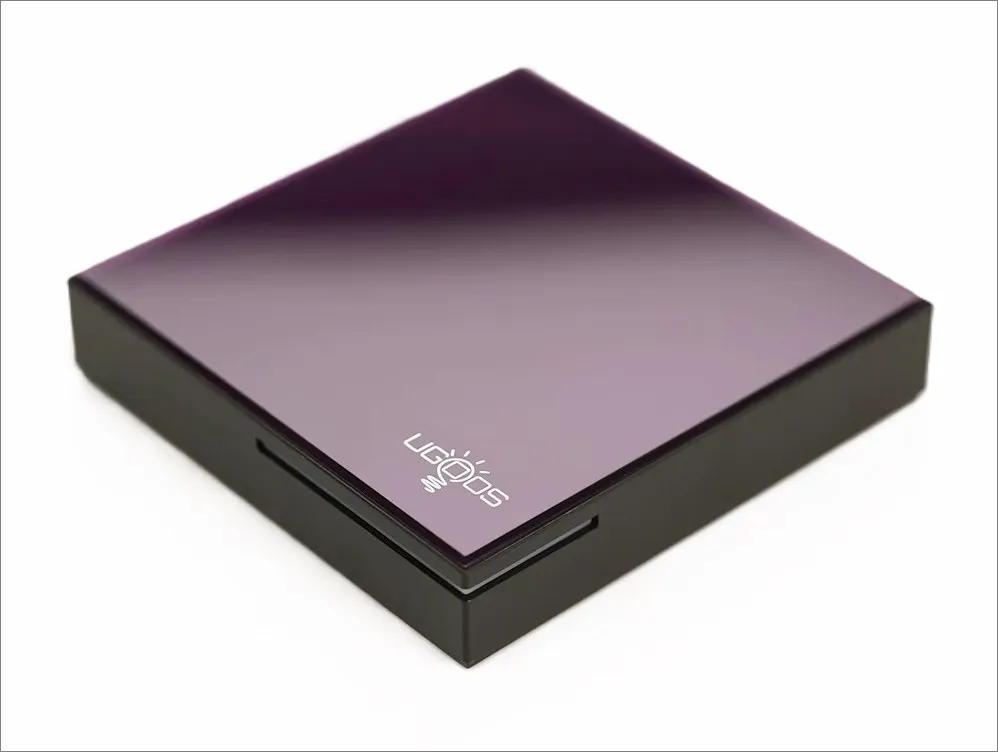
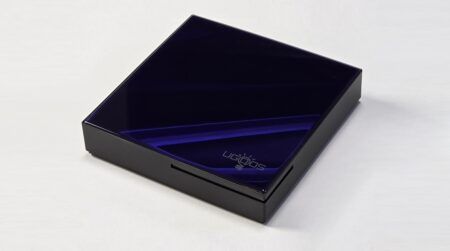
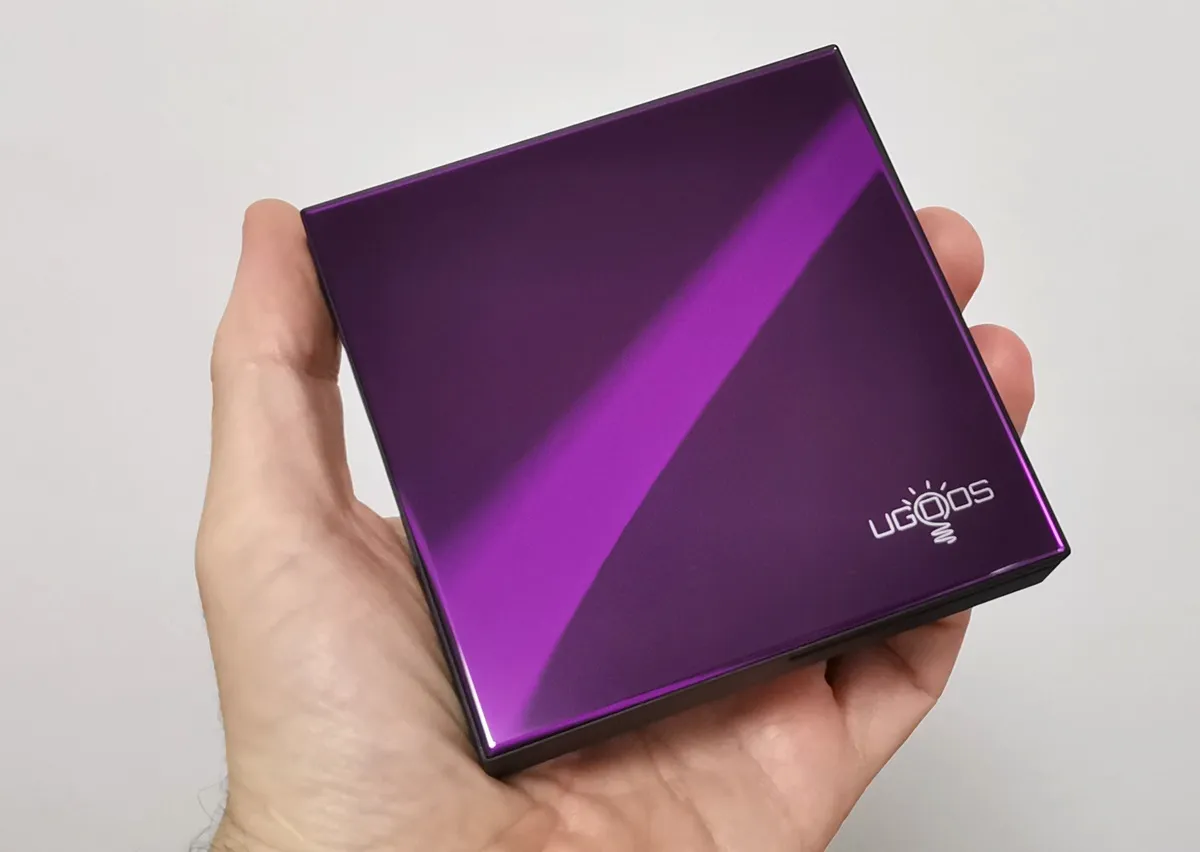
A highlight of the 2025 lineup is the Ugoos SK4 TV Box, a mid-range Android TV device powered by Amlogic’s new S905X5M-J SoC, running Android 14 AOSP and loaded with unique software features developed by the Ugoos team. Whether you’re ditching cable, exploring media, or upgrading your existing media center device, the new SK4 deserves a closer look. This review covers the hardware specs, performance tests, software experience, and everyday usability to help determine if this TV box is worth buying.

Ugoos SK4
Ugoos SK4 2
Ugoos SK4 2
Ugoos SK4 3
Ugoos SK4 3
Ugoos SK4 4
Ugoos SK4 4
Ugoos SK4 5
Ugoos SK4 5
Ugoos SK4 1
Ugoos SK4 1

Key hardware specs (highlights)

CPUAmlogic S905X5M-J with Quad core ARM Cortex-A55.
GPUARM G310 V2
OSAndroid 14
RAMLPDDR4 4GB
ROM64GB eMMC
VideoHDMI 2.1b output up to 4K@60fps
Connectivity100M LAN, Wi-Fi 6 2T2R Wi-Fi, BT5.4
SupportDolby Audio, Dolby Vision
Unique software features (built into the firmware)✔ OTA Updates
✔ Root access
✔ Built-in Samba server
✔ Performance monitoring tools
✔ Programmable remote buttons

Specifications

CategorySpecification
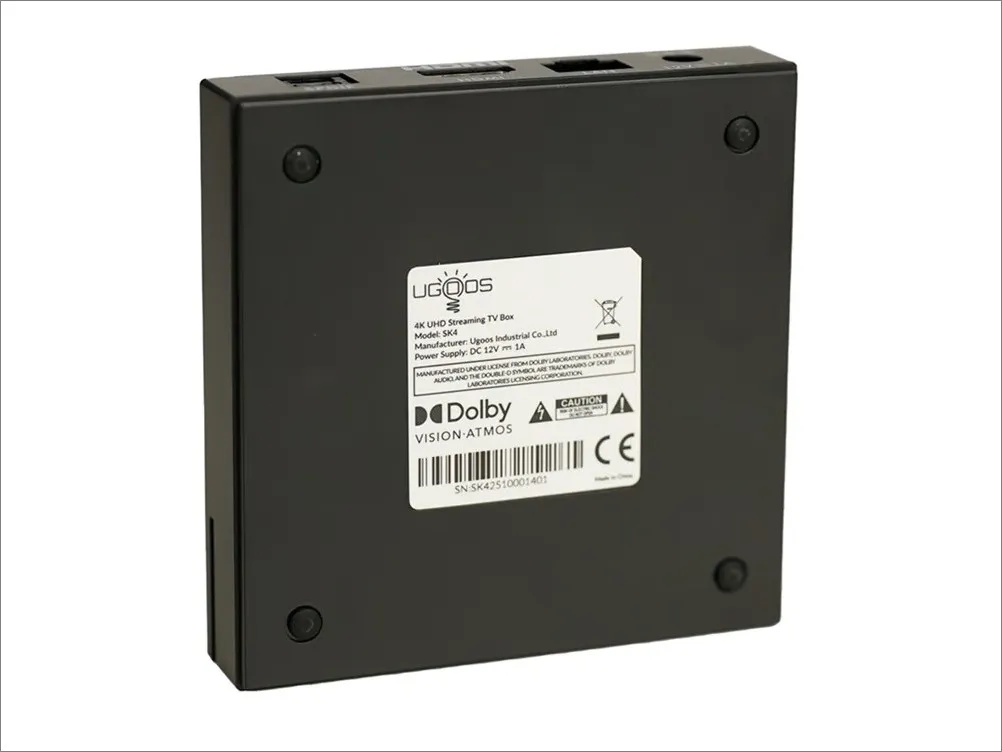
ModelUgoos SK4
Operating SystemAndroid 14 (AOSP)
CPUAmlogic S905X5M-J, Quad-core ARM Cortex-A55
GPUARM G310 V2
AI ProcessingAI Super Resolution NPU for image enhancement
RAM4 GB LPDDR4
Storage64 GB eMMC
Video OutputHDMI 1.4 & 2.1b, up to 4K @ 60fps, HDCP 2.2
Supported Video FormatsAV1, VP9, H.265/HEVC, H.264, MPEG-2, AVS-P16 (AVS+), AVS-P2 JiZhun Profile up to 1080p@60fps
Supported Audio FormatsMP3, AAC, WMA, RM, FLAC, Ogg; Dolby Atmos & Dolby Vision; programmable 7.1/5.1 channels
Audio InterfacesSPDIF/IEC958 output, PCM input/output, built-in stereo DAC
NetworkingDual-band Wi-Fi 6 (2.4 GHz / 5 GHz, 802.11 a/b/g/n/ac/ax, 2T2R)
BluetoothBluetooth 5.4
EthernetRJ45 100M Ethernet (IEEE 802.3 10/100M)
USB Ports1 × USB 2.0 OTG, 1 × USB-C host
Other InterfacesSPDIF output, LED work light
Supported Resolutions480i/p, 576i/p, 720p, 1080i/p, 4K UHD (4Kx2K)
Image ProcessingJPEG/MJPEG unlimited pixel resolution decoding, thumbnail, scaling, rotation, transition effects
SubtitlesMulti-language and multi-format subtitle support
Power SupplyDC 12V / 1A
Remote ControlLatest Ugoos Bluetooth remote included
Extra FeaturesAuto frame rate switching, HDR support, CEC support, multi-language UI
Dimensions96x96x21.9mm (3.78×3.78×0.86 inches)
Package Contents
1 x Ugoos SK4 Box
1 x BT Voice Remote
1 x Power Adapter
1 x HDMI Cable
1 x English User Manual

What Is the Ugoos SK4?

The Ugoos SK4 is a mid-range Android TV box powered by the Amlogic S905X5M-J chipset, released in end of 2024 as the successor to the popular SK1 model. Designed for users who demand smooth 4K HDR streaming, low-latency gaming, and extensive codec support, the SK4 runs a stock version of Android 14 TV OS self-developed by Ugoos team. The firmware stands out with one-click root access and other customization features that are exclusive to this brand.

The Ugoos SK4 TV Box comes packed with a variety of unique software features integrated right into its firmware, and here are the key highlights:

1. Ugoos Custom Settings menu offers detailed options for HDMI output (like RGB/YUV color formats, deep color, and resolution presets), audio passthrough (supporting Dolby Digital, DTS, Dolby TrueHD, DTS-HD MA, and Dolby Atmos), as well as deinterlacing and hardware acceleration settings.

2.The firmware features Auto Frame Rate (AFR), which automatically adjusts the TV’s refresh rate to match the frame rate of the source content (like 23.976Hz for movies), reducing judder and ensuring smooth, cinematic playback—perfect for use with Kodi and other media players.

3. Over-the-air (OTA) firmware updates are delivered regularly, providing Android security patches, driver improvements, codec enhancements, and bug fixes directly through the system settings, ensuring long-term reliability.

4. The SK4 supports a dual bootloader and recovery mode, allowing access to Android Recovery for cache wipes or factory resets, and enabling advanced users to sideload or multiboot alternative operating systems like CoreELEC without permanently replacing Android.

5. Featuring pre-installed media utilities streamline usability, including Ugoos Media Player (with hardware decoding and subtitle sync), File Commander (with SMB/NFS network browsing), and a real-time System Monitor for CPU, RAM, and thermal stats.

6. Network and sharing enhancements are built-in, with native SMB client/server support, DLNA/UPnP media serving, and easy configuration of static IP and custom DNS—ideal for IPTV or NAS setups.

7. Though consumer-focused, the firmware retains developer and debugging tools, including ADB debugging (enabled via standard Android methods), Linux terminal access, and decoder logs for troubleshooting.

8. The system includes Kodi-specific optimizations at the firmware level, such as automatic hardware decoding for HEVC, VP9, and AV1, zero-copy rendering for UI smoothness, and pre-configured paths for local or networked media libraries—making Kodi run flawlessly even though it’s not pre-installed.

9. IR and HDMI-CEC customization let users program the remote via IR learning and fine-tune CEC behavior, such as auto-waking the TV or passing through remote commands.

10. The firmware prioritizes privacy and minimalism, featuring zero bloatware, no ads or telemetry, and full Android 14-compliant permission controls—delivering a clean, secure, and user-respectful experience that caters equally to casual streamers and advanced media enthusiasts.


How Root Access Functions on the Ugoos SK4:

  1. Official Root Option in Developer Settings
    Starting with firmware version 01.03.00+ (2024–2025 releases), Ugoos includes a hidden but accessible “Root Access” toggle within the developer options:
    • Go to Settings > Device Preferences > About > Build Number (tap 7 times to enable Developer Options).
    • Return to Device Preferences > Developer Options.
    • Scroll down to find “Root Access” (may appear as “Root Permission” or “Superuser Access” depending on firmware).
    • Toggle it ON, then reboot the device.
    • After reboot, any root-capable app (e.g., Magisk Manager, Root Explorer, Titanium Backup) will be able to request and obtain superuser privileges.
  2. No Need for Unlocking Bootloader or Flashing Custom Recovery
    Unlike many Android devices, the SK4 does not require bootloader unlocking or custom recovery installation to gain root. Ugoos implements root via a signed, system-integrated SU binary that coexists with Google-certified Android TV—meaning you retain access to the Play Store, Netflix, YouTube, and OTA updates even with root enabled.
  3. Magisk Compatibility
    While the built-in root is sufficient for most tasks, advanced users can also install Magisk via ADB if they prefer Magisk Manager’s module system and systemless root approach. This is typically done by:
    • Patching the boot image with Magisk (using a PC).
    • Flashing it via fastboot or Ugoos’ recovery.
    • Note: This may temporarily disable OTA updates until reverted, but core media features remain intact.
  4. Root Does Not Break Key Features
    Crucially, enabling root does not disable:
    • Auto Frame Rate (AFR)
    • Dolby Vision / HDR10+ output
    • Audio passthrough (Dolby Atmos, DTS:X)
    • Wi-Fi 6 or Gigabit Ethernet
    • Google Play certification (apps like Prime Video and Disney+ continue to function normally)
    This is a major advantage over uncertified Android boxes, where root often breaks DRM and streaming apps.
  5. Security Consideration
    Ugoos disables root access by default as a security measure. Once enabled, users should only grant superuser permissions to trusted apps, as root access can potentially expose the system to malware or misconfiguration.

Hardware Breakdown: Powered by a SoC built for solid mid-range performance

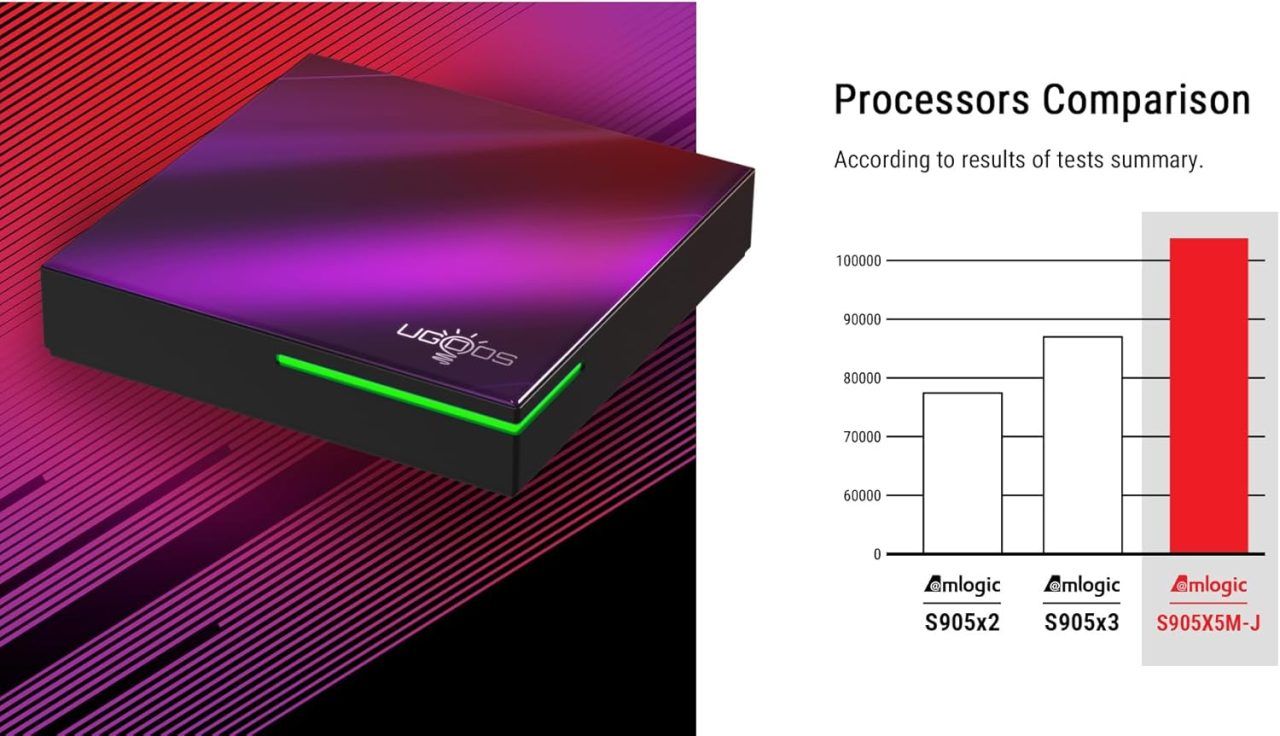
This TV box comes with the Amlogic S905X5M-J, a quad-core ARM Cortex-A55 CPU teamed up with an ARM G310 V2 GPU, offering a clear performance boost compared to the older S905X4 or S922X chips used by many competitors. Its Cortex-A55 cores are optimized for high-frequency performance, running at a base frequency of around 2.0 GHz (similar to the S905X4) and boosting up to 2.5 GHz, enabling faster app launches, smoother navigation, and better multitasking.
Ugoos SK4 Processor
Ugoos SK4 Processor Comparison

Basically, the S905X5M-J is a budget-friendly, streamlined version of the Amlogic S905X5, offering solid performance tailored for mid-range TV boxes.

Detailed Comparison Table (Previous vs new Amlogic SoCs)

SoCAmlogic S905X5Amlogic S905X5M-JAmlogic S905X4
Process Technology6nm6nm12nm
CPUQuad-core Armv9 Cortex-A510, up to 2.4 GHzQuad-core Arm Cortex-A55, up to 2.5 GHzQuad-core Arm Cortex-A55, up to 2.0 GHz
GPUMali-G310 V5Mali-G310 V2Mali-G31 MP2
AI Accelerator (NPU)3.2–4 TOPSLimited AI-SR supportNone
RAM SupportLPDDR4X / LPDDR5 (up to 8 GB)LPDDR4 (up to 4 GB typical)DDR3/4, LPDDR3/4
Storage SupporteMMC 5.1, NANDeMMC 5.1, NANDeMMC 5.0, NAND, SPI NOR/NAND, SD
Video DecodingH.266/VVC, AV1, VP9, H.265/HEVC, H.264, AVS3AV1, VP9, H.265/HEVC, H.264, MPEG-2AV1, VP9, H.265/HEVC, H.264, AVS2
Max Resolution4K @ 120fps (H.266/AV1), 4K @ 60fps (H.264/H.265)4K @ 75fps (AV1), 4K @ 60fps (H.264/H.265)4K @ 60fps
HDR SupportHDR10+, Dolby Vision, HLGHDR10+, Dolby Vision, HLGHDR10+, Dolby Vision, HLG
Audio FeaturesDolby Atmos, Dolby TrueHD, DTS-HDDolby Atmos, Dolby Vision, PCM, SPDIFDolby Digital, DTS, SPDIF
ConnectivityHDMI 2.1 with eARC, VRR, QMS; USB 3.0 + USB 2.0; Gigabit EthernetHDMI 2.1b; USB 2.0 + USB-C; Fast EthernetHDMI 2.1; USB 2.0 + USB 3.0; Gigabit Ethernet
Bluetooth/Wi-FiBluetooth 5.0, Wi-Fi 6Bluetooth 5.4, Wi-Fi 6Bluetooth 4.0/5.0, Wi-Fi 5 (802.11ac)
Target DevicesPremium Android TV boxes, set-top boxesMid-range Android TV boxes (e.g., Ugoos SK4)Older mid-range Android TV boxes (e.g., H96 Max X4)

Hardware Configuration

The SK4 packs 4GB of LPDDR4X RAM and 32GB of eMMC storage. It features eMMC 5.1 flash, which is noticeably faster and more reliable than the standard eMMC or SPI NAND used in budget devices. This boost in speed makes a big difference when installing large apps like Kodi, Plex, or gaming platforms such as Steam Link or GeForce NOW.

Video decoding and display resolution

The SK4 offers HDMI 2.1 for video output, delivering 4K resolution at 60Hz along with Dolby Vision, HDR10+, HLG, and Auto Low Latency Mode (ALLM), making it a great choice for both gamers and movie lovers. It also handles 10-bit HEVC/H.265, VP9 Profile 2, and AV1 decoding up to 4K60, ensuring it works seamlessly with major streaming platforms like Netflix, Disney+, Amazon Prime Video, and YouTube.


Connectivity

Connectivity options are quite good, aside from the 100Mbps Ethernet port, which isn’t a major drawback for most users thanks to the built-in WiFi 6 support.

  • Wi-Fi 6 (802.11ax) for faster, more stable wireless streaming.
  • Bluetooth 5.4 for connecting headphones, gamepads, or keyboards.
  • 100M Gigabit Ethernet port for wired internet.
  • USB 2.0 and USB Type-C ports for external storage or peripherals.

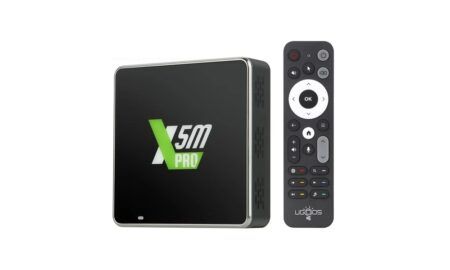
The SK4 includes a generic IR receiver compatible with most universal remotes, along with a Bluetooth voice remote functionality. It features dedicated Netflix and YouTube buttons, plus a built-in microphone for Google Assistant voice commands.
1 2 3 4 5 6 7 8 9 10
Share. Facebook Twitter Pinterest LinkedIn Tumblr Email
Previous ArticleOrange Pi 6 Unveiled: The Affordable, Slimmed-Down SBC Alternative to the 6 Plus
Next Article Raspberry Pi 5 vs Orange Pi 6: Which SBC is Best in 2026?
androidpimp
  • Website

Related Posts

Ugoos X5M Pro Android 14 TV Box with Amlogic S905X5M – 4K HDR, WiFi 6 & AI Upscaling

July 22, 2025
Ugoo AM9 Android TV Box

Ugoos AM9 Review: The Ultimate 4K Android TV Box for 2025?

July 14, 2025

Ugoos SK2 Review: A Budget-Friendly Certified Android/Google TV Box – Is It Worth It?

May 22, 2025
0 0 votes
Article Rating
Subscribe
Notify of
0 Comments
Oldest
Newest Most Voted
Inline Feedbacks
View all comments
Categories
PureVPN
PureVPN Ad Banner
VyprVPN – No. 1 in Anonymity
Vyprvpn 350x260
PrivadoVPN – No. 1 in Parental Control
PrivadoVPN 350x437
Recent Posts
  • Banana Pi BPI-R4 Pro Review: The Best WiFi 7 OpenWrt Router? We Checked!
  • AliExpress New Promotions: Country-specific Promo Codes
  • CamThink NeoEyes NE301: An Ultra-Low Power Edge AI Camera with STM32N6 MCU (Review)
  • Kickpi K7C RK3576 Edge AI SBC Launches with 6 TOPS AI Power & Dual Gigabit Ethernet
  • Raspberry Pi 5 vs Orange Pi 6: Which SBC is Best in 2026?
  • Ugoos SK4 Review (2025): The Best Mid-Range Android TV Box for Value & Features
  • Orange Pi 6 Unveiled: The Affordable, Slimmed-Down SBC Alternative to the 6 Plus
  • Orange Pi 6 Plus Review: A 12-Core SBC Powerhouse (Benchmarks, Specs, and Pricing)
  • LattePanda IOTA Review: 4 Reasons It Beats Raspberry Pi 5
  • Ugoos GaN Fast Chargers (35W, 65W, 140W): USB‑C PD 3.1, Ultra‑Compact, High‑Speed Charging 2026
RSS The Latest RSS Feeds
  • Banana Pi BPI-R4 Pro Review: The Best WiFi 7 OpenWrt Router? We Checked!
  • AliExpress New Promotions: Country-specific Promo Codes
  • CamThink NeoEyes NE301: An Ultra-Low Power Edge AI Camera with STM32N6 MCU (Review)
Facebook X (Twitter) Instagram Pinterest
@2026 - All Right Reserved. Designed by AndroidPIMP

Type above and press Enter to search. Press Esc to cancel.

Accessibility
Accessibility modes
Epilepsy Safe Mode
Dampens color and removes blinks
This mode enables people with epilepsy to use the website safely by eliminating the risk of seizures that result from flashing or blinking animations and risky color combinations.
Visually Impaired Mode
Improves website's visuals
This mode adjusts the website for the convenience of users with visual impairments such as Degrading Eyesight, Tunnel Vision, Cataract, Glaucoma, and others.
Cognitive Disability Mode
Helps to focus on specific content
This mode provides different assistive options to help users with cognitive impairments such as Dyslexia, Autism, CVA, and others, to focus on the essential elements of the website more easily.
ADHD Friendly Mode
Reduces distractions and improve focus
This mode helps users with ADHD and Neurodevelopmental disorders to read, browse, and focus on the main website elements more easily while significantly reducing distractions.
Blindness Mode
Allows using the site with your screen-reader
This mode configures the website to be compatible with screen-readers such as JAWS, NVDA, VoiceOver, and TalkBack. A screen-reader is software for blind users that is installed on a computer and smartphone, and websites must be compatible with it.
Readable Experience
Content Scaling
Default
Text Magnifier
Readable Font
Dyslexia Friendly
Highlight Titles
Highlight Links
Font Sizing
Default
Letter Spacing
Default
Left Aligned
Center Aligned
Right Aligned
Visually Pleasing Experience
Dark Contrast
Light Contrast
Monochrome
High Contrast
High Saturation
Low Saturation
Adjust Text Colors
Adjust Title Colors
Adjust Background Colors
Easy Orientation
Mute Sounds
Hide Images
Hide Emoji
Reading Guide
Stop Animations
Reading Mask
Highlight Hover
Highlight Focus
Big Dark Cursor
Big Light Cursor
Cognitive Reading
Virtual Keyboard
Navigation Keys
Voice Navigation

AndroidPIMP

Accessibility Statement

  • AndroidPIMP.com
  • 10/18/2025

Compliance status

We believe the internet should be open and accessible to everyone, and we’re dedicated to making our website usable for the widest audience possible, no matter their circumstances or abilities.

To achieve this, we follow the World Wide Web Consortium’s (W3C) Web Content Accessibility Guidelines 2.1 (WCAG 2.1) at the AA level as closely as possible. These guidelines outline how to make web content accessible for people with a variety of disabilities. By complying with them, we help ensure our website is usable by everyone, including those who are blind, have motor or visual impairments, cognitive disabilities, and more.

This website uses a range of technologies to stay accessible at all times. An accessibility interface lets people with specific disabilities customize the site’s UI and design to fit their personal needs.

The website also uses an AI-powered application that works in the background to constantly enhance its accessibility. This app fixes the site’s HTML, adjusts its features and behavior for screen readers used by blind users, and optimizes keyboard functions for people with motor impairments.

If you’ve found a malfunction or have ideas for improvement, we’ll be happy to hear from you. You can reach out to the website’s operators by using the following email [email protected]

Screen-reader and keyboard navigation

Our website implements the ARIA attributes (Accessible Rich Internet Applications) technique, alongside various different behavioral changes, to ensure blind users visiting with screen-readers are able to read, comprehend, and enjoy the website’s functions. As soon as a user with a screen-reader enters your site, they immediately receive a prompt to enter the Screen-Reader Profile so they can browse and operate your site effectively. Here’s how our website covers some of the most important screen-reader requirements, alongside console screenshots of code examples:

  1. Screen-reader optimization: we run a background process that learns the website’s components from top to bottom, to ensure ongoing compliance even when updating the website. In this process, we provide screen-readers with meaningful data using the ARIA set of attributes. For example, we provide accurate form labels; descriptions for actionable icons (social media icons, search icons, cart icons, etc.); validation guidance for form inputs; element roles such as buttons, menus, modal dialogues (popups), and others. Additionally, the background process scans all the website’s images and provides an accurate and meaningful image-object-recognition-based description as an ALT (alternate text) tag for images that are not described. It will also extract texts that are embedded within the image, using an OCR (optical character recognition) technology. To turn on screen-reader adjustments at any time, users need only to press the Alt+1 keyboard combination. Screen-reader users also get automatic announcements to turn the Screen-reader mode on as soon as they enter the website.

    These adjustments are compatible with all popular screen readers, including JAWS and NVDA.

  2. Keyboard navigation optimization: The background process also adjusts the website’s HTML, and adds various behaviors using JavaScript code to make the website operable by the keyboard. This includes the ability to navigate the website using the Tab and Shift+Tab keys, operate dropdowns with the arrow keys, close them with Esc, trigger buttons and links using the Enter key, navigate between radio and checkbox elements using the arrow keys, and fill them in with the Spacebar or Enter key.Additionally, keyboard users will find quick-navigation and content-skip menus, available at any time by clicking Alt+1, or as the first elements of the site while navigating with the keyboard. The background process also handles triggered popups by moving the keyboard focus towards them as soon as they appear, and not allow the focus drift outside it.

    Users can also use shortcuts such as “M” (menus), “H” (headings), “F” (forms), “B” (buttons), and “G” (graphics) to jump to specific elements.

Disability profiles supported in our website

  • Epilepsy Safe Mode: this profile enables people with epilepsy to use the website safely by eliminating the risk of seizures that result from flashing or blinking animations and risky color combinations.
  • Visually Impaired Mode: this mode adjusts the website for the convenience of users with visual impairments such as Degrading Eyesight, Tunnel Vision, Cataract, Glaucoma, and others.
  • Cognitive Disability Mode: this mode provides different assistive options to help users with cognitive impairments such as Dyslexia, Autism, CVA, and others, to focus on the essential elements of the website more easily.
  • ADHD Friendly Mode: this mode helps users with ADHD and Neurodevelopmental disorders to read, browse, and focus on the main website elements more easily while significantly reducing distractions.
  • Blindness Mode: this mode configures the website to be compatible with screen-readers such as JAWS, NVDA, VoiceOver, and TalkBack. A screen-reader is software for blind users that is installed on a computer and smartphone, and websites must be compatible with it.
  • Keyboard Navigation Profile (Motor-Impaired): this profile enables motor-impaired persons to operate the website using the keyboard Tab, Shift+Tab, and the Enter keys. Users can also use shortcuts such as “M” (menus), “H” (headings), “F” (forms), “B” (buttons), and “G” (graphics) to jump to specific elements.

Additional UI, design, and readability adjustments

  1. Font adjustments – users, can increase and decrease its size, change its family (type), adjust the spacing, alignment, line height, and more.
  2. Color adjustments – users can select various color contrast profiles such as light, dark, inverted, and monochrome. Additionally, users can swap color schemes of titles, texts, and backgrounds, with over seven different coloring options.
  3. Animations – person with epilepsy can stop all running animations with the click of a button. Animations controlled by the interface include videos, GIFs, and CSS flashing transitions.
  4. Content highlighting – users can choose to emphasize important elements such as links and titles. They can also choose to highlight focused or hovered elements only.
  5. Audio muting – users with hearing devices may experience headaches or other issues due to automatic audio playing. This option lets users mute the entire website instantly.
  6. Cognitive disorders – we utilize a search engine that is linked to Wikipedia and Wiktionary, allowing people with cognitive disorders to decipher meanings of phrases, initials, slang, and others.
  7. Additional functions – we provide users the option to change cursor color and size, use a printing mode, enable a virtual keyboard, and many other functions.

Browser and assistive technology compatibility

We aim to support the widest array of browsers and assistive technologies as possible, so our users can choose the best fitting tools for them, with as few limitations as possible. Therefore, we have worked very hard to be able to support all major systems that comprise over 95% of the user market share including Google Chrome, Mozilla Firefox, Apple Safari, Opera and Microsoft Edge, JAWS and NVDA (screen readers).

Notes, comments, and feedback

Despite our very best efforts to allow anybody to adjust the website to their needs. There may still be pages or sections that are not fully accessible, are in the process of becoming accessible, or are lacking an adequate technological solution to make them accessible. Still, we are continually improving our accessibility, adding, updating and improving its options and features, and developing and adopting new technologies. All this is meant to reach the optimal level of accessibility, following technological advancements. For any assistance, please reach out to [email protected]

wpDiscuz