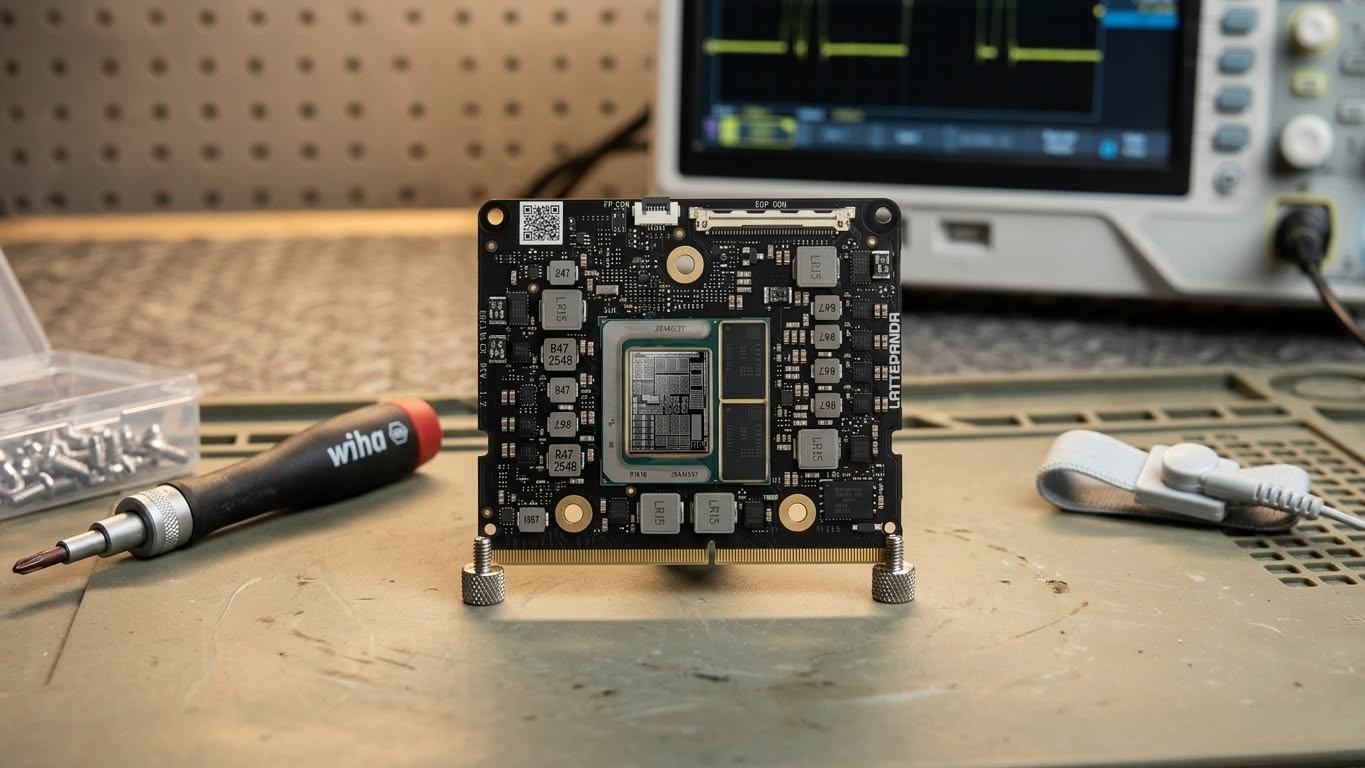
- LattePanda Mu Ultra: The Next-Gen Micro x86 Computing Module Designed for On-Device AI Carrier boards.
- The AI workloads shift
- What is the LattePanda Mu Ultra?
- Hardware Specifications
- Five Key Applications for On-Device AI
- Engineered for AI edge computing
- Running local LLMs
- 115 TOPS: Processing power for AI tasks
- High-Bandwidth Memory for AI Workloads
- Deep Dive: Technical Specifications & Architecture
- 1. Processor and CPU Performance
- 2. Unprecedented AI Acceleration (Up to 115 TOPS)
- 3. Lightning-Fast Unified Memory Architecture
- 4. Compact Physical Dimensions
- The Carrier Board Ecosystem: Flexibility Meets Customization
- Target Applications & Real-World Use Cases
- 1. Edge AI and Local LLM Inference
- 2. Industrial IoT and Automation
- 3. Robotics and Autonomous Systems
- 4. Digital Signage and Smart Retail
- 5. Medical Devices and Edge Vision
- Software Support & Developer Experience
- Operating System Compatibility
- Optimized AI Frameworks
- Community and Documentation
- Performance Benchmarks & Competitive Landscape
- vs. Raspberry Pi Compute Module 5 (CM5)
- vs. Previous LattePanda Mu (N100/N305)
- vs. Traditional x86 Single-Board Computers
- Pricing, Availability, and How to Purchase
- Business inquiries and questions
- Conclusion & Future Outlook
Maybe you missed it? LattePanda IOTA Review.
LattePanda Mu Ultra: The Next-Gen Micro x86 Computing Module Designed for On-Device AI Carrier boards.
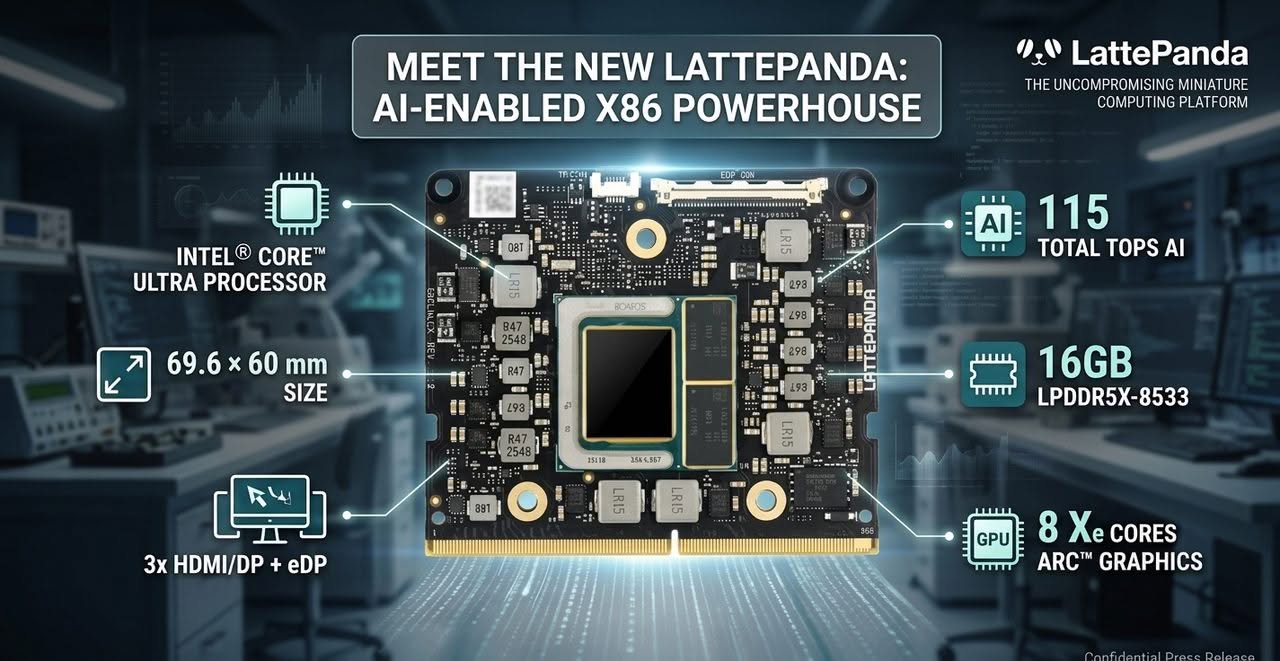
[8:00 PM (Beijing Time, China) on September 9, 2026] —- LattePanda Team today launched the LattePanda Mu Ultra, a micro x86 compute module specifically designed for on-device AI. Powered by Intel Core Ultra 5 226V and Ultra 7 256V processors, it delivers up to 115 TOPS of AI performance in a compact 69.6 × 60 mm form factor. Created to tackle the hardware, compute, and software challenges of running AI locally, the LattePanda Mu Ultra brings powerful AI computing capabilities to engineering teams, system integrators, and OEMs across various sectors, including robotics, industrial automation, portable instruments, vision AI, and a wide array of intelligent edge applications.

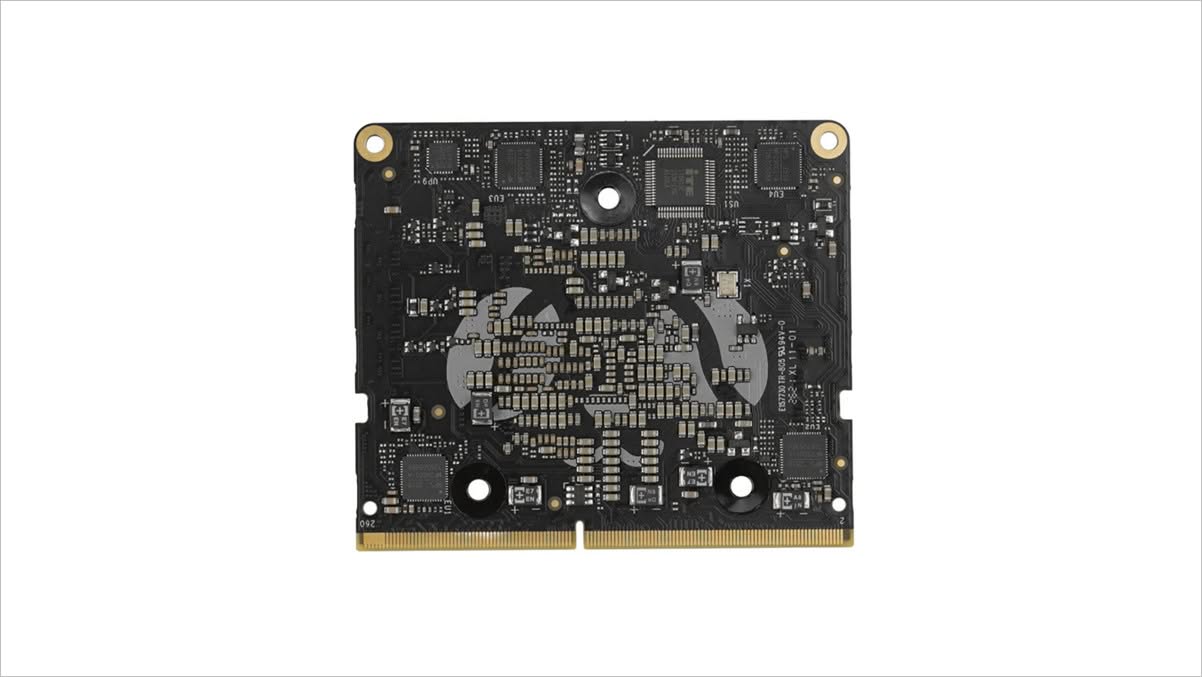
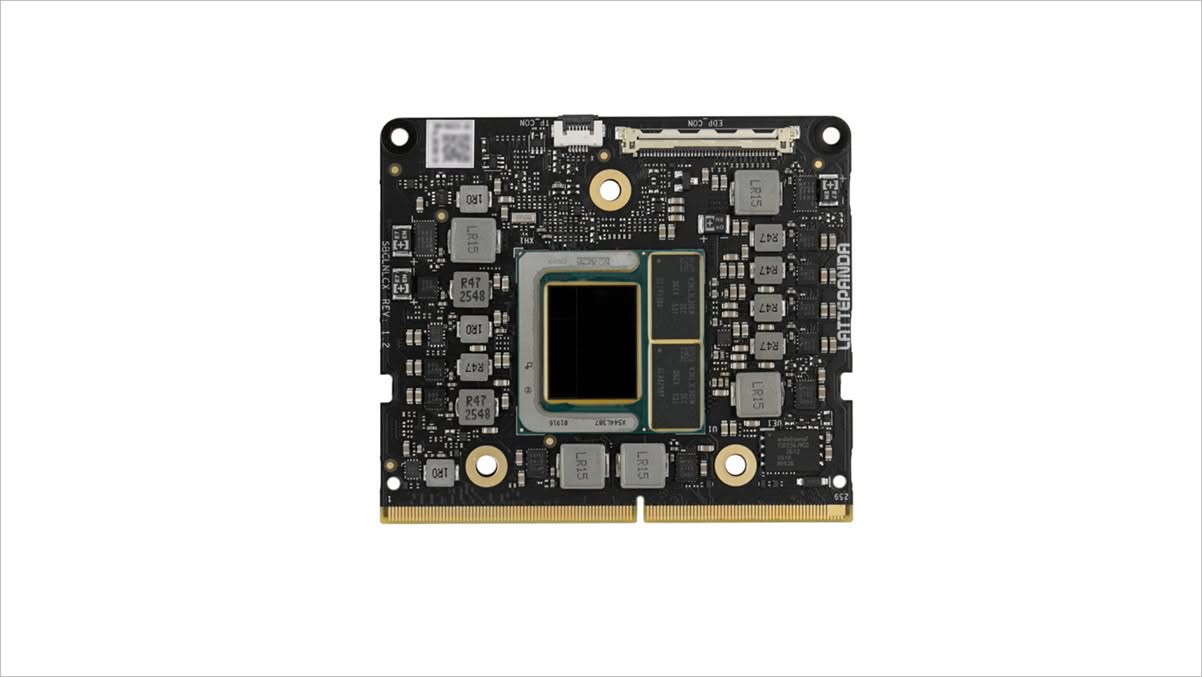
The AI workloads shift
The landscape of embedded computing and artificial intelligence is experiencing an exciting transformation! For years, developers and original equipment manufacturers (OEMs) have navigated a tricky trade-off: should they pursue the broad software compatibility and raw power of x86 architecture, or choose the compact, low-power advantages of ARM-based system-on-modules (SoMs)? Additionally, as AI workloads shift from centralized cloud servers to the edge, the need for localized, high-throughput AI inference has become more important than ever.
Designed explicitly as a micro x86 compute module for on-device AI, the Mu Ultra empowers developers to build the next generation of intelligent devices without compromise. Whether you are engineering autonomous robotics, deploying local Large Language Models (LLMs), or designing advanced industrial IoT systems, this Ultra module provides the scalable, powerful, and flexible foundation you need.
What is the LattePanda Mu Ultra?
To understand the design of the LattePanda Mu Ultra, it is essential to understand the compute module paradigm. Unlike traditional single-board computers (SBCs) that solder all interfaces onto a single fixed board, a compute module (or system-on-module, SoM) separates the core processing components—CPU, GPU, RAM, and storage—into a compact, standardized module. This module then plugs into a custom or semi-custom “carrier board” that provides the specific input/output (I/O) interfaces required for a particular application.
As mentioned previously, the original LattePanda Mu, introduced with Intel Processor N100 and N305 options, proved the viability of the x86 compute module format, delivering two to three times the CPU performance of competing entry-level boards. However, the LattePanda Mu Ultra is not merely an incremental refresh; it is a complete architectural reimagining built for the AI era.
Powered by the latest Intel Core Ultra processors, the Mu Ultra integrates a high-performance CPU, advanced Intel Arc graphics, and a dedicated Neural Processing Unit (NPU) into a single, cohesive package. It is purpose-built for developers, embedded systems engineers, and OEMs who require powerful local AI processing, flexible hardware integration, and a scalable compute solution for next-generation intelligent devices. By maintaining full x86 compatibility, it ensures seamless deployment of existing Windows and Linux software stacks, eliminating the costly and time-consuming process of porting ARM-based applications.
Hardware Specifications
| Category | Specification |
| Processor Options | Intel® Core™ Ultra 5 226V (16GB memory) Intel® Core™ Ultra 7 256V (16GB memory) |
| AI Performance | Up to 115 TOPS (CPU + GPU + NPU, INT8) |
| NPU (Neural Processing Unit) | Up to 47 TOPS INT8 |
| GPU (Graphics Processing Unit) | Intel® Arc™ Graphics (up to 8 Xe Cores) |
| Memory | 16GB LPDDR5X-8533 |
| VRAM | Up to 11.6GB allocatable VRAM (for large language models & KV Cache) |
| Display Output | Up to 3 × HDMI / DisplayPort 1 × eDP |
| Dimensions | 69.6 × 60 mm |
Five Key Applications for On-Device AI
| Application | Key Capabilities & Use Cases |
| Intelligent AI Terminals ✅ | Runs LLMs locally for translation devices, voice assistants, and private knowledge-based applications prioritizing low latency and data privacy. |
| Portable Instruments ✅ | Delivers high-performance x86 computing to handheld devices like spectrum analyzers and portable diagnostic equipment for real-time AI analysis. |
| Autonomous Mobile Robots (AMRs) ✅ | Supports real-time sensor fusion, SLAM, and autonomous navigation within a compact platform designed for space-constrained robots. |
| Service Robots ✅ | Runs vision, voice, and LLM-based multimodal AI workloads on a single computing module, providing an integrated processing core. |
| On-Device Vision AI ✅ | Processes high-resolution video locally in smart cameras and inspection systems, enabling rapid defect detection while cutting cloud transmission costs. |
Engineered for AI edge computing
Running local LLMs
According to DFRobot, in their testing, the LattePanda Mu Ultra achieved text generation speeds of 18 tokens per second with Qwen 3.5-9B and 55 tokens per second with Qwen 3.5-2B, using INT4 quantization with OpenVINO GenAI on the iGPU. These results demonstrate its capability to support responsive, local conversational AI without the need for cloud inference. This makes it suitable for applications such as local voice assistants, offline document processing, and private knowledge retrieval, keeping sensitive data on the device.
115 TOPS: Processing power for AI tasks
Delivering up to 115 TOPS (INT8) of AI performance, the Mu Ultra incorporates the CPU, GPU, and NPU from Intel’s Ultra 5 226V and Ultra 7 256V processors in a compact x86 module, which includes 47 TOPS from the dedicated NPU.
High-Bandwidth Memory for AI Workloads
LattePanda Mu Ultra features 16GB of LPDDR5X-8533 memory, with up to 11.6GB available for graphics memory, providing the necessary bandwidth for demanding AI applications. The memory architecture is designed to support various workloads, including large language models (LLMs), multimodal AI, and real-time sensor processing. With idle power consumption as low as 2.5W, the module is well-suited for portable and always-on applications where power efficiency is crucial for workloads across its CPU, GPU, and NPU.
Deep Dive: Technical Specifications & Architecture
The LattePanda Mu Ultra is available in two distinct configurations, tailored to different performance and budget requirements: the LattePanda Mu Ultra 226V and the LattePanda Mu Ultra 256V. Both models share a foundational commitment to high-bandwidth memory and expansive AI capabilities, but differ in their peak computational throughput.
1. Processor and CPU Performance
At the heart of the Mu Ultra lies the Intel Core Ultra architecture, optimized for both sustained workloads and bursty, multi-threaded applications.
- LattePanda Mu Ultra 226V: Features the Intel® Core™ Ultra 5 Processor 226V, offering 8 Cores and 8 Threads with a maximum turbo frequency of up to 4.5 GHz.
- LattePanda Mu Ultra 256V: Steps up to the Intel® Core™ Ultra 7 Processor 256V, maintaining the 8-core, 8-thread configuration but pushing the maximum turbo frequency to an impressive 4.8 GHz.
This 8-core design ensures that the module can effortlessly handle complex background tasks, real-time data ingestion, and heavy computational workloads simultaneously, making it vastly superior to previous-generation 4-core embedded processors.
2. Unprecedented AI Acceleration (Up to 115 TOPS)
The defining feature of the LattePanda Mu Ultra is its tripartite AI acceleration engine, which distributes machine learning workloads across the CPU, GPU, and NPU for maximum efficiency. The platform delivers a staggering Overall Peak AI Performance of up to 115 TOPS (Int8) on the 256V model. This performance is broken down as follows:
- NPU (Neural Processing Unit): The Intel® AI Boost engine delivers up to 47 TOPS (on the 256V) or 40 TOPS (on the 226V). The NPU is specifically designed to handle sustained, low-power AI inference tasks, such as continuous computer vision analysis or background voice recognition, without draining system resources or generating excessive heat.
- GPU (Graphics Processing Unit): The integrated Intel® Arc™ graphics provide massive parallel processing power. The 256V model features 8 Xe-cores clocked up to 1.95 GHz, delivering 64 TOPS of AI performance. This is ideal for heavy-duty tasks like real-time video transcoding, complex 3D rendering, and large-batch AI inference.
- CPU: The core processor itself contributes up to 4 TOPS, ensuring that legacy AI models or highly serialized operations can still be executed efficiently.
3. Lightning-Fast Unified Memory Architecture
In AI computing, particularly with Large Language Models (LLMs), memory bandwidth is often a more significant bottleneck than raw compute power. The LattePanda Mu Ultra addresses this head-on with up to 16GB of LPDDR5X-8533 MT/s memory.
This cutting-edge memory configuration delivers a blistering 136.5 GB/s of bandwidth, ensuring rapid token throughput during LLM generation. Furthermore, the unified memory architecture allows for up to 11.6GB of allocatable VRAM. This is a game-changing specification for edge AI, as it enables the module to load and run 7-billion or 8-billion parameter local LLMs entirely in memory, complete with sufficient space for the Key-Value (KV) cache, without requiring a discrete, power-hungry graphics card.
4. Compact Physical Dimensions
Despite housing desktop-grade technology, the LattePanda Mu Ultra measures a mere 60mm × 69.6mm. This ultra-compact form factor allows it to be integrated into space-constrained environments, from handheld medical devices to slim digital signage players and compact robotic controllers.
The Carrier Board Ecosystem: Flexibility Meets Customization
A compute module’s true potential is unlocked by its carrier board. The LattePanda Mu Ultra is designed with an expansive, high-speed I/O interface that connects to the carrier board, giving hardware designers unprecedented flexibility. Instead of being locked into a fixed set of ports, OEMs can design carrier boards tailored to their exact needs, while hobbyists and developers can utilize official or community-made evaluation boards.
The Mu Ultra module exposes a rich array of connectivity options:
- PCIe 4.0 Expansion: The module supports highly flexible PCIe lane configurations, including up to 4× PCIe 4.0 x1 lanes, 4× PCIe 4.0 x2 lanes, or 2× PCIe 4.0 x4 lanes. This allows developers to connect high-speed NVMe SSDs for massive local storage, 10-Gigabit Ethernet cards for industrial networking, or even external AI accelerator cards.
- USB Connectivity: It features 2× USB 3.2 Gen2 ports (capable of 10 Gbps data transfer, ideal for high-resolution cameras or fast external storage) and 6× USB 2.0 ports for peripherals like keyboards, mice, or microcontrollers.
- Legacy and IoT Interfaces: For direct hardware control, the module provides 3× UART, 3× I2C, and 14× GPIO pins. This eliminates the need for a secondary microcontroller in many embedded applications, allowing the Mu Ultra to directly read sensors, control motors, or interface with industrial PLCs.
- Advanced Wireless (CNVio3): The inclusion of a CNVio3 interface ensures future-proof wireless connectivity, supporting the latest Wi-Fi 7 and Bluetooth 5.4 modules for ultra-low latency, high-throughput wireless communication.
- Multi-Display Support: The graphics engine can drive up to 3 independent displays simultaneously. The module supports 3× HDMI or DisplayPort outputs, plus 1× eDP (Embedded DisplayPort) for direct integration with custom LCD panels. This makes it an ideal candidate for advanced digital signage, multi-monitor trading stations, or complex human-machine interfaces (HMIs).
LattePanda continues its strong tradition of open-source hardware by providing open-source carrier board files and libraries as reference materials. This empowers the global developer community to fine-tune carrier board designs, share innovations, and rapidly prototype new products without starting from scratch.
Target Applications & Real-World Use Cases
The versatility of the Mu Ultra makes it suitable for a wide array of demanding industries. Here is how different sectors can leverage its unique capabilities:
1. Edge AI and Local LLM Inference
The ability to run AI models locally is no longer a luxury; it is a necessity for data privacy, latency reduction, and offline reliability. With up to 115 TOPS of AI performance and 11.6GB of allocatable VRAM, the Mu Ultra is perfectly sized for running quantized LLMs via frameworks like Ollama or llama.cpp. Developers can build intelligent, conversational AI assistants, automated document summarizers, or code-generation tools that operate entirely offline, ensuring sensitive data never leaves the device.
2. Industrial IoT and Automation
Industrial environments demand reliability, real-time processing, and robust connectivity. The Mu Ultra’s x86 architecture ensures compatibility with established industrial software, while its 14 GPIO pins, UART, and I2C interfaces allow for direct integration with factory sensors and actuators. The dedicated NPU can run continuous predictive maintenance algorithms, analyzing vibration or thermal data in real-time to detect equipment anomalies before they cause costly downtime.
3. Robotics and Autonomous Systems
In robotics, every millisecond of latency matters. The LattePanda Mu Ultra provides the high TOPS-per-watt ratio required for mobile robotics. Its powerful Intel Arc GPU can process multiple high-resolution camera feeds simultaneously for Simultaneous Localization and Mapping (SLAM), object detection, and path planning. The compact 60mm × 69.6mm footprint ensures it can be mounted directly onto drone frames, robotic arms, or autonomous guided vehicles (AGVs) without adding significant weight or bulk.
4. Digital Signage and Smart Retail
Retail environments require visually striking, reliable, and easily manageable displays. The Mu Ultra’s ability to drive three independent 4K displays, combined with its Windows 11 compatibility, makes it a powerhouse for digital signage. Retailers can run dynamic, AI-driven content that adapts to customer demographics (analyzed locally via the NPU for privacy) while maintaining smooth video playback via the Arc GPU.
5. Medical Devices and Edge Vision
Healthcare applications require strict adherence to data privacy regulations like HIPAA and GDPR. By processing patient data, medical imaging, or diagnostic AI models locally on the Mu Ultra, healthcare providers can leverage advanced AI without transmitting sensitive information to the cloud. The reliable x86 architecture ensures compatibility with certified medical software ecosystems.
Software Support & Developer Experience
Hardware specifications only tell half the story; a seamless developer experience is what truly drives adoption. The Mu Ultra is backed by a robust software ecosystem designed to get developers from unboxing to deployment in record time.
Operating System Compatibility
The module natively supports both Windows 11 and Ubuntu 24.04 LTS. This dual-OS support is critical. Windows 11 provides a familiar environment for enterprise deployment, legacy software compatibility, and easy integration with Microsoft’s AI tooling. Ubuntu 24.04 LTS offers the stability, open-source flexibility, and containerization support (via Docker) preferred by cloud-native and embedded Linux developers.
Optimized AI Frameworks
LattePanda has worked closely with Intel to ensure the Mu Ultra is fully optimized for modern AI workflows. The hardware is a perfect match for Intel OpenVINO, an open-source toolkit that accelerates deep learning inference across Intel hardware. Developers can easily quantize models from PyTorch or TensorFlow and deploy them to run efficiently on the Mu Ultra’s NPU or GPU. Furthermore, out-of-the-box compatibility with llama.cpp and Ollama means that running a local LLM requires only a few terminal commands, democratizing edge AI development.
Community and Documentation
Developers are never left in the dark. The board ecosystem is supported by comprehensive wikis, detailed API documentation, and an active community forum where engineers share carrier board designs, software tweaks, and project showcases. Additionally, global distribution and technical support through partners like DFRobot ensure that users have access to reliable supply chains and professional assistance.
Performance Benchmarks & Competitive Landscape
To truly appreciate the LattePanda Mu Ultra, it must be contextualized within the current embedded computing market. How does it stack up against the competition?
vs. Raspberry Pi Compute Module 5 (CM5)
The Raspberry Pi CM5 is a popular choice for basic embedded tasks, but it fundamentally operates in a different league. While the CM5 relies on an ARM-based processor with minimal dedicated AI acceleration, the LattePanda Mu Ultra offers true x86 compatibility and a dedicated NPU delivering up to 47 TOPS. For tasks requiring local LLM inference, heavy video transcoding, or Windows-based software, the Mu Ultra is not just faster; it makes previously impossible workloads viable. The Mu Ultra’s 136.5 GB/s memory bandwidth also dwarfs the LPDDR4X bandwidth of the CM5, providing a massive advantage in data-heavy AI tasks.
vs. Previous LattePanda Mu (N100/N305)
The original LattePanda Mu was a groundbreaking product that brought capable x86 computing to the SoM form factor. However, it relied on Intel’s entry-level N-series processors, which lacked a dedicated NPU and featured weaker integrated graphics. The Mu Ultra’s transition to the Core Ultra architecture represents a paradigm shift. The addition of the Intel AI Boost NPU and the vastly superior Arc 140V GPU transforms the device from a “capable embedded PC” into a “dedicated edge AI powerhouse” . The jump to LPDDR5X-8533 memory further ensures that the system is not bottlenecked by data transfer speeds.
vs. Traditional x86 Single-Board Computers
Traditional x86 SBCs often suffer from rigid I/O configurations, larger physical footprints, and higher power consumption. By adopting the compute module architecture, the Mu Ultra allows OEMs to strip away unnecessary ports, reducing the overall bill of materials (BOM) cost and physical size of the final product, while still retaining the option to scale up via PCIe expansions when needed.
Pricing, Availability, and How to Purchase
Now available on the official LattePanda online store; pricing starts at $599. To ensure a smooth purchasing experience for global developers and enterprise clients, the LattePanda Mu Ultra will be available through global distribution partners, including DFRobot’s official website.
Official Online Purchase Link: Buy LattePanda Mu Ultra from DFRobot
Currently, the company offers both standalone compute modules and comprehensive Evaluation Kits. The Evaluation Kit is highly recommended for first-time users and developers, as it includes the LattePanda Mu Ultra module paired with a Full-Function Evaluation Carrier Board, a power supply, and necessary cooling solutions. This kit provides immediate access to all I/O features, allowing you to prototype your AI applications, test OS compatibility, and validate performance metrics right out of the box.
Business inquiries and questions
For OEMs and volume buyers, custom carrier board design services and bulk pricing options are available. You’re welcome to contact the LattePanda and DFRobot sales teams directly to discuss integration support and volume licensing.
If you would like to learn more about their products or have any questions, please feel free to reach out.
- Order and Shipping Questions: store@dfrobot.com
- Distributor Inquiries: distributor@dfrobot.com
- US Warehouse / Urgent Orders: store@dfrobot.com
- Product wiki page: https://wiki.dfrobot.com/
Conclusion & Future Outlook
By successfully merging the raw computational power of Intel Core Ultra processors, the specialized efficiency of a dedicated NPU, and the unparalleled flexibility of the compute-module form factor, LattePanda has removed the traditional barriers to on-device AI development.
As artificial intelligence continues to decentralize, moving from massive cloud data centers to the devices we interact with every day, the demand for hardware that is simultaneously powerful, compact, and software-compatible will only grow. The LattePanda Mu Ultra is purpose-built to meet this demand, empowering a new generation of developers to build smarter, faster, and more private intelligent systems.
For more information, you’re welcome to visit the official LattePanda Mu Ultra product page to explore detailed documentation and carrier board schematics.