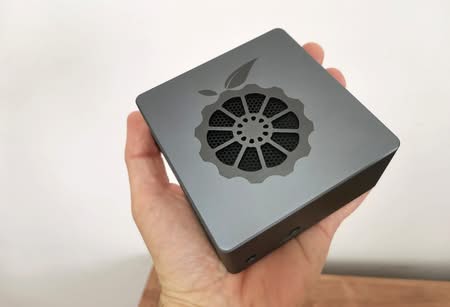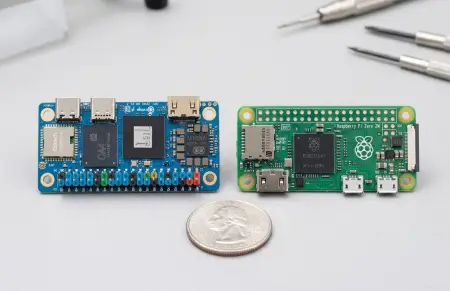

Maybe you missed it? Orange Pi Zero 3W Review
Meet the New Orange Pi Zero 4: The Ultra-Powerful Pocket-Size SBC
[27/08/2026 Shenzhen, China] The new Orange Pi Zero 4 is officially here. For years, the Orange Pi Zero series has been a beloved staple for hobbyists, educators, and developers who need a compact, budget-friendly computing solution. But with the Zero 4, Orange Pi isn’t just iterating on an old design; they are completely redefining what a board of this size can achieve.
We are talking about a device that is smaller than a standard business card and possesses similar specifications to the Orange Pi Zero W3 board. Its hardware capabilities support the operation of a mini PC, providing lightweight AI processing and lightning-fast connectivity within its small form factor. Whether you are a veteran developer in search of a powerful edge-computing node or a novice wanting to explore Raspberry Pi alternatives, the Orange Pi Zero 4 looks like an interesting piece of hardware. So let’s take a closer look at the specifications, features, and real-life applications of this little board.
Orange Pi Zero 4 Specfication
| Item | Specifications |
| SOC | Allwinner A733 |
| CPU | 2×Cortex-A76 + 6×Cortex-A55,up to 2.0GHz |
| GPU | PowerVR BXM-4-64 MC1 |
| NPU | Up to 3 TOPS |
| Memory | LPDDR5 / LPDDR4X / LPDDR4,up to 16GB |
| Storage | Optional onboard eMMC(8/16/32GB)or UFS(32/64/128GB),TF card slot(up to 128GB) |
| wireless | Wi-Fi 6 + BT 5.4 |
| Wired Network | RJ45 Gigabit Ethernet |
| Display | Mini HDMI(4K@60fps)、Type-C (supports USB 3.1&eDP/DP) |
| Camera | 2×22Pin FPC(MIPI CSI 4 Lane) |
| Expansion | 16Pin FPC(PCIe 3.0 & USB 3.1)、13Pin、26Pin GPIO、2Pin fan header |
| Audio | 13-pin expansion interface, I2S digital audio input/output interface, TWI digital microphone interface |
| Power | Type-C 5V/3A |
| Dimensions | 50mm × 55mm × 1.2mm |
| Weight | 21g |
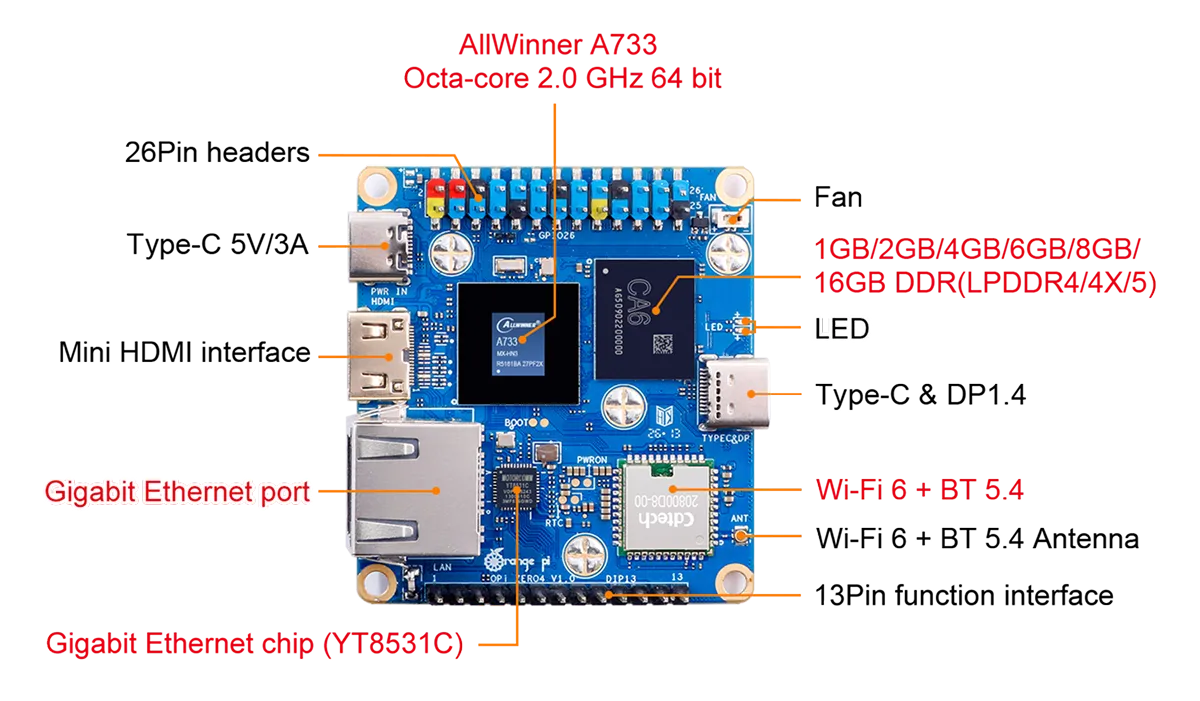
Powered by an Allwinner A733 Processor
Inside the Orange Pi Zero 4, there is a powerful processor: the Allwinner A733. I know that “SoC” (System on Chip) details can be hard to understand, so let’s break down why this is important in easy words.
The A733 features an octa-core heterogeneous architecture. This means it has eight processing cores divided into two distinct teams to handle tasks with maximum efficiency. It boasts two high-performance Cortex-A76 cores paired with six power-efficient Cortex-A55 cores, all clocking at a maximum speed of 2.0GHz.
Why is this “big.LITTLE” style architecture so brilliant? When you are doing something demanding, like compiling code, running a local server, or decoding a high-resolution video, the powerful A76 cores kick in to deliver smooth, lag-free performance. When you are just idling or running lightweight background tasks, the A55 cores take over, sipping power and keeping the board cool and quiet.
Handling the graphics duties is the Imagination PowerVR BXM-4-64 GPU. This isn’t your grandpa’s basic graphics controller. It provides robust hardware acceleration for modern graphical interfaces, ensuring that if you decide to run a lightweight desktop environment, everything from window animations to video playback will feel buttery smooth.
AI at Your Fingertips: The 3 TOPS NPU
Here is where the Orange Pi Zero 4 truly separates itself from the pack of traditional single-board computers. It features a dedicated Neural Processing Unit (NPU) capable of delivering up to 3 TOPS (Trillions of Operations Per Second) of AI performance.
You might be wondering, “Do I really need AI on a tiny single-board computer?” The answer is a resounding yes, and the possibilities are incredibly exciting. We are living in an era where edge computing is becoming the norm. Instead of sending all your data to the cloud to be processed (which introduces latency, requires constant internet, and raises privacy concerns), you can process it right on the device.
With 3 TOPS of processing power, the Zero 4 is perfectly suited for lightweight AI tasks. Imagine building a smart security camera that can locally recognize faces or detect packages without needing an internet connection. Picture a voice-controlled smart home hub that processes your commands locally for instant, private responses. Or perhaps you are working on a robotics project that requires basic computer vision to navigate a room. The integrated NPU makes all of this not just possible, but highly efficient, freeing up the main CPU cores to handle other system tasks.
Memory and Storage
One of the most common frustrations with older or budget-friendly SBCs has always been memory and storage bottlenecks. Orange Pi has clearly listened to the community’s feedback and addressed this head-on with the Zero 4.
First, let’s talk about RAM. The board supports up to a massive 16GB of LPDDR5, LPDDR4X, or LPDDR4 memory. Let that sink in for a moment. Sixteen gigabytes of high-speed RAM on a board the size of a credit card! Even if you opt for a lower-tier configuration for a simpler project, the sheer availability of LPDDR5 ensures that multitasking is an absolute breeze. You can run a web browser with dozens of tabs, a local database, and a media server simultaneously without the system breaking a sweat.
eMMC & UFS (Optional)
Storage is equally impressive. While there is a traditional TF (microSD) card slot supporting up to 1TB which is great for beginners or simple, low-cost projects, the Zero 4 elevates the game by offering optional onboard eMMC storage (up to 32GB) or blazing-fast UFS (Universal Flash Storage) depending on the model.
If you’ve ever experienced the agonizingly slow read/write speeds and eventual corruption of a cheap microSD card, you will appreciate this upgrade immensely. UFS and eMMC provide significantly faster, more reliable, and more durable storage, making the Zero 4 a viable candidate for daily-driver desktop use or mission-critical server applications where data integrity is paramount.
Connectivity: Wired and Wireless support
A powerful computer is only as good as its ability to communicate with the outside world, and the Orange Pi Zero 4 excels in this department.
For those who demand maximum stability and speed, the board includes a dedicated RJ45 Gigabit Ethernet port. This is an absolute must-have for anyone using the board as a network-attached storage (NAS) device, a Pi-hole network-wide ad blocker, or a home automation hub. Wired connections mean zero interference, no dropped packets, and consistent, low-latency performance.
But we live in a wireless world, and Orange Pi hasn’t skimped here either. The Zero 4 comes equipped with Wi-Fi 6 and Bluetooth 5.4. Wi-Fi 6 (802.11ax) is a massive upgrade over older Wi-Fi 5 standards. It offers faster maximum speeds, better performance in congested network environments (like apartment buildings with dozens of overlapping Wi-Fi networks), and improved power efficiency.
Pair that with Bluetooth 5.4, and you have a board that can seamlessly connect to modern wireless peripherals, beacons, and IoT sensors with enhanced range and lower power consumption. Whether you are streaming audio to wireless speakers or connecting a wireless keyboard and mouse, the connectivity is rock solid.
Display and Multimedia
Don’t let the tiny footprint fool you; the Orange Pi Zero 4 is a tiny multimedia powerhouse. It supports dual display output, which is a fantastic feature for productivity, digital signage, or kiosk projects.
The first output is a Mini HDMI 2.0 port, capable of pushing a stunning 4K resolution at 60 frames per second. This means you can hook it up to a modern 4K television or monitor and enjoy crisp, vibrant visuals. Whether you are building a retro gaming console, a media center running Kodi or Plex, or a high-resolution information dashboard, the Mini HDMI has you covered.
The second output is via the versatile USB Type-C port, which natively supports DisplayPort 1.4 (DP1.4) output. This dual-display capability allows you to extend your desktop across two monitors, vastly improving your workflow if you are using the Zero 4 as a lightweight Linux desktop replacement.
For the computer vision enthusiasts, the board features dual 22-pin FPC connectors for MIPI CSI 4-lane cameras. This means you can attach two high-quality camera modules simultaneously. Imagine a 3D scanning setup, a dual-lens security system, or a robot that uses one camera for navigation and another for object recognition. The hardware is genuinely ready for your most ambitious ideas.
Expansion and GPIO: For the Makers and Tinkerers
Now, let’s get to the part that makers, hardware hackers, and engineers truly care about: expansion. A great SBC needs to play nicely with the physical world, and the Zero 4 offers a rich, versatile array of interfaces.
The crown jewel of its expansion capabilities is the 16-pin FPC connector that breaks out PCIe 3.0 and USB 3.1. This is a massive deal for a board this size. PCIe 3.0 opens the door to connecting high-speed NVMe M.2 SSDs (via a simple adapter), dramatically boosting storage speeds beyond what eMMC or UFS can offer. It also allows for the addition of dedicated capture cards, advanced AI accelerators, or other high-bandwidth peripherals that older boards simply couldn’t handle.
Additionally, the board features a 13-pin expansion header and a 26-pin GPIO (General Purpose Input/Output) header. These pins provide access to a wide variety of protocols, including I2C, UART, PWM, SPI, and I2S (for digital audio input/output). There is even a TWI digital microphone interface and an IR receiver pin, making it incredibly easy to build voice-controlled projects or universal remote setups without needing a slew of external dongles.
Thermal management is also thoughtfully addressed with a dedicated 2-pin fan header. While the A733 is designed to be power-efficient, pushing it to its limits will generate heat. Having a native header to connect a small cooling fan ensures your “pocket rocket” stays cool and maintains peak performance during sustained, heavy workloads.
Design and Form Factor: Small but Mighty
We have to talk about the physical design, because it is genuinely remarkable. The Orange Pi Zero 4 measures a mere 50mm × 55mm × 1.2mm. To put that into perspective, it is literally smaller than a standard business card. It weighs in at an astonishing 21 grams.
Despite this diminutive size, it does not compromise on essential features. Powering the board is a standard USB Type-C port requiring a 5V/3A input. This is incredibly convenient, as it means you can power the board using the same high-quality charger you might already use for a modern smartphone, eliminating the need for bulky, proprietary, or hard-to-find power adapters.
The layout is clean, well-organized, and clearly designed with integration in mind. Whether you are embedding it inside a custom 3D-printed enclosure, mounting it behind a monitor with VESA adapters, or tucking it away in a smart home control panel, its tiny footprint ensures it will fit almost anywhere without adding bulk.
Use Cases: What Can You Actually Build?
Specs are great on paper, but what can you actually do with the Orange Pi Zero 4? The beauty of this board is its sheer versatility. The winning combination of a “high-performance CPU + 3 TOPS NPU + 4K display + Gigabit networking + rich interfaces” expands its use cases far beyond basic maker and educational projects.
Here are just a few ideas to get your creative gears turning:
- Edge AI Gateway: Use the NPU to run local machine learning models for smart home automation, processing sensor data, and controlling devices without relying on the cloud, ensuring privacy and zero latency.
- Compact Desktop PC: With up to 16GB of RAM, fast UFS storage, and dual 4K display outputs, it makes a surprisingly capable, low-power desktop computer for web browsing, document editing, and software development.
- Advanced Media Center: Hook it up to your TV via Mini HDMI, install a media center OS, and enjoy flawless 4K video playback with dedicated hardware acceleration.
- Retro Gaming Console: The powerful GPU and CPU can comfortably emulate a wide range of classic gaming consoles (up to PlayStation 1 and N64 era), and the USB 3.1 port ensures low-latency controller input.
- Network-Attached Storage (NAS): Combine the Gigabit Ethernet port with a PCIe 3.0 to NVMe adapter to create a blazing-fast, ultra-compact home server for file sharing, media streaming, and automated backups.
- Computer Vision Projects: Utilize the dual MIPI CSI camera interfaces and the NPU to build smart security cameras, object-tracking robots, or automated quality inspection systems for small-scale manufacturing.
First Conclusions
The announcement of the Orange Pi Zero 4 is a great addition for the single-board computer community. Orange Pi has managed to strike a near-perfect balance. They have maintained the compact size and legendary cost-performance ratio that the Zero series is known for.
This board bridges the gap between simple hobbyist boards and expensive, high-end industrial computers. It is especially suitable for projects that demand high integration, low power consumption, and excellent cost efficiency.
Whether you are a seasoned engineer prototyping the next big IoT device, or a curious hobbyist looking to build your first smart mirror, the Orange Pi Zero 4 provides a robust, future-proof foundation. It’s not just an incremental update; it’s a bold leap forward in what we can expect from pocket-sized computing.
🛒Price and Availability
The Orange Pi Zero series, such as the Zero 2W and Zero 3, has introduced very competitive pricing. The Zero 4 is now launching at a flexible price range of $26.00 to $83 USD.
Based on updated information provided by Orange Pi, and given the inclusion of premium components like the Allwinner A733, a 3 TOPS NPU, WiFi 6, PCIe 3.0, and support for up to 16GB of LPDDR5 RAM, here is a breakdown of the pricing:
- Base Model (1GB): $26.5USD range. This would be the sweet spot for hobbyists, basic retro gaming, and very lightweight home-server tasks.
- Semi-Base Model (2GB): $37 USD range. This would be the sweet spot for hobbyists, retro gaming, and lightweight home server tasks.
- Mid-Tier Model (4GB): Likely in the $52 USD range. This configuration would be perfect for desktop replacement, heavy multitasking, and moderate AI workloads.
- High-Tier Model (6GB): Range from $63USD. This is aimed at developers, edge-AI professionals, and power users who need maximum local storage speed and memory headroom.
- Top-Tier Model (8GB): Range from $83USD. This is aimed at developers, edge-AI professionals, and power users who need maximum local storage speed and memory headroom.
Where to Buy?
![Orange Pi Zero 4W [4GB RAM]](https://cdn.androidpimp.com/wp-content/uploads/2026/08/Orange-Pi-Zero-4-Buy.jpg)
Orange Pi Zero 4W [4GB RAM]
The Orange Pi Zero 4 is an ultra-compact, square-shaped (50 × 55 mm) single-board computer built for tight spaces and edge AI applications.
Key Takeaways
- Orange Pi Zero 3W Review Meet the New Orange Pi Zero 4: The Ultra-Powerful Pocket-Size SBC [27/08/2026 Shenzhen, China] The new Orange Pi Zero 4 is officially here.
- Additionally, the board features a 13-pin expansion header and a 26-pin GPIO (General Purpose Input/Output) header.
- Design and Form Factor: Small but Mighty We have to talk about the physical design, because it is genuinely remarkable.
- This is incredibly convenient, as it means you can power the board using the same high-quality charger you might already use for a modern smartphone, eliminating the need for bulky, proprietary, or hard-to-find power…
- 🛒Price and Availability The Orange Pi Zero series (like the Zero 2W and Zero 3) has been incredibly aggressive on price, often launching in the $15 to $35 USD range for base models.
Frequently Asked Questions
Is range worth it?
4, and you have a board that can seamlessly connect to modern wireless peripherals, beacons, and IoT sensors with enhanced range and lower power consumption.
How do I use range?
4, and you have a board that can seamlessly connect to modern wireless peripherals, beacons, and IoT sensors with enhanced range and lower power consumption.
What are the main features of range?
The A733 features an octa-core heterogeneous architecture.
How to use the range command to select a range
4, and you have a board that can seamlessly connect to modern wireless peripherals, beacons, and IoT sensors with enhanced range and lower power consumption.