Close Menu
  • Home
  • About
  • Wearables
  • Earbuds
  • Computer Accessories
    • Routers
    • Remotes
  • Embedded
    • Single Board Computers
    • Addon Boards
    • Raspberry Pi
  • Wireless Routers
  • Contact
Facebook X (Twitter) Instagram Threads
Trending
  • Top Global AliExpress Promo Codes February 25, 2026
  • WaveNote AI Review 2026: An Honest Pro/Con Comparison (Tested)
  • CamThink NE301 Review: 25 FPS YOLOv8 on STM32 Edge AI
  • PrivadoVPN Review 2026: Is the Best Free VPN Still Good for Streaming?
  • Orange Pi 6: Why Buy an AI HAT+? This SBC has 45 TOPS of Integrated AI Power
  • AliExpress Shopping Guide 2026: How to Find Top Deals & Avoid Scams
  • Banana Pi BPI-R4 Pro Review: The Best WiFi 7 OpenWrt Router? We Checked!
  • Best Off-Grid LoRa Mesh Messenger [2026] – LoraSecret
AndroidPIMP
Facebook X (Twitter) Instagram
  • Home
  • About
  • Wearables
  • Earbuds
  • Computer Accessories
    • Routers
    • Remotes
  • Embedded
    • Single Board Computers
    • Addon Boards
    • Raspberry Pi
  • Wireless Routers
  • Contact
AndroidPIMP
Tablet PCs

Poco Pad Review: A Detailed Hands-on Review

By androidpimpMarch 27, 2025Updated:March 27, 2025No Comments23 Mins Read
Facebook Twitter Pinterest LinkedIn Tumblr Email
Follow Us
Google News Flipboard
Xiaomi Poco Pad Review
Table of contents
  1. Part I: Xiaomi Poco Pad Introduction
  2. Xiaomi Poco Pad Specifications
  3. Comparing Specifications: Xiaomi Pad 6S versus Poc Pad.
  4. Comparison: Xiaomi Poco Pad and Apple iPad Pro 12.9-inch
  5. Powered by HyperOS
  6. An affordable alternative to the Pad Pro with comparable quality
  7. Part II: Xiaomi Poco Pad Review
  8. Unboxing All Items:
  9. The main package (Tablet & Accessories)
  10. Poco Pad Cover (Optional Accessory)
  11. Poco Pad Keyboard (Optional Accessory)
    1. Using the Poco Pad Keyboard
  12. The crucial accessory overlooked by Xiaomi
    1. What are the benefits?
  13. Smart pen (Optional Accessory)
  14. Design
  15. Weight
  16. Display
    1. Testing the visibility of displays in strong sunlight conditions.
    2. Whatโ€™s a TรœV Rheinland certified device is and why it is crucial for the health of your eyes?
  17. Quad speakers for immersive stereo sound
  18. Hardware
  19. Software
    1. What is the current amount of available space?
  20. Interconnectivity
  21. Xiaomi Interconnectivity โ€“ Pairing with the Poco X7 Pro smartphone
  22. Kodi Compatibility
    1. Kodi Performance and Memory Use
  23. Using the Tablet With Stylus Pen For Drawing & Writing
    1. What does Mi Canvas Apps have to offer?
  24. Smart Pen
    1. Charging the Smart Pen
    2. Palm rejection support
    3. Latency
    4. Understanding Smart Pen Latency
    5. How good is the latency on the Poco Pad?
    6. Pressure sensitivity
  25. Cameras
    1. What is the quality of the picture like?
  26. Benchmarking
    1. AnuTu Benchmark
    2. Geekbench 6: Test Results
    3. Comparing the results to equivalent devices
  27. 3DMark performance assessment:
    1. Can the hardware handle graphically intensive games?
  28. Battery Life and Charging Speed of Poco Pad
  29. Battery life during Netflix streaming
  30. Netflix Streaming
  31. The Poco Pad offers support for WiFi 6, providing even better connectivity options.
  32. What about the competition?
  33. Accessories for the Xiaomi Poco Pad
  34. Is the Xiaomi Poco Pad Worth Buying?
  35. Frequently asked questions about the Poco Pad
    1. What type of processor powers the POCO Pad?
    2. What storage options are offered for the POCO Pad?
    3. What kind of display is included in the POCO Pad?
    4. What is the battery capacity and charging capability of the POCO Pad?
    5. Can Kodi be installed on the Poco Pad, and how does it perform?
    6. Is the POCO Pad OS capable of fully utilizing the available 8GB of RAM?
    7. Does the Poco Pad HyperOS support a 64-bit architecture and allow the installation of 64-bit APKs?
    8. What is the highest resolution that Netflix supports for video playback on the Poco Pad?
  36. Verdict, Pricing, and Availability
    1. Poco Pad Pricing and purchasing options
    2. Poco Pad

Benchmarking

AnuTu Benchmark

Xiaomi Poco Pad – AnTuTu 10.2.6 Benchmark Test Results
Model: POCO 2405CPCFBG

AnTuTu Score: 509141

CPU Score: 178150

CPU Mathematical Operations

29548

CPU Common Algorithms

39469

CPU Multi-Core

109133

GPU Score: 60856

Seasons – Vulkan

Not Supported

Coastlline2 – Vulkan

60856

MEM Score: 125872

RAM Bandwidth

19098

RAM Latency

39715

ROM APP IO

15969

ROM Sequential Read

9069

ROM Sequential Write

9803

ROM Random Access

32218

UX Score: 144263

Data Security

22503

Data Processing

20896

Document Processing

6409

Image Decoding

29170

Image Processing

7390

User Experience

38923

Video CTS

3500

Video Decoding

15472

Video Editing

Not Supported


Geekbench 6: Test Results

Poco Pad (8GB/256GB)

Geekbench 6.0 Score

1036

Single-Core Score

3001

Multi-Core Score

    Single-Core Performance

Single-Core Score

1036

Integer Score

1072

Floating Point Score

973

File Compression

938

Navigation

991 

HTML.5 Browser

 1268

PDF Render

 1332

Photo Library

 1034

Clang

 1060

Text Processing

 1090

Asset Compression

 1136

Object Detection

 874

Background Blur

 908

Horizon Detection

 1292

Object Remover

 627

HDR

 1153

Photo Filter

 902

Ray Tracker

 966

Structure from Motion

 1114

Poco Pad (8GB/256GB)

Geekbench 6.0 Score

1036

Single-Core Score

3001

Multi-Core Score

  Multi-Core Performance

Multi-Core Score

3001

Integer Score

2914

Floating Point Score

3170

File Compression

1476

Navigation

3343

HTML.5 Browser

3386

PDF Render

4524

Photo Library

3638

Clang

4118

Text Processing

1321

Asset Compression

5288

Object Detection

1917

Background Blur

2424

Horizon Detection

4444

Object Remover

1694

HDR

3323

Photo Filter

2785

Ray Tracker

4542

Structure from Motion

4193

Comparing the results to equivalent devices


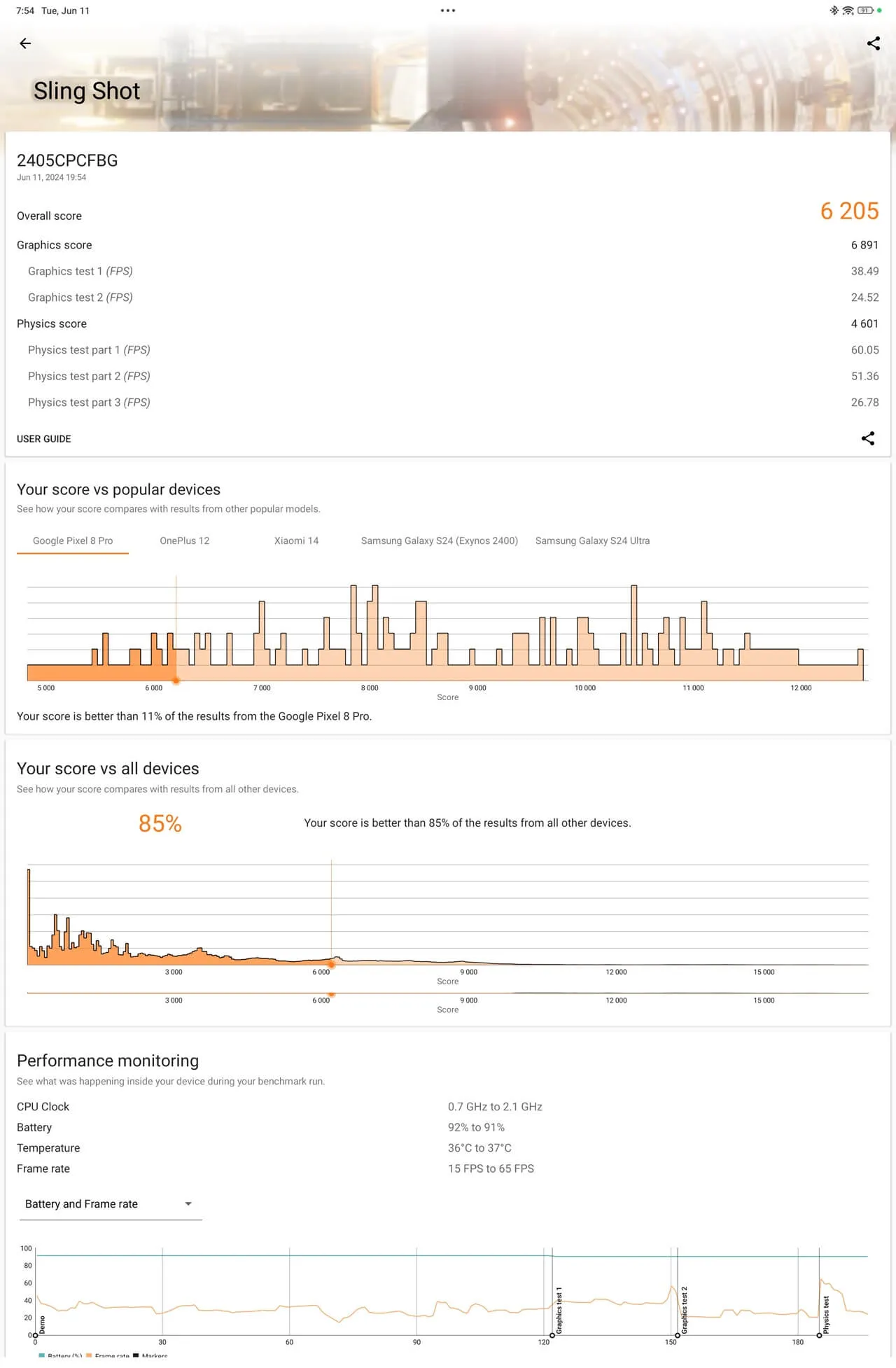
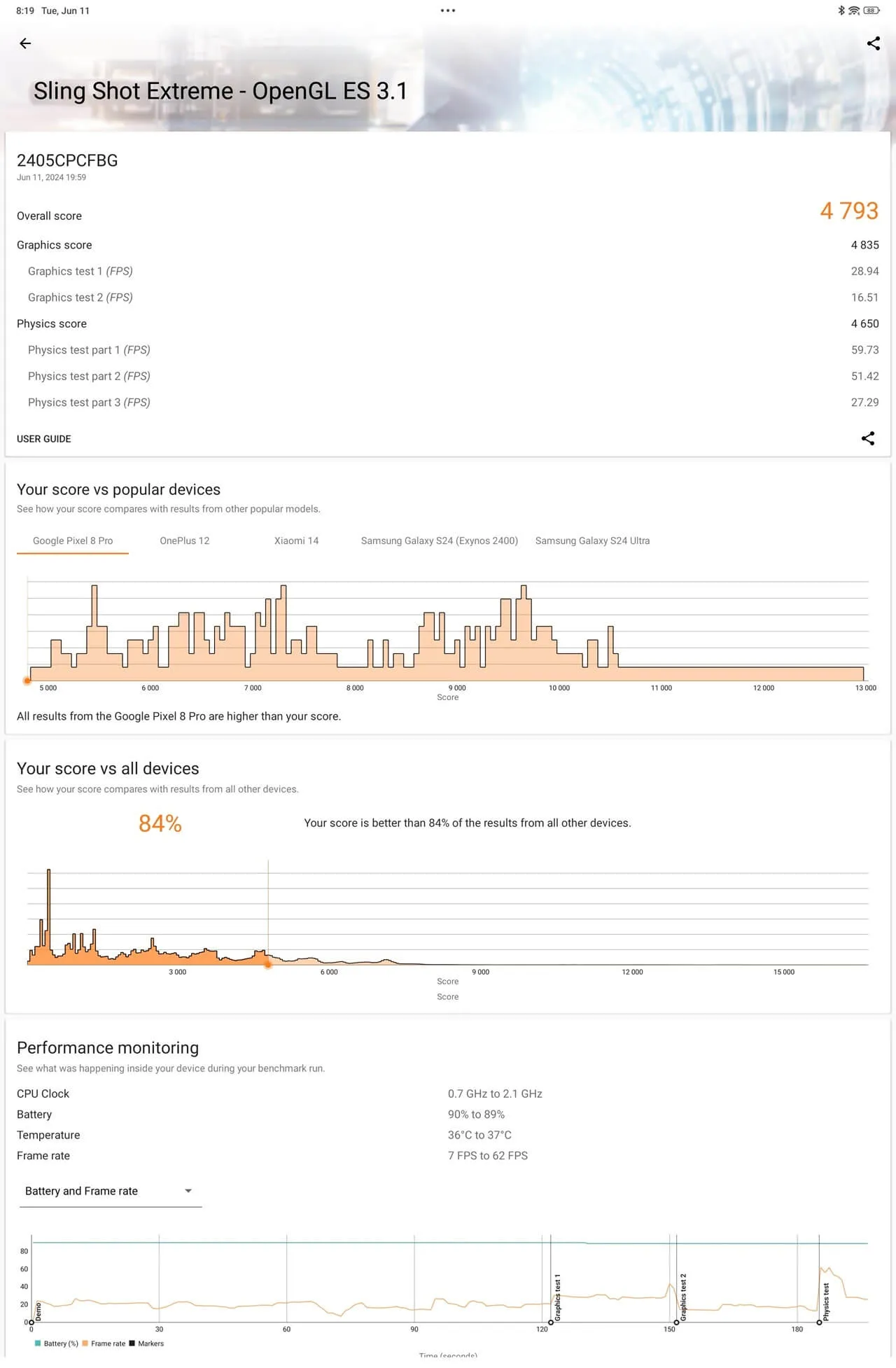
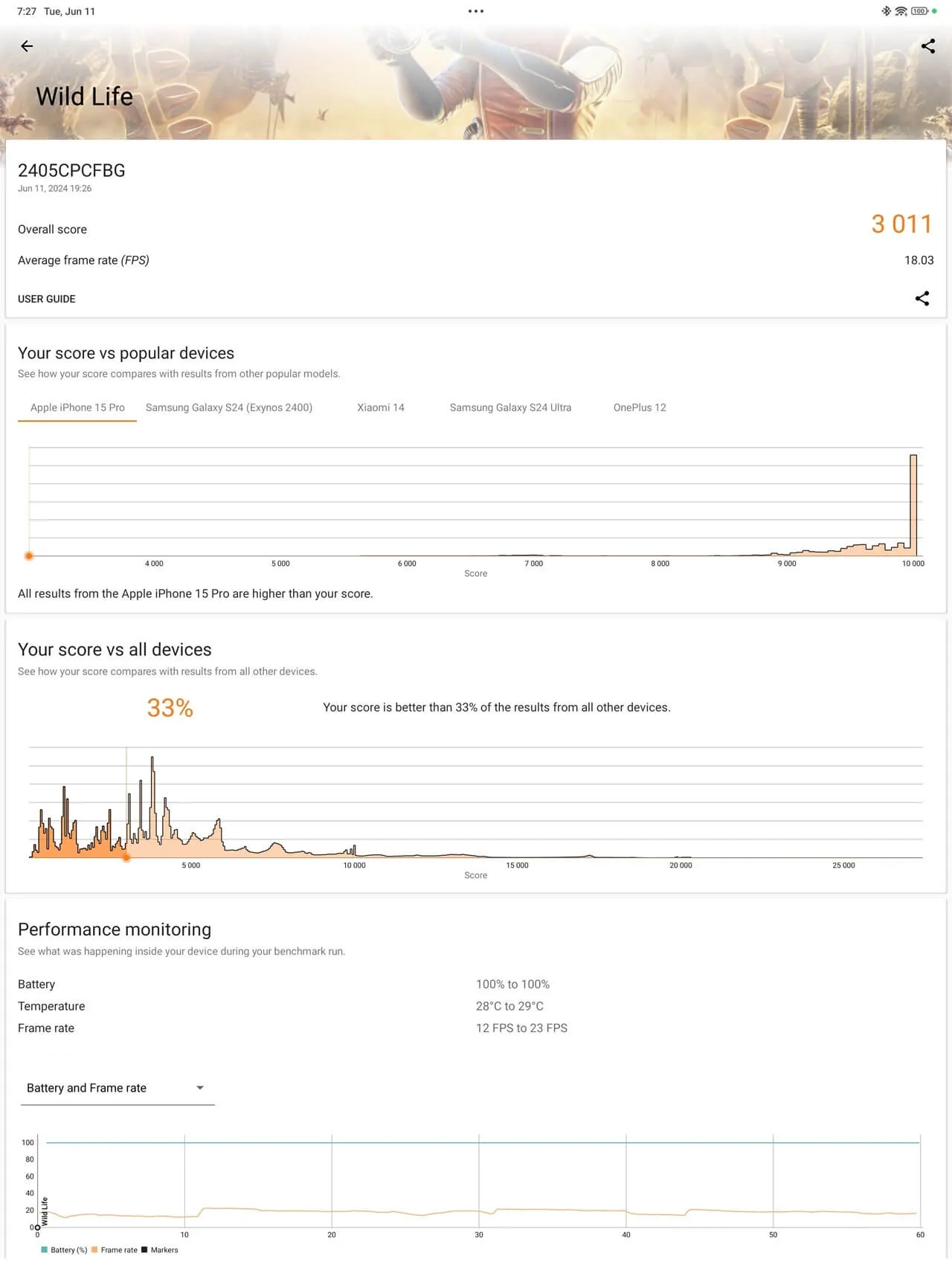
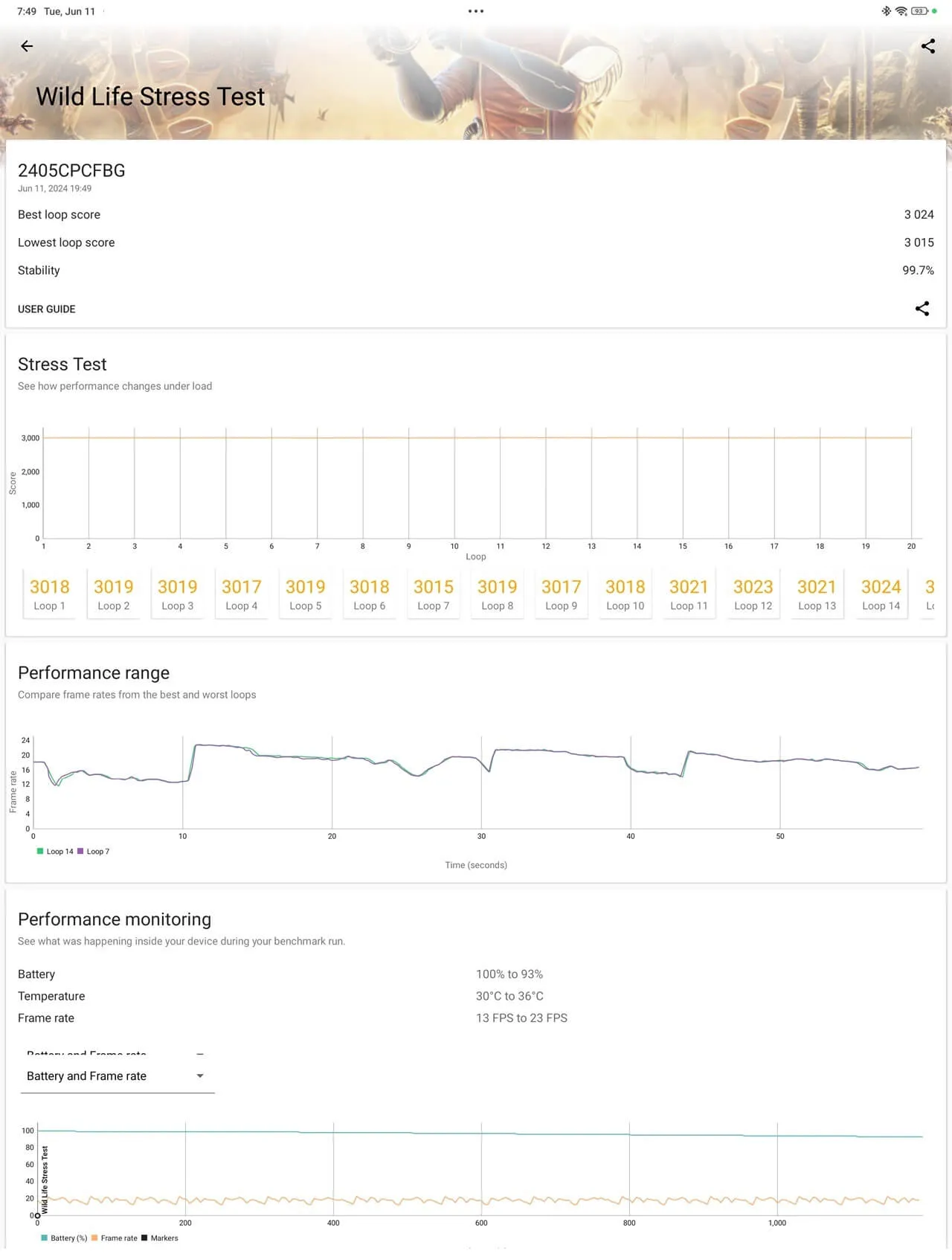
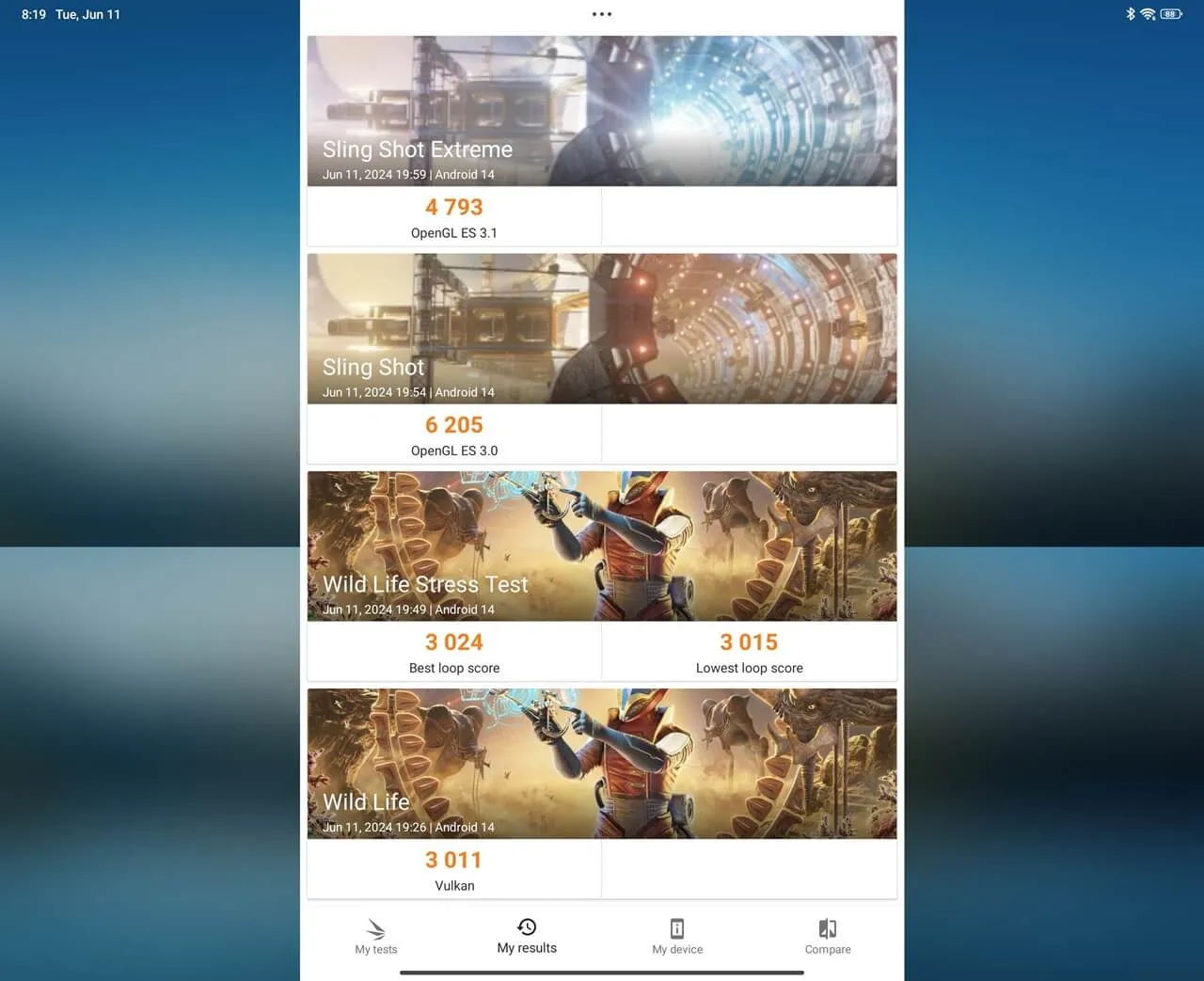
3DMark performance assessment:

  • Sling Shot: 6205 (OpenGL ES 3.1).
  • Sling Shot Extreme: 4793 (OpenGL ES 3.1).
  • Wild Life: 3011 (Vulkan).
  • Wild Life Stress Test: 3024 (Best loop score), 3015 (Lowest loop score).

3DMark Benchmark test results
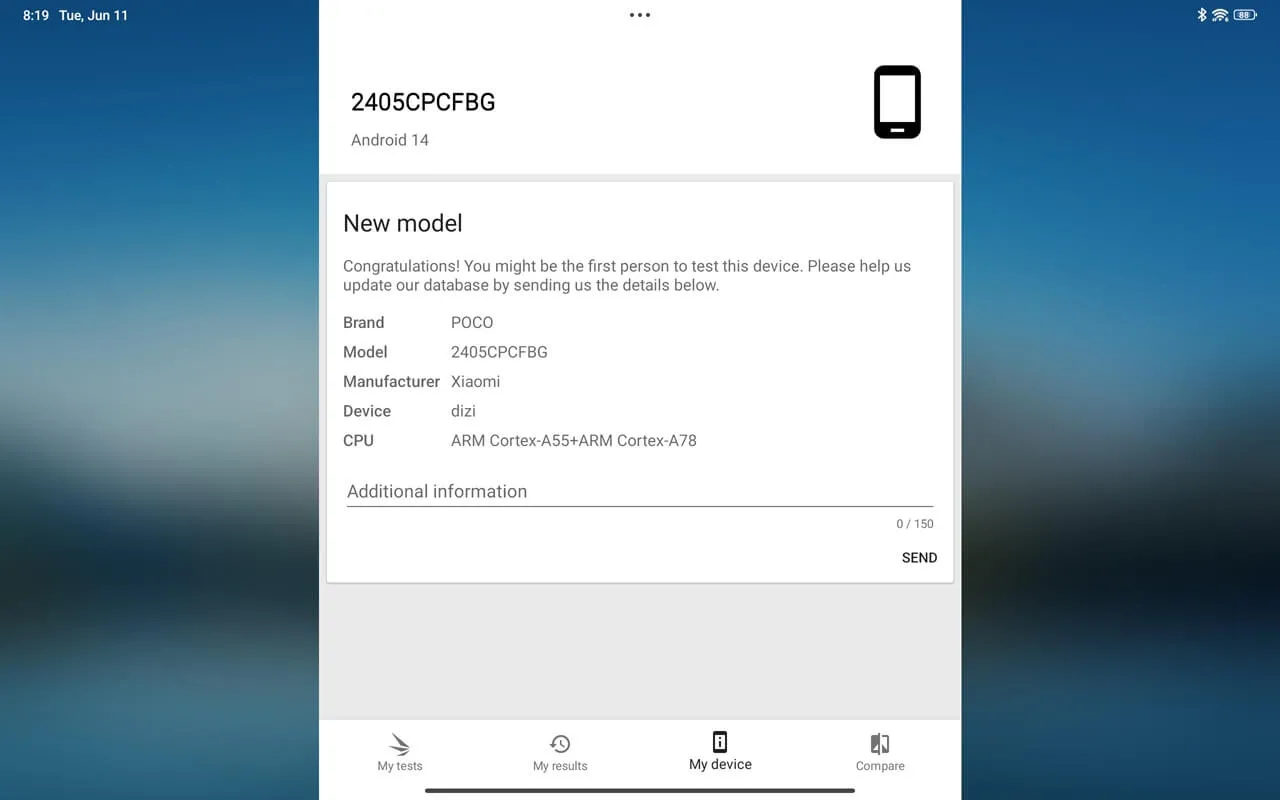
Poco Pad DMark
Poco Pad DMark
Poco Pad DMark
Poco Pad DMark
Poco Pad DMark
Poco Pad DMark
Poco Pad DMark
Poco Pad DMark
Poco Pad DMark
Poco Pad DMark
Poco Pad DMark
Poco Pad DMark

Comparing the results of several high-end devices based on the Dimensity 9300 and the Snapdragon Gen 3 chipsets. As mentioned earlier, the hardware of the Poco Pad is more suitable for multimedia applications than for intensive gaming. We also observed that the peak temperature reached up to 37 °C under high resource loading, which indicates an excellent cooling system.

Can the hardware handle graphically intensive games?

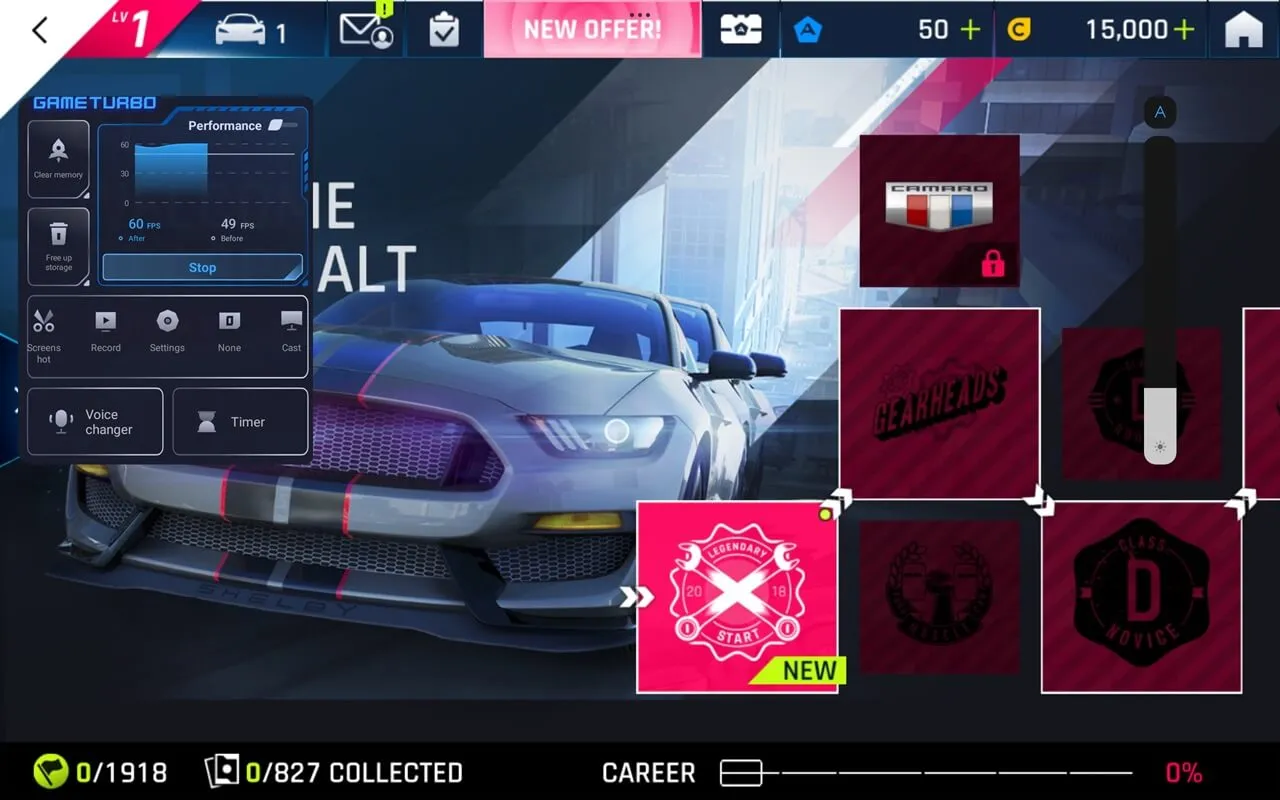
The Snapdragon 7s Gen 2 processor is designed specifically for mid-range tablets, but its standout performance shines when combined with Xiaomi’s game turbo software feature, integrated as part of Xiaomi HyperOS.

One of the key ways this software optimizes your device is by identifying non-essential running applications and closing them to free up RAM for gaming. Enhancing performance by increasing CPU and GPU clock speeds, extracting more power while making minimal compromises on resolution. This powerful combination optimizes performance and drastically enhances frame rates when running high-demand, resource-intensive games.

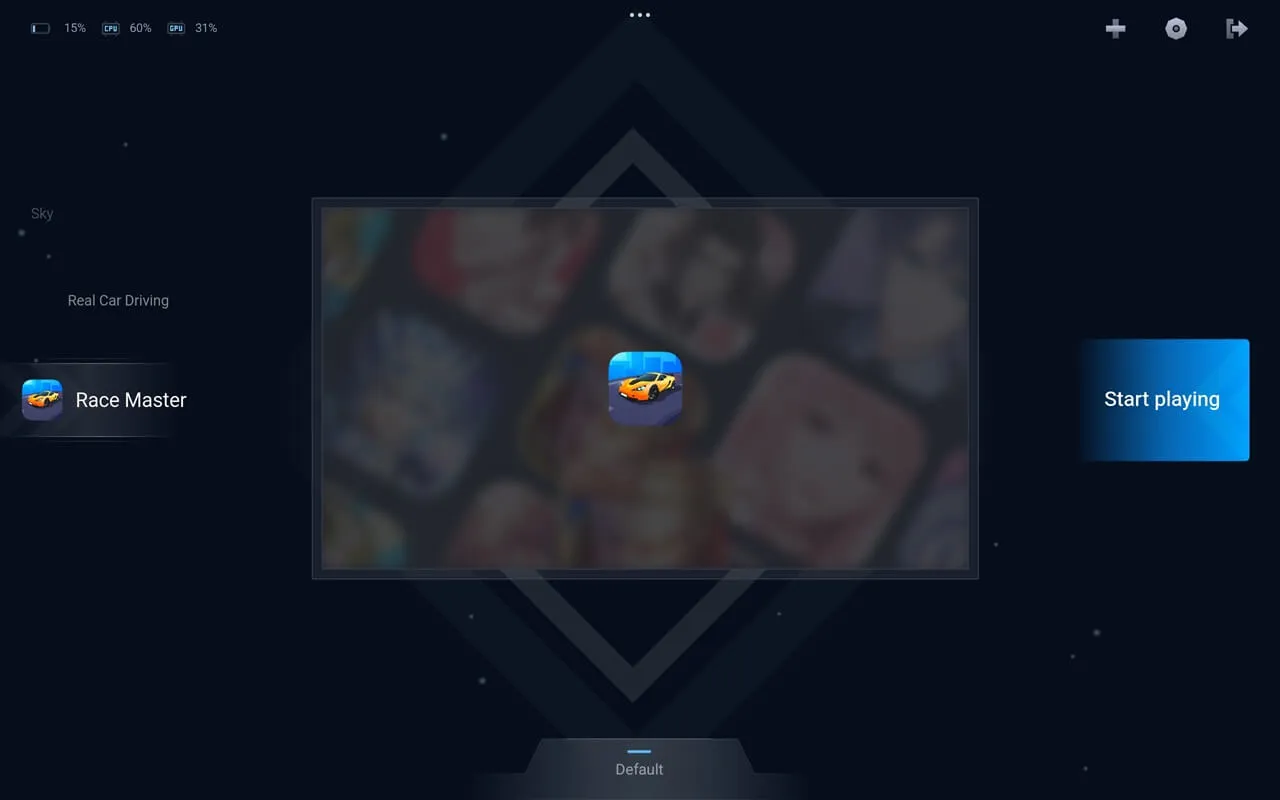
The GAMETURBO menu always runs in the background when accessible while playing games. With it, you can perform advanced tasks such as freeing up additional space, recording the game, monitoring performance, clearing memory, changing your voice, and even streaming your game to a WiFi-supported smart device like a TV.

We have thoroughly tested several high-demand games such as CSR Racing 2, Asphalt 9, and Cover Fire, and we are pleased to report that they performed exceptionally well.

Running Asphalt 9 with GAMETURBO in the background (Screenshots)

Poco Pad Game Turbo 1
Poco Pad Game Turbo 2
Poco Pad Game Turbo 3
Poco Pad Game Turbo 4
1 2 3 4 5 6 7 8 9 10 11
Share. Facebook Twitter Pinterest LinkedIn Tumblr Email
Previous ArticleSinoVoip unveils Banana Pi BPI-AI2N SBC powered by Renesas RZ/V2N AI MPU
Next Article Banana Pi R4 gets an 8GB RAM upgrade. Here’s why you should consider buying one!
androidpimp
  • Website

Related Posts

Redmi Pad 2 Tablet Review

Redmi Pad 2 Review (2025): The Best Budget Tablet Value? Full Review

September 26, 2025
Xiaomi Redmi Pad 5 Review

Xiaomi Redmi Pad Review: Powerful and Affordable

June 30, 2024

Xiaomi Pad 6 Specs, price and top features

July 7, 2023
5 1 vote
Article Rating
Subscribe
Notify of
0 Comments
Oldest
Newest Most Voted
Inline Feedbacks
View all comments
PureVPN
PureVPN Ad Banner
VyprVPN – No. 1 in Anonymity
Vyprvpn 350x260
PrivadoVPN – No. 1 in Parental Control
PrivadoVPN 350x437
Recent Posts
  • Top Global AliExpress Promo Codes February 25, 2026
  • WaveNote AI Review 2026: An Honest Pro/Con Comparison (Tested)
  • CamThink NE301 Review: 25 FPS YOLOv8 on STM32 Edge AI
  • PrivadoVPN Review 2026: Is the Best Free VPN Still Good for Streaming?
  • Orange Pi 6: Why Buy an AI HAT+? This SBC has 45 TOPS of Integrated AI Power
  • AliExpress Shopping Guide 2026: How to Find Top Deals & Avoid Scams
  • Banana Pi BPI-R4 Pro Review: The Best WiFi 7 OpenWrt Router? We Checked!
  • Best Off-Grid LoRa Mesh Messenger [2026] – LoraSecret
  • Redmi Turbo 5 Max (2026) unveiled with 9,000mAh battery, specs, price, and design
  • HiWonder WonderLLM: ESP32-S3 AI Vision & Chatbot Module with 2MP Camera
RSS The Latest RSS Feeds
  • WaveNote AI Review 2026: An Honest Pro/Con Comparison (Tested)
  • Top Global AliExpress Promo Codes February 25, 2026
  • CamThink NE301 Review: 25 FPS YOLOv8 on STM32 Edge AI
Facebook X (Twitter) Instagram Pinterest
@2026 - All Right Reserved. Designed by AndroidPIMP

Type above and press Enter to search. Press Esc to cancel.

Powered by
►
Necessary cookies enable essential site features like secure log-ins and consent preference adjustments. They do not store personal data.
None
►
Functional cookies support features like content sharing on social media, collecting feedback, and enabling third-party tools.
None
►
Analytical cookies track visitor interactions, providing insights on metrics like visitor count, bounce rate, and traffic sources.
None
►
Advertisement cookies deliver personalized ads based on your previous visits and analyze the effectiveness of ad campaigns.
None
►
Unclassified cookies are cookies that we are in the process of classifying, together with the providers of individual cookies.
None
Powered by
Accessibility
Accessibility modes
Epilepsy Safe Mode
Dampens color and removes blinks
This mode enables people with epilepsy to use the website safely by eliminating the risk of seizures that result from flashing or blinking animations and risky color combinations.
Visually Impaired Mode
Improves website's visuals
This mode adjusts the website for the convenience of users with visual impairments such as Degrading Eyesight, Tunnel Vision, Cataract, Glaucoma, and others.
Cognitive Disability Mode
Helps to focus on specific content
This mode provides different assistive options to help users with cognitive impairments such as Dyslexia, Autism, CVA, and others, to focus on the essential elements of the website more easily.
ADHD Friendly Mode
Reduces distractions and improve focus
This mode helps users with ADHD and Neurodevelopmental disorders to read, browse, and focus on the main website elements more easily while significantly reducing distractions.
Blindness Mode
Allows using the site with your screen-reader
This mode configures the website to be compatible with screen-readers such as JAWS, NVDA, VoiceOver, and TalkBack. A screen-reader is software for blind users that is installed on a computer and smartphone, and websites must be compatible with it.
Readable Experience
Content Scaling
Default
Text Magnifier
Readable Font
Dyslexia Friendly
Highlight Titles
Highlight Links
Font Sizing
Default
Letter Spacing
Default
Left Aligned
Center Aligned
Right Aligned
Visually Pleasing Experience
Dark Contrast
Light Contrast
Monochrome
High Contrast
High Saturation
Low Saturation
Adjust Text Colors
Adjust Title Colors
Adjust Background Colors
Easy Orientation
Mute Sounds
Hide Images
Hide Emoji
Reading Guide
Stop Animations
Reading Mask
Highlight Hover
Highlight Focus
Big Dark Cursor
Big Light Cursor
Cognitive Reading
Virtual Keyboard
Navigation Keys
Voice Navigation

AndroidPIMP

Accessibility Statement

  • AndroidPIMP.com
  • 10/18/2025

Compliance status

We believe the internet should be open and accessible to everyone, and weโ€™re dedicated to making our website usable for the widest audience possible, no matter their circumstances or abilities.

To achieve this, we follow the World Wide Web Consortiumโ€™s (W3C) Web Content Accessibility Guidelines 2.1 (WCAG 2.1) at the AA level as closely as possible. These guidelines outline how to make web content accessible for people with a variety of disabilities. By complying with them, we help ensure our website is usable by everyone, including those who are blind, have motor or visual impairments, cognitive disabilities, and more.

This website uses a range of technologies to stay accessible at all times. An accessibility interface lets people with specific disabilities customize the siteโ€™s UI and design to fit their personal needs.

The website also uses an AI-powered application that works in the background to constantly enhance its accessibility. This app fixes the siteโ€™s HTML, adjusts its features and behavior for screen readers used by blind users, and optimizes keyboard functions for people with motor impairments.

If youโ€™ve found a malfunction or have ideas for improvement, weโ€™ll be happy to hear from you. You can reach out to the websiteโ€™s operators by using the following email [email protected]

Screen-reader and keyboard navigation

Our website implements the ARIA attributes (Accessible Rich Internet Applications) technique, alongside various different behavioral changes, to ensure blind users visiting with screen-readers are able to read, comprehend, and enjoy the websiteโ€™s functions. As soon as a user with a screen-reader enters your site, they immediately receive a prompt to enter the Screen-Reader Profile so they can browse and operate your site effectively. Hereโ€™s how our website covers some of the most important screen-reader requirements, alongside console screenshots of code examples:

  1. Screen-reader optimization: we run a background process that learns the websiteโ€™s components from top to bottom, to ensure ongoing compliance even when updating the website. In this process, we provide screen-readers with meaningful data using the ARIA set of attributes. For example, we provide accurate form labels; descriptions for actionable icons (social media icons, search icons, cart icons, etc.); validation guidance for form inputs; element roles such as buttons, menus, modal dialogues (popups), and others. Additionally, the background process scans all the websiteโ€™s images and provides an accurate and meaningful image-object-recognition-based description as an ALT (alternate text) tag for images that are not described. It will also extract texts that are embedded within the image, using an OCR (optical character recognition) technology. To turn on screen-reader adjustments at any time, users need only to press the Alt+1 keyboard combination. Screen-reader users also get automatic announcements to turn the Screen-reader mode on as soon as they enter the website.

    These adjustments are compatible with all popular screen readers, including JAWS and NVDA.

  2. Keyboard navigation optimization: The background process also adjusts the websiteโ€™s HTML, and adds various behaviors using JavaScript code to make the website operable by the keyboard. This includes the ability to navigate the website using the Tab and Shift+Tab keys, operate dropdowns with the arrow keys, close them with Esc, trigger buttons and links using the Enter key, navigate between radio and checkbox elements using the arrow keys, and fill them in with the Spacebar or Enter key.Additionally, keyboard users will find quick-navigation and content-skip menus, available at any time by clicking Alt+1, or as the first elements of the site while navigating with the keyboard. The background process also handles triggered popups by moving the keyboard focus towards them as soon as they appear, and not allow the focus drift outside it.

    Users can also use shortcuts such as โ€œMโ€ (menus), โ€œHโ€ (headings), โ€œFโ€ (forms), โ€œBโ€ (buttons), and โ€œGโ€ (graphics) to jump to specific elements.

Disability profiles supported in our website

  • Epilepsy Safe Mode: this profile enables people with epilepsy to use the website safely by eliminating the risk of seizures that result from flashing or blinking animations and risky color combinations.
  • Visually Impaired Mode: this mode adjusts the website for the convenience of users with visual impairments such as Degrading Eyesight, Tunnel Vision, Cataract, Glaucoma, and others.
  • Cognitive Disability Mode: this mode provides different assistive options to help users with cognitive impairments such as Dyslexia, Autism, CVA, and others, to focus on the essential elements of the website more easily.
  • ADHD Friendly Mode: this mode helps users with ADHD and Neurodevelopmental disorders to read, browse, and focus on the main website elements more easily while significantly reducing distractions.
  • Blindness Mode: this mode configures the website to be compatible with screen-readers such as JAWS, NVDA, VoiceOver, and TalkBack. A screen-reader is software for blind users that is installed on a computer and smartphone, and websites must be compatible with it.
  • Keyboard Navigation Profile (Motor-Impaired): this profile enables motor-impaired persons to operate the website using the keyboard Tab, Shift+Tab, and the Enter keys. Users can also use shortcuts such as โ€œMโ€ (menus), โ€œHโ€ (headings), โ€œFโ€ (forms), โ€œBโ€ (buttons), and โ€œGโ€ (graphics) to jump to specific elements.

Additional UI, design, and readability adjustments

  1. Font adjustments โ€“ users, can increase and decrease its size, change its family (type), adjust the spacing, alignment, line height, and more.
  2. Color adjustments โ€“ users can select various color contrast profiles such as light, dark, inverted, and monochrome. Additionally, users can swap color schemes of titles, texts, and backgrounds, with over seven different coloring options.
  3. Animations โ€“ person with epilepsy can stop all running animations with the click of a button. Animations controlled by the interface include videos, GIFs, and CSS flashing transitions.
  4. Content highlighting โ€“ users can choose to emphasize important elements such as links and titles. They can also choose to highlight focused or hovered elements only.
  5. Audio muting โ€“ users with hearing devices may experience headaches or other issues due to automatic audio playing. This option lets users mute the entire website instantly.
  6. Cognitive disorders โ€“ we utilize a search engine that is linked to Wikipedia and Wiktionary, allowing people with cognitive disorders to decipher meanings of phrases, initials, slang, and others.
  7. Additional functions โ€“ we provide users the option to change cursor color and size, use a printing mode, enable a virtual keyboard, and many other functions.

Browser and assistive technology compatibility

We aim to support the widest array of browsers and assistive technologies as possible, so our users can choose the best fitting tools for them, with as few limitations as possible. Therefore, we have worked very hard to be able to support all major systems that comprise over 95% of the user market share including Google Chrome, Mozilla Firefox, Apple Safari, Opera and Microsoft Edge, JAWS and NVDA (screen readers).

Notes, comments, and feedback

Despite our very best efforts to allow anybody to adjust the website to their needs. There may still be pages or sections that are not fully accessible, are in the process of becoming accessible, or are lacking an adequate technological solution to make them accessible. Still, we are continually improving our accessibility, adding, updating and improving its options and features, and developing and adopting new technologies. All this is meant to reach the optimal level of accessibility, following technological advancements. For any assistance, please reach out to [email protected]

wpDiscuz