
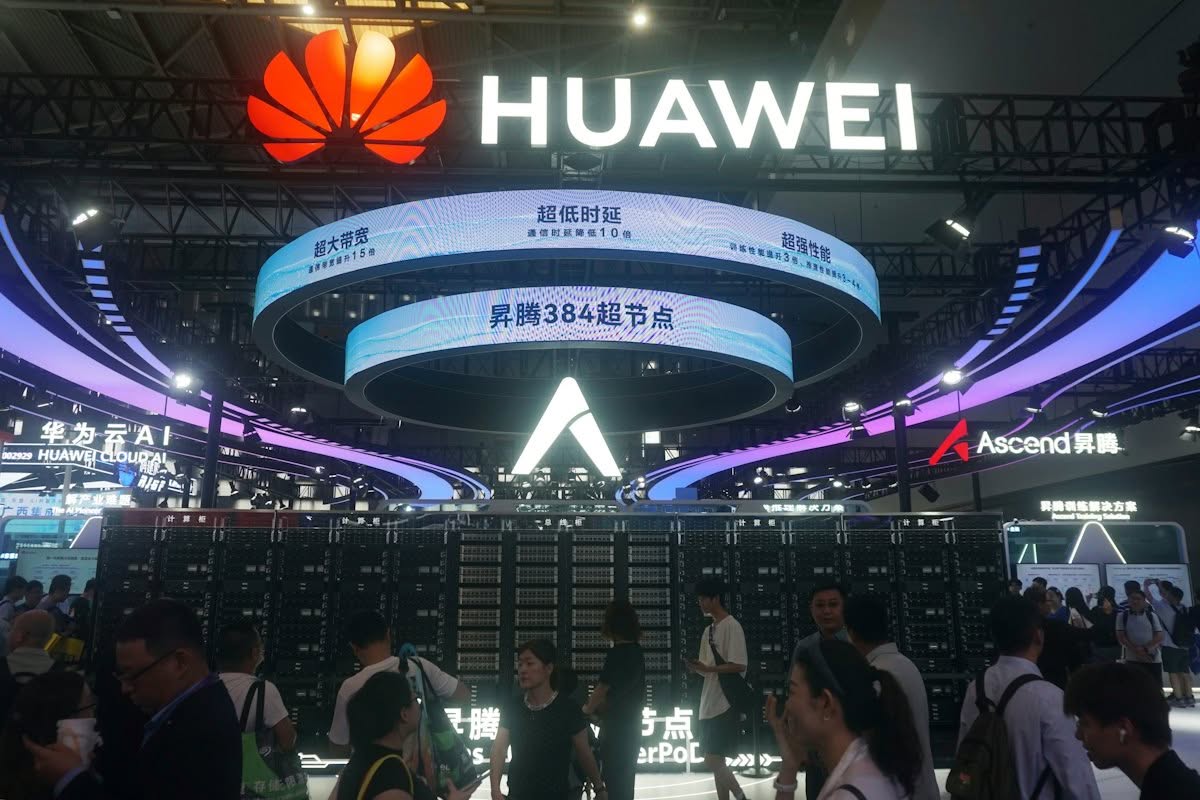
Maybe you missed it? Orange Pi Maker XunLong & Huawei Launch Edge AI at WAIC 2026
Inside Huawei’s Ambitious AI Chip Roadmap Featuring the Anticipated Ascend 960 Chip.
The global race for AI dominance just got a major new twist. Chinese tech giant Huawei is gearing up to unveil its next-generation AI processor, the Ascend 960, at an upcoming event in Shanghai.
But this isn’t just about a single new piece of silicon. Huawei is rolling out a bold, multi-year roadmap: launching a new AI chip every year, doubling the computing power with each generation, and building massive systems that can link up to one million processors to work together as a single, giant brain.
Huawei’s ultimate goal is to create a true, homegrown alternative to Nvidia. This push is happening against the backdrop of strict US export controls, which have limited China’s access to the world’s most advanced semiconductor technology.
A New Chip Every Year: The Ascend Roadmap
According to Reuters, Huawei’s rotating chairman, David Wang, will present the Ascend 960 at the company’s annual conference. The commercial rollout is set for 2027, with an initial “960DT” version arriving in the first quarter, followed by a “960PR” version later in the year.
And Huawei isn’t stopping there. Their ambitious timeline looks like this:
- 2027: Ascend 960 launches
- 2028: Ascend 970 arrives
- 2029: Ascend 980 hits the market
The promise? A brand-new generation every year, with each iteration delivering twice the computing power of the last.
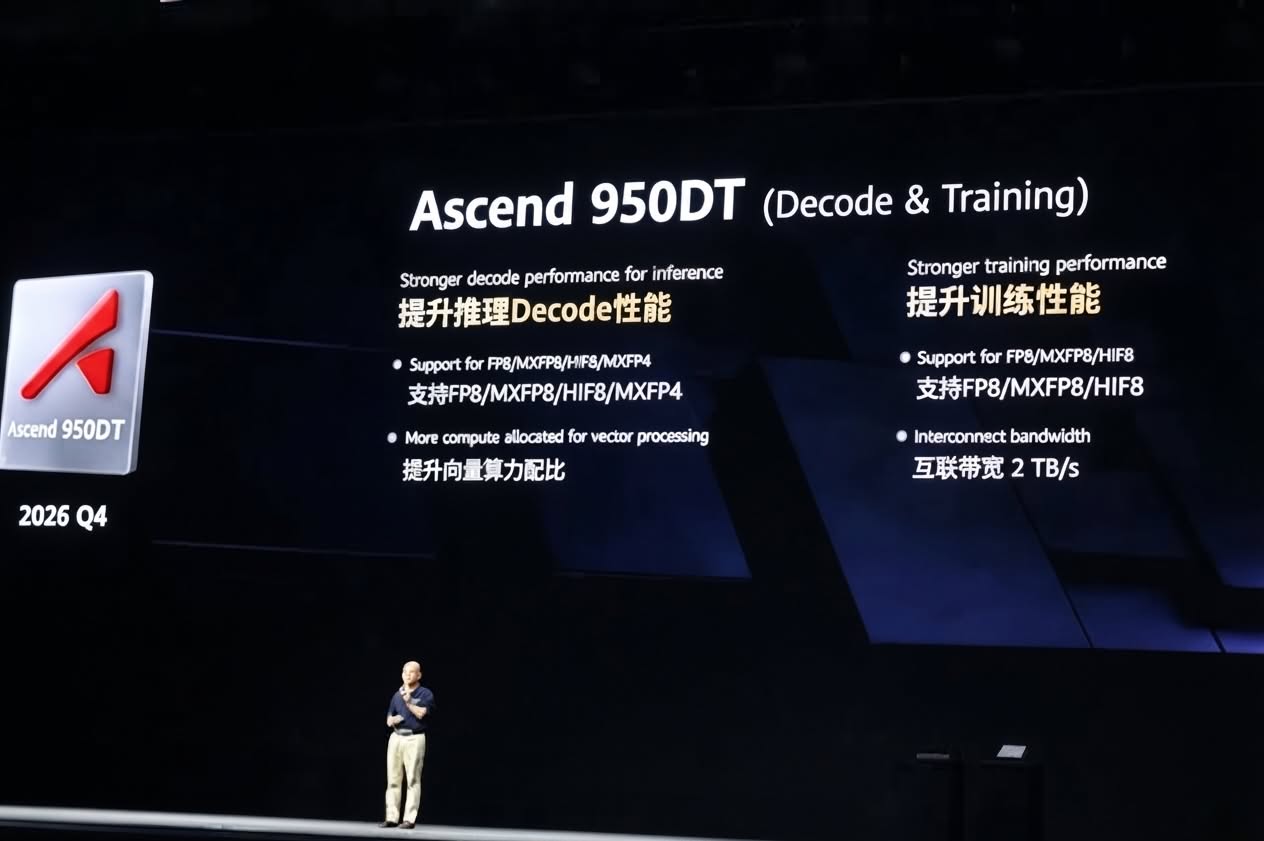
What is the Huawei Ascend 950DT?
The Huawei Ascend 950DT is a powerful AI chip designed to handle massive data workloads—think training large AI models and running complex AI tasks at scale.
Key Features:
- Massive Memory: 144 GB of Huawei’s own High Bandwidth Memory (HBM) for lightning-fast data processing
- Built for Speed: 128 MB L2 cache and 18 Unified Bus ports to maximize data transfer speeds
- Energy Efficient: Native support for low-precision formats like FP8, which boosts performance while using less power
- China’s Answer to Nvidia: Positioned as the leading domestic alternative to American AI chips
Real-World Impact:
Launched on Huawei Cloud in August 2026, the chip has already been adopted by major AI developers, including DeepSeek. Commercial deployments are scaling rapidly through Q4 2026, making it one of China’s most successful AI chip launches to date.
Huawei Ascend 950DT: Roadmap Announcement: September 2025 (initial reveal of the launch plan for Q4 2026)
The Big Goal: Running Any AI Model, Anywhere
Behind these aggressive targets is a much bigger vision. Huawei wants the Ascend family to become the default foundation for running any AI model, starting in China and eventually expanding globally.
For Beijing, this is about national security and self-reliance. Because US sanctions make it incredibly hard for Chinese companies to buy Nvidia’s top-tier chips, China has been pouring billions into building its own independent tech supply chain.
But Huawei knows that simply making a slightly faster chip isn’t enough to catch up. Instead, they are using a “strength in numbers” approach: connecting vast arrays of good-enough chips to act like one incredibly powerful supercomputer.
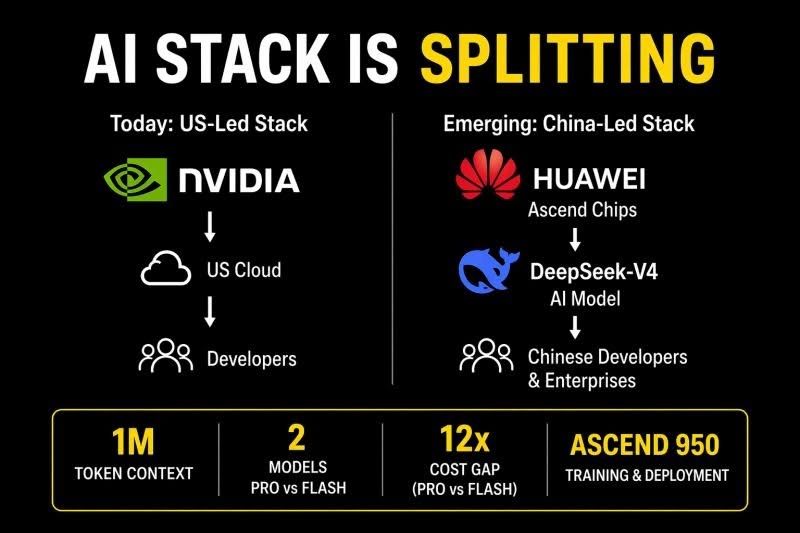
Nvidia vs Huawei: The AI World Is Splitting in Two
The global artificial intelligence landscape is rapidly fracturing into two distinct, parallel ecosystems, creating what industry experts are calling the “AI Divide.” On one side, the Western AI stack remains heavily anchored by Nvidia’s dominant hardware, which powers the major US cloud giants like AWS, Azure, and Google Cloud to serve a global network of developers. On the other side, China is aggressively building an independent, homegrown stack. Driven by Huawei’s Ascend 910B and 950 chips, this ecosystem is already powering advanced domestic models like DeepSeek, providing a complete, self-sufficient pipeline for Chinese enterprises.
This bifurcation isn’t just about hardware; it’s about scale and economics. With the new Ascend 950 designed for both training and inference, and Chinese models boasting a massive 1-million-token context window, China is leveraging a reported 12x cost advantage to ensure its domestic AI industry can thrive and innovate completely independent of Western technology.
Thinking Bigger: From “Supernodes” to Million-Processor Clusters
Huawei is already seeing traction. The company says its Ascend developer community now has over 5,200 active developers every month, and they’ve already delivered more than 1,000 AI computing systems (called “Supernodes”) to over 370 clients.
A Supernode links multiple AI processors to tackle the same massive task at once. This lets companies train huge AI models by pooling the power of many chips, rather than relying on the limits of a single processor.
Now, Huawei is taking this to the next level with the Ascend 960 SuperPoD. They’ve recently upgraded their UnifiedBus communication technology, which acts as the “nervous system” connecting these chips. When paired with a new optical networking system called Hi-ONE, a single SuperPoD can link up to 4,000 processors with blazing-fast optical cables.
Why does this matter? Because in modern AI, the biggest bottleneck isn’t always the speed of a single chip—it’s getting thousands of chips to talk to each other quickly and stay perfectly synchronized. By mastering this connectivity, Huawei is finding a clever way to close the performance gap with Nvidia.
In fact, Huawei claims its architecture can eventually scale to “Superclusters” containing up to one million AI processors, with configurations of 100,000+ chips working seamlessly as one unified resource.
This is happening right now in reality.
This isn’t just theoretical. Chinese AI startup DeepSeek is reportedly planning to deploy at least 160,000 Ascend 950DT chips in a new data center in Mongolia to power its next-generation AI models.
At the same time, Huawei is looking beyond its home market. Reports indicate the company is actively exploring international partnerships in countries like Malaysia and Egypt to expand the reach of its AI technology.
What This Means for the Future of AI
For Nvidia, Huawei’s progress is a wake-up call. US export restrictions were meant to slow China’s access to cutting-edge computing. Instead, they’ve acted as a catalyst, forcing Beijing to accelerate its own homegrown solutions.
Huawei, which has been under heavy US sanctions for years, is no longer just trying to build a “Chinese copy of an Nvidia chip.” If their roadmap holds up, they are building an entire, self-sustaining ecosystem from the ground up.
The endgame? To give the Chinese AI industry a complete, independent foundation—from the silicon in the chip to the massive data centers running the models—so they can keep innovating, no matter what happens in the global tech landscape.