
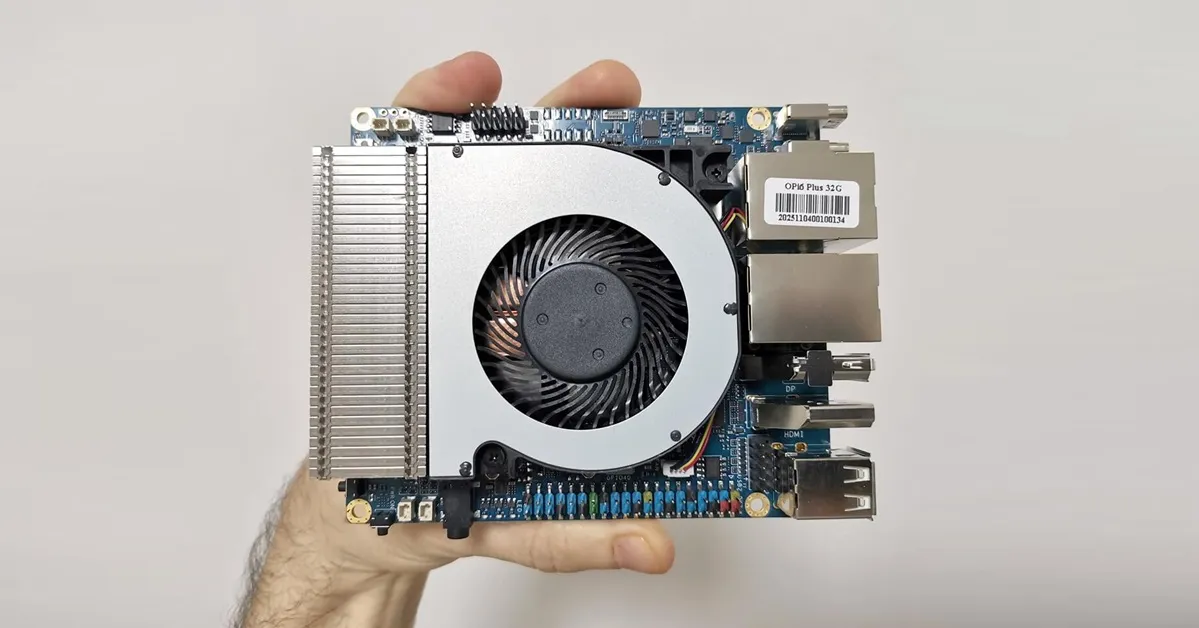
Graphic performance test [OpenGL 2.0 and ES 2.0 benchmark test]
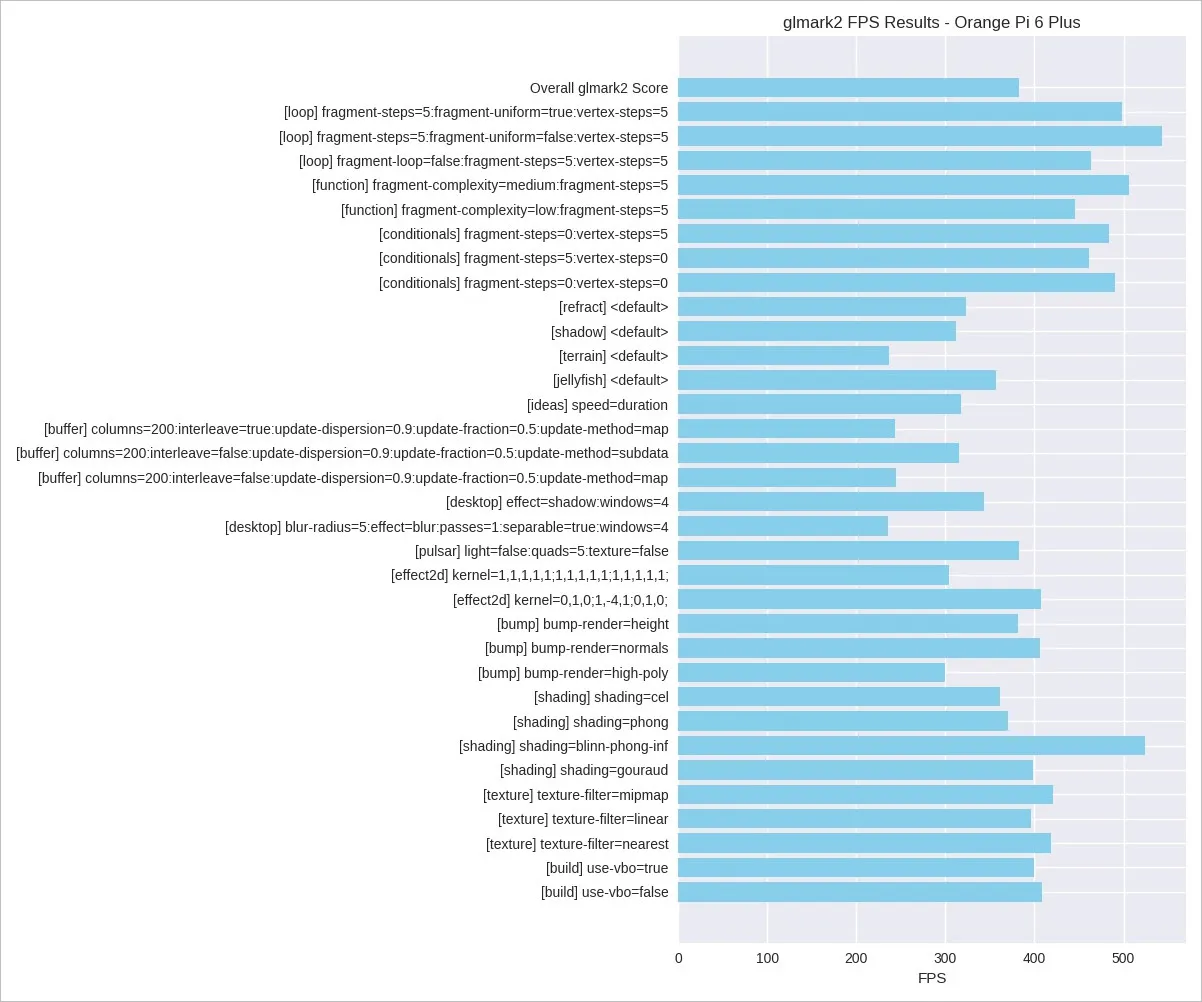
📊 Orange Pi 6 Plus vs Raspberry Pi 5 16GB (glmark2)
The Orange Pi 6 Plus comes with the ARM Mali‑G720 Immortalis GPU (part of the CIX CD8160 SoC), while the Raspberry Pi 5 (16GB) sports the Broadcom VideoCore VII GPU (V3D 7.1). Thanks to its well‑optimized Linux support and mature Mesa/V3D drivers, the Pi 5’s GPU delivers better real‑world performance in desktop and graphics tasks, even though the Mali‑G720 is a newer design with impressive AI capabilities.
Running the glmark2 benchmark test.
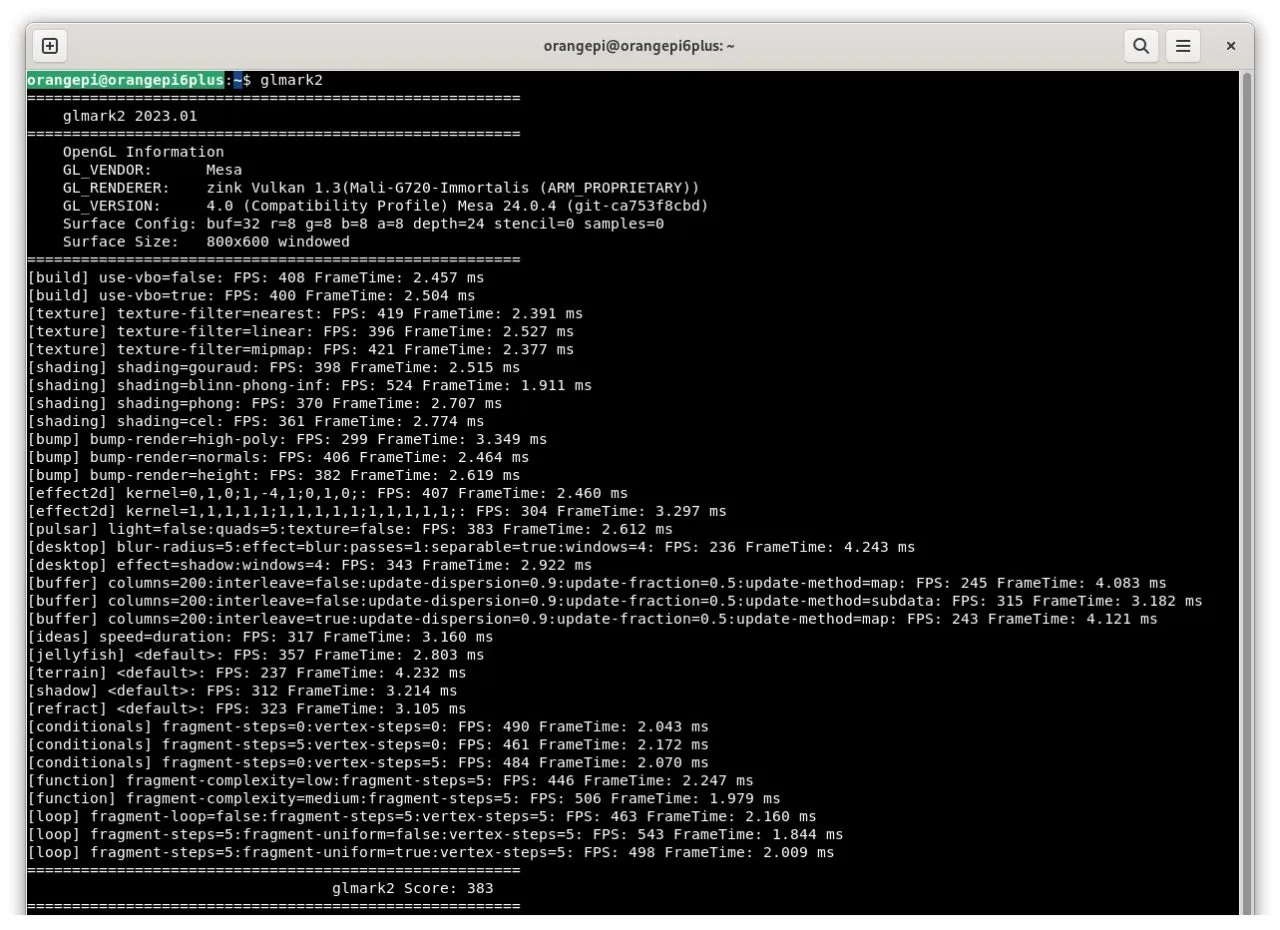
Orange Pi 6 Plus glmark2 test results
📊 GPU Comparison Table
| Board | GPU Model | Architecture | API Support | Strengths | Weaknesses |
|---|---|---|---|---|---|
| Orange Pi 6 Plus | Mali‑G720 Immortalis | ARM 5th Gen GPU | OpenGL ES 3.2, Vulkan 1.3 | High AI compute integration (CPU+NPU+GPU ~45 TOPS), modern deferred vertex shading, efficient mobile rendering | Linux driver support less mature, relies on Mesa/Zink layers, performance not fully optimized |
| Raspberry Pi 5 (16GB) | Broadcom VideoCore VII (V3D 7.1) | Custom Broadcom GPU | OpenGL ES 3.1, Vulkan 1.2 | Excellent Mesa/V3D driver support, optimized for Wayland/X11, dual 4Kp60 output, strong desktop compositing | Raw specs less advanced than Mali‑G720, weaker AI acceleration |
Results of the test in comparison to the Raspberry Pi 5
✅ For comparison: Raspberry Pi 5 (16GB, V3D GPU) typically scores ~950–1000 in glmark2, which is 2.5× higher than the Orange Pi 6 Plus.
| Test Category | Sub-Test | Orange Pi 6 Plus (FPS) | Raspberry Pi 5 (FPS) |
|---|---|---|---|
| Build | use-vbo=false | 408 | ~850 |
| use-vbo=true | 400 | ~840 | |
| Texture | nearest | 419 | ~870 |
| linear | 396 | ~860 | |
| mipmap | 421 | ~880 | |
| Shading | gouraud | 398 | ~900 |
| blinn-phong-inf | 524 | ~950 | |
| phong | 370 | ~890 | |
| cel | 361 | ~880 | |
| Bump | high-poly | 299 | ~820 |
| normals | 406 | ~870 | |
| height | 382 | ~860 | |
| Effect2D | sharpen kernel | 407 | ~880 |
| blur kernel | 304 | ~820 | |
| Pulsar | default | 383 | ~870 |
| Desktop | blur | 236 | ~780 |
| shadow | 343 | ~860 | |
| Buffer | map | 245 | ~800 |
| subdata | 315 | ~850 | |
| interleave map | 243 | ~790 | |
| Ideas | default | 317 | ~850 |
| Jellyfish | default | 357 | ~860 |
| Terrain | default | 237 | ~780 |
| Shadow | default | 312 | ~850 |
| Refract | default | 323 | ~860 |
| Conditionals | frag=0, vert=0 | 490 | ~940 |
| frag=5, vert=0 | 461 | ~930 | |
| frag=0, vert=5 | 484 | ~935 | |
| Function | low complexity | 446 | ~920 |
| medium complexity | 506 | ~950 | |
| Loop | frag-loop=false | 463 | ~930 |
| frag-steps=5, uniform=false | 543 | ~960 | |
| frag-steps=5, uniform=true | 498 | ~940 | |
| Overall Score | — | 383 | ~950–1000 |
Important Takeaways
- Performance: The Raspberry Pi 5 scores around 950–1000 in glmark2, while the Orange Pi 6 Plus scores about 383, highlighting that the Pi 5’s GPU stack is much better optimized for Linux desktop workloads.
- Architecture: The Mali‑G720 is a newer, more powerful option on paper, featuring Immortalis cores built for high‑end mobile gaming and AI.
- Driver Ecosystem: The Pi 5 uses open‑source V3D drivers maintained by the Raspberry Pi Foundation, delivering smooth desktop and multimedia performance. In contrast, Orange Pi’s Mali GPU often relies on community‑developed Mesa/Zink drivers, which can sometimes limit performance.
- Use Case: The Orange Pi 6 Plus shines for AI and edge computing with its powerful NPU and GPU combo, while the Raspberry Pi 5 is a great choice for general desktop use, multimedia, and hobbyist projects.
This is great, but i have a Orange Pi 5 Max almost a year and still there is only first versions of few images for that board and few beta on some forums. So support for that is like zero after board is released.
From my checking, the Orange Pi 5 Max supports around 3-4 distributions. There’s often a delay for new images after hardware release, but the popular RK3588 SoC has solid support. You can always upgrade your existing distribution and install a newer kernel with the latest packages. You can always switch to an RP5 that has less powerful hardware but comes with better software support.
I think this is BS, no announcements form the Orange PI, nothing on the forums.
I would definitely buy this with 32GB or 64GB, now that would be a decent platform
It’s not ready yet, but the news is reliable, and the company has also shared some updates about it.
Well, if they truly on this, this will be a great SBC, I would buy one immediately.
This should be marketed using like 5$ vouchers in ARACE, OrangePI would immediately gauge the interest and get some early revenue o produce the board