
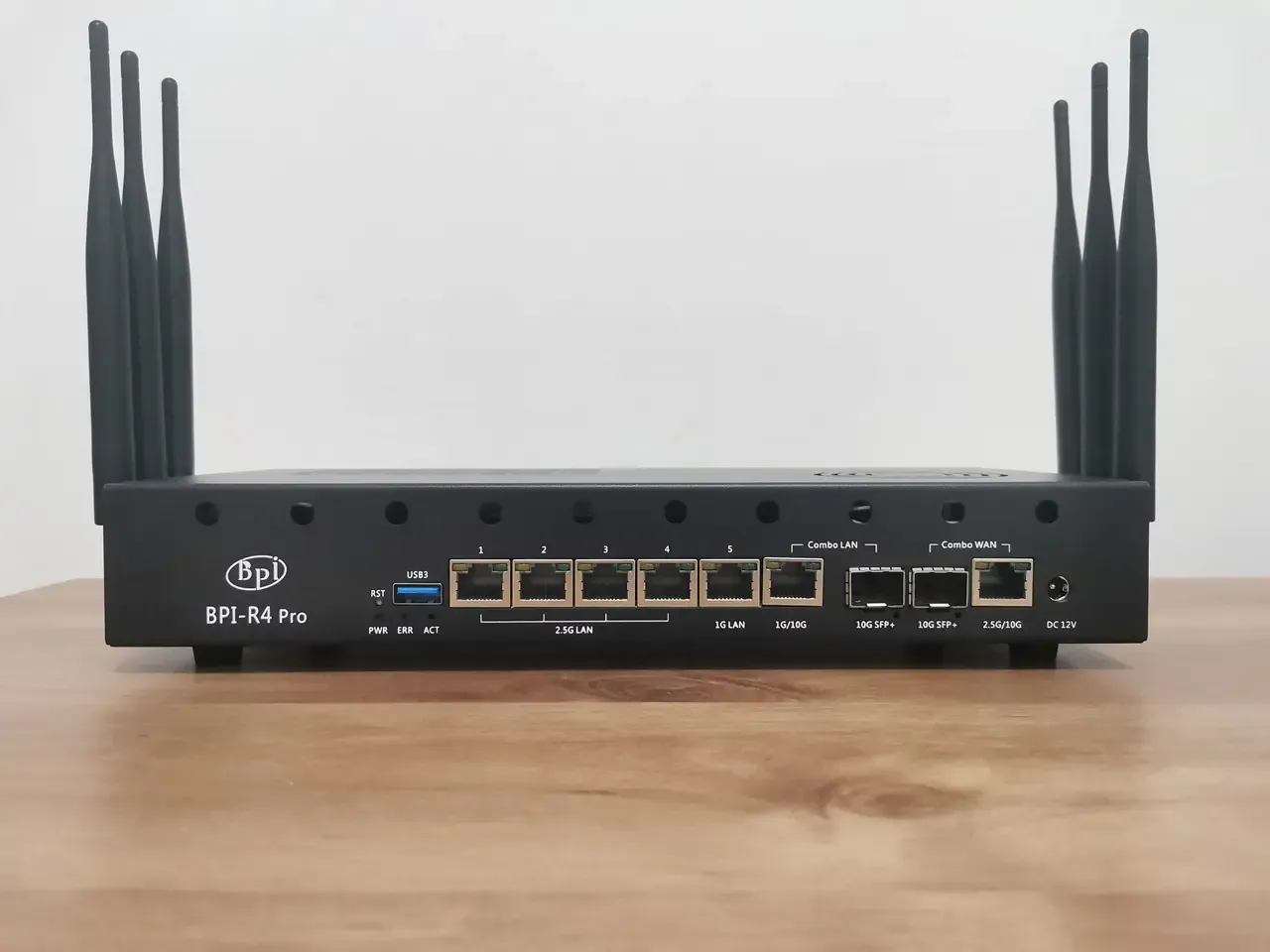
Software wise
Like the earlier Banana Pi R4, the R4 Pro features the same MediaTek Filogic 880 (MT7988A) SoC. Fresh from the factory, our unit arrived with a lean, pre-flashed OpenWrt 24.10 snapshot from Banana Pi. There are still a few bugs to iron out, but we’re confident that official mainline updates will be available on the OpenWrt site soon, just as with other Banana Pi router boards.
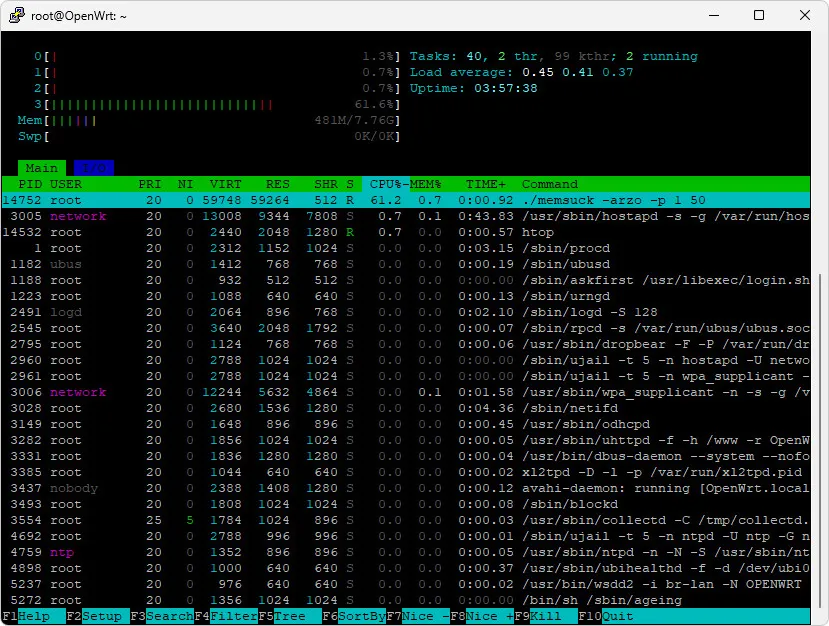
When it comes to system resources, you won’t have any issues with plenty of free RAM available. This board comes with 8GB DDR4 of RAM, and there’s also an optional 4GB version. As for RAM usage, as shown in the photo below, without installing any additional background services, only about 481MB of 7.76GB (8GB) was used (utilized).
Monitoring system resources with the htop tool
BPI-R4 Pro bootstrap configuration
The R4 Pro comes with a simple bootstrap switch that basically lets you choose how the system files are booted on the device. You can choose from three bootstrap operation methods: SD card, SPI NAND, or eMMC. The simplest option is to burn the OS image file onto a microSD card and set both switches down. We recommend using this option until the official mainline version becomes available on the OpenWrt official website.
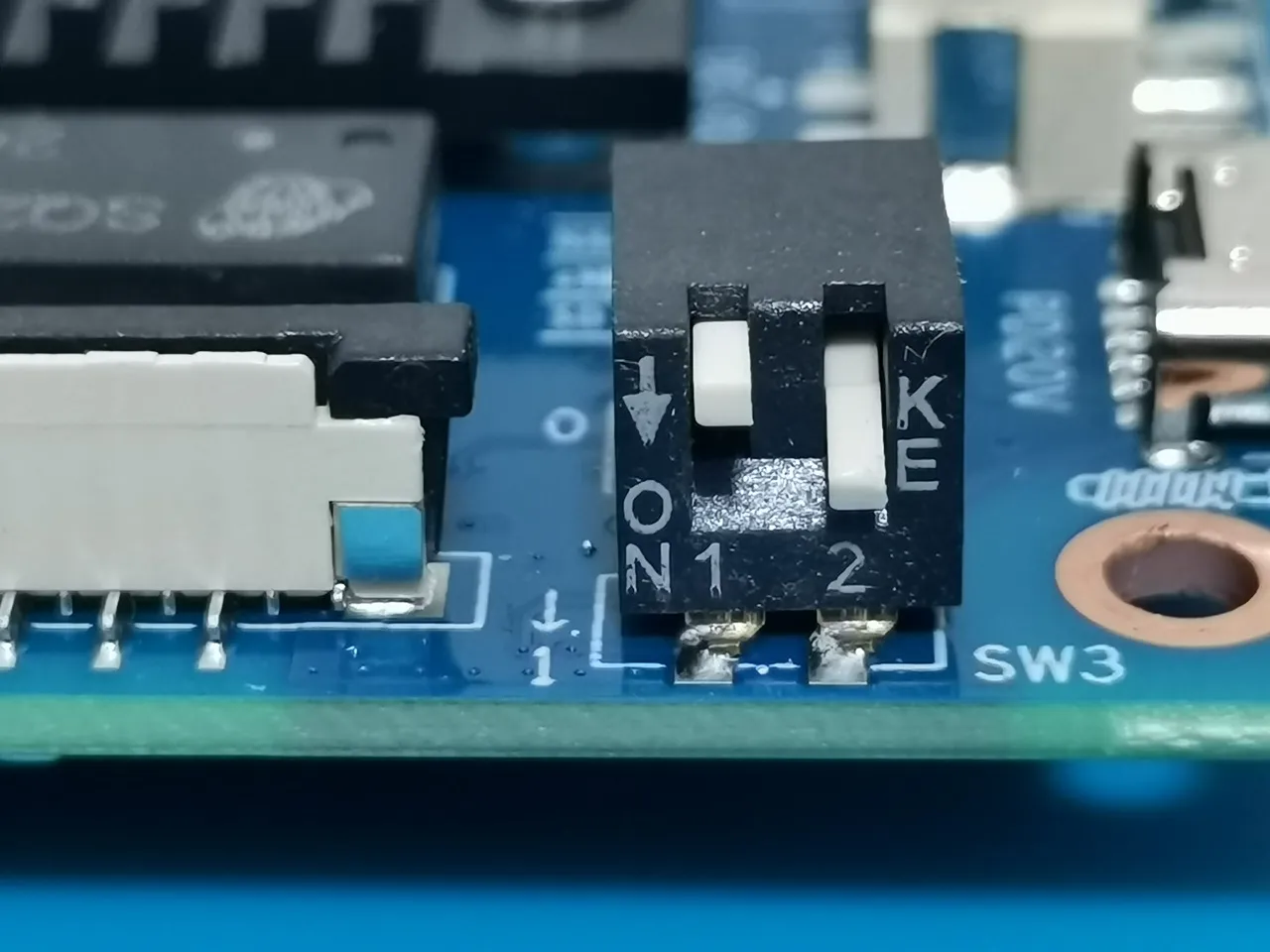
The best choice for now!
Until a newer, more stable version of OpenWrt is released, the best approach is to burn the latest snapshot image file onto a Micro-SD card. Once the final version is available, you can then burn it onto the eMMC / SPI-NAND Flash.
To burn the image, check the R4 Pro documentation page and prepare a microSD card with a suitable capacity of 32GB–64GB. If you run into boot problems like we did, consider switching to a reliable brand like SanDisk, which worked great for us.
What image can you use right now?
Check out the OpenWrt images made by Xiaomi_ax3600 and frank-w, active members of the Banana Pi Forum, who’ve put great effort into creating builds with bug fixes and all the snapshot packages. You can also find Debian images from frank-w worth exploring. These builds are designed for self-testing, compatible with kernel 6.12.62 or later, and ready to download and try on your R4 Pro (Links are posted below).
Using AI to build a network configuration that actually works!
With the current snapshot, you can expect all bands—2.4GHz, 5GHz, and 6GHz—to work. Multi-Link Operation (MLO) didn’t work for us and probably needs some fixing. So, with so many settings, how can you configure your OpenWrt to work properly?
We recommend using the AI Prompt approach as shown in the example below. Due to different country locations and regulations, we recommend using a single prompt to generate a complete wireless configuration file with all the necessary settings, which can then be copied to the OpenWrt directory at /etc/config/wirelessand modified if needed.
Using Microsoft Copilot (ChatGPT) to create a compatible OpenWrt network configuration file.
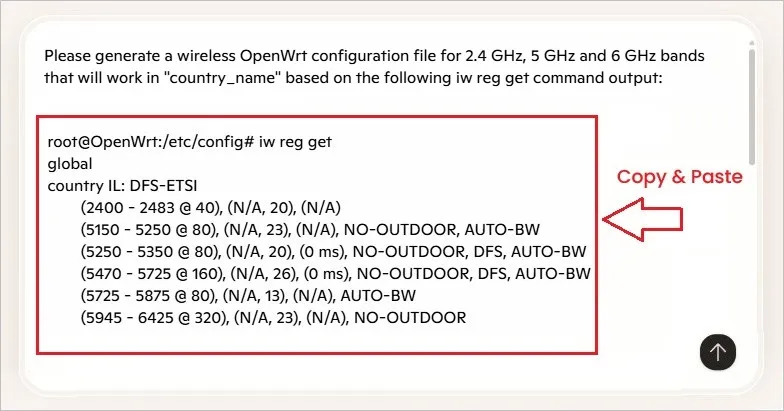
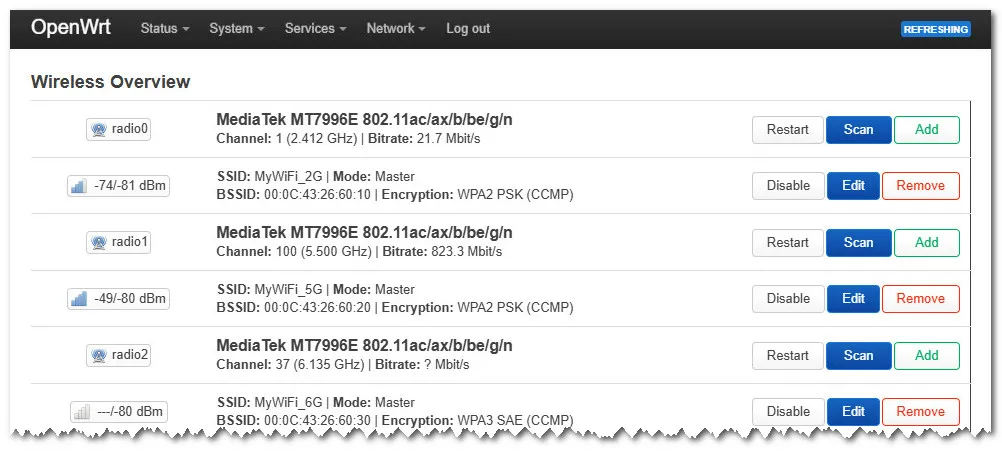
In this example, we split all three bands into separate SSID names. You can also unite the 2.4GHz and 5.0GHz bands for longer range, depending on what suits your needs.
| Band | SSID Name |
| 2.4 GHz | MyWiFi_2G |
| 5.0 GHz | MyWiFi_5G |
| 6.0 GHz | MyWiFi_6G |
# An example configuration file that worked for us
root@OpenWrt:~# cat /etc/config/wireless
config wifi-device 'radio0'
option type 'mac80211'
option path 'soc/11300000.pcie/pci0000:00/0000:00:00.0/0000:01:00.0'
option radio '0'
option band '2g'
option channel '1'
option htmode 'HT40'
option country 'IL'
option cell_density '0'
option disabled '0'
config wifi-iface 'default_radio0'
option device 'radio0'
option network 'lan'
option mode 'ap'
option ssid 'MyWiFi_2G'
option encryption 'psk2'
option key 'password'
config wifi-device 'radio1'
option type 'mac80211'
option path 'soc/11300000.pcie/pci0000:00/0000:00:00.0/0000:01:00.0'
option radio '1'
option band '5g'
option channel '36'
option htmode 'VHT80'
option country 'IL'
option disabled '0'
option txpower '20'
option cell_density '0'
config wifi-iface 'default_radio1'
option device 'radio1'
option network 'lan'
option mode 'ap'
option ssid 'MyWiFi_5G'
option encryption 'psk2'
option key 'password'
config wifi-device 'radio2'
option type 'mac80211'
option path 'soc/11300000.pcie/pci0000:00/0000:00:00.0/0000:01:00.0'
option radio '2'
option band '6g'
option channel '37'
option htmode 'EHT160'
option country 'IL'
option cell_density '0'
config wifi-iface 'default_radio2'
option device 'radio2'
option network 'lan'
option mode 'ap'
option ssid 'MyWiFi_6G'
option encryption 'sae'
option key 'password'
option ieee80211be '1'
option ocv '0'
We gave the official Banana Pi snapshot a test run
During our test, we tried different Wi-Fi configurations. It was a bit tricky to tweak all the settings to get everything working, but we managed to set up a functional configuration based on Copilot’s (ChatGPT) prompt suggestion, as we showed previously. It simplified the set-up process and worked well.
After manually setting up the OpenWrt network, all bands—2.4GHz, 5GHz, and 6GHz—worked flawlessly, delivering a steady 1200Mbps link on the 5G band with ourPoco F6 Pro phone. That said, it’s likely the network settings can be fine-tuned further to achieve even better bandwidth.
Screenshot of OpenWrt 24.10 Snapshot wireless network settings
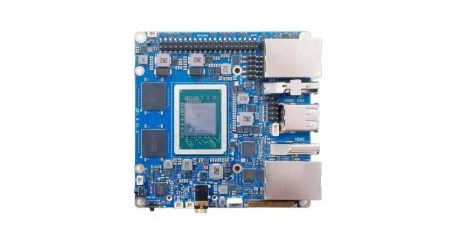
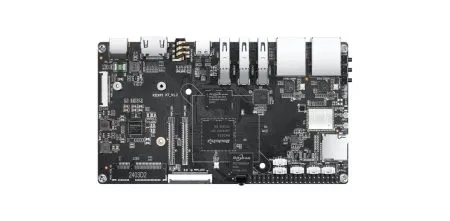

It is already on presale.
Yes, I know, thank you.
Hi, the main problem about the BPI R4 is its BE14 Wifi NIC (6 antennas and many shielding/noise problems).
In your pictures, we can clearly see the new BE19 NIC with 14 antennas: did you test it? Is it going to be released to the public this year? Thank you!
HI. Not yet, but from what I’ve heard, it should officially be released in a few weeks.
Thank you so much! Will you make a new post when the BE19 will be out? Did you have the R4 Pro for testing or these are just info from the company?
Not yet, but I’ll probably test the R4 Pro and the Wi-Fi expansion board and review them once both are ready and available.
For now, it’s just general news info.