- Maybe you missed it? LattePanda IOTA Review.
Part 1: Introducing the DFRobot 6.67″ 1.2 mm Bendable AMOLED Display
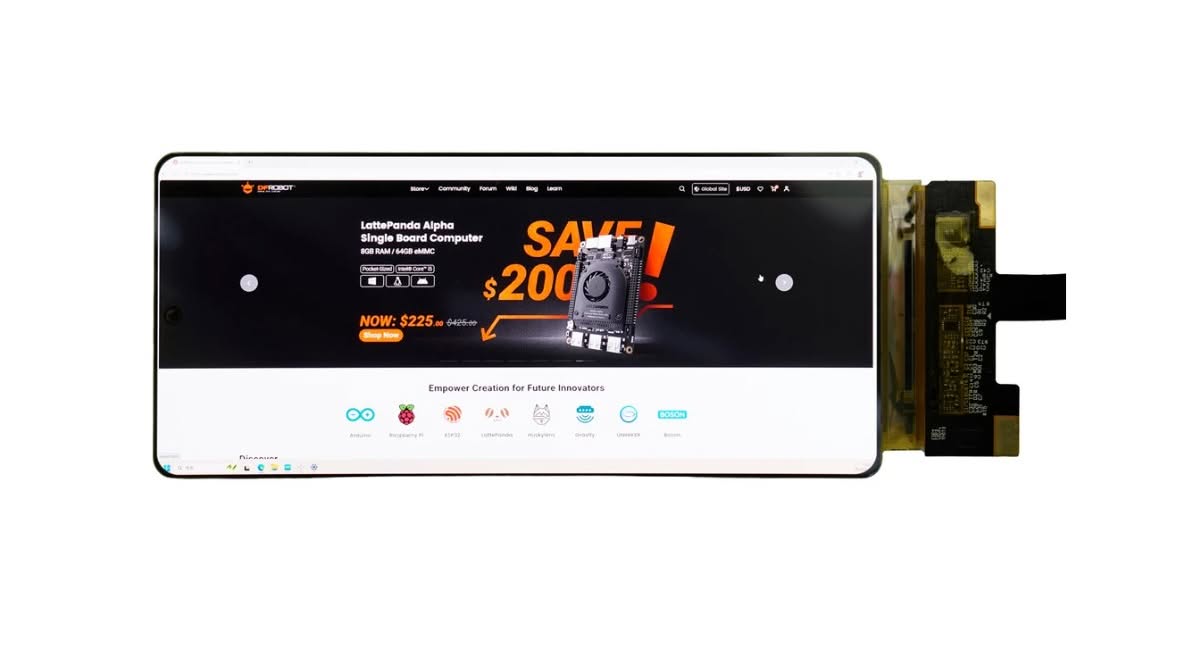
DFRobot launches its new ultra-thin 6.67″ flexible AMOLED display.
The landscape of maker electronics, rapid prototyping, and single-board computing (SBC) has experienced a a huge leep. For years, developers using platforms like the Raspberry Pi or LattePanda were limited to rigid, boxy designs. When a project required a visual interface, builders had to rely on standard flat-panel liquid crystal displays (LCDs) or inflexible organic light-emitting diode (OLED) modules. Although these displays were highly functional, they constrained the physical design of a product to the flat surface of the screen, hindering creativity in human-machine interface (HMI) design, wearable technology, and robotics.
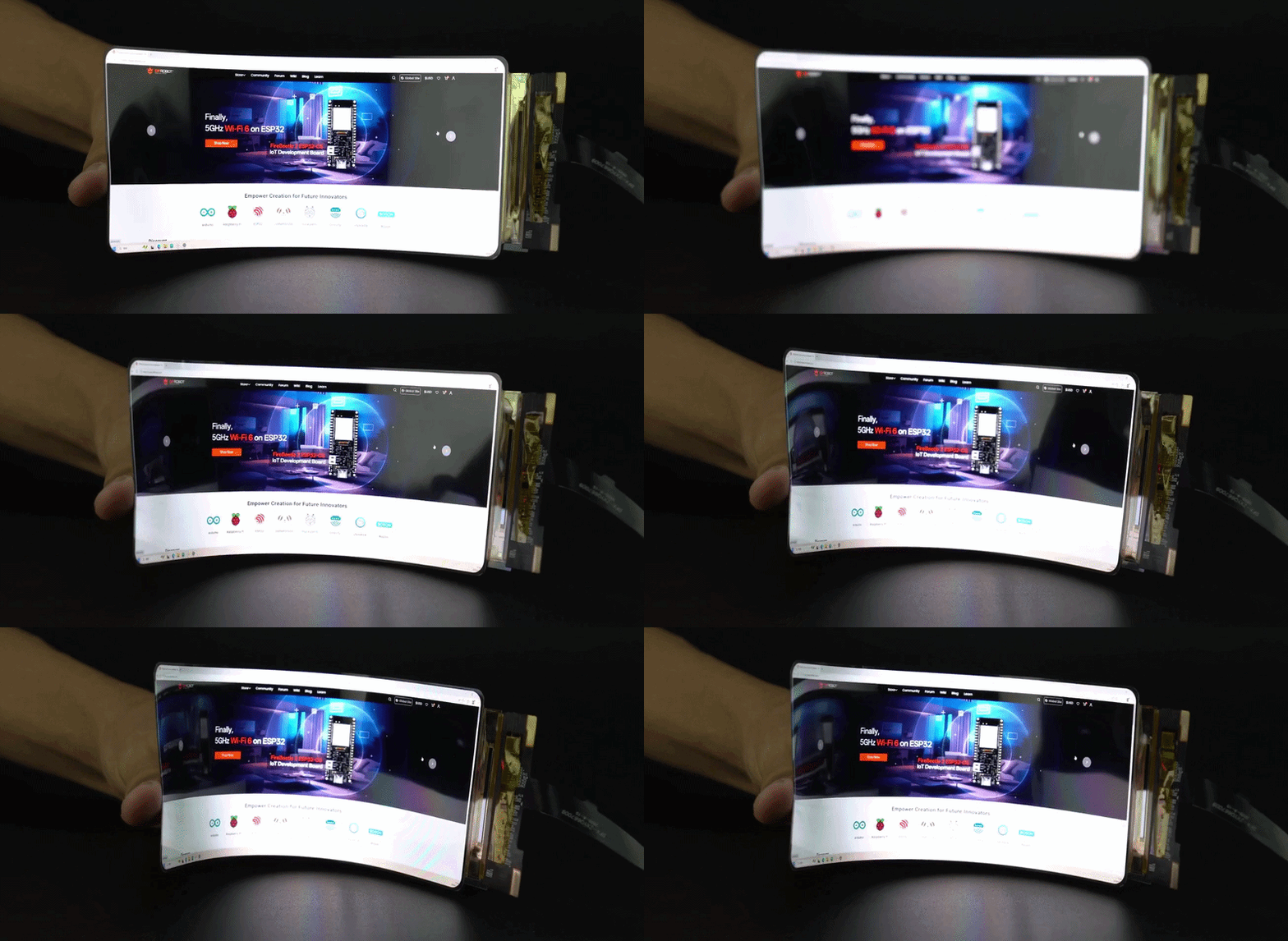
Design Tailored for DIY Projects, Engineers, and Designers.
DFRobot has addressed design limitations with the release of its 6.67” Flexible AMOLED Display, specifically designed for LattePanda and Raspberry Pi boards. This kit merges an ultra-thin, flexible substrate with a high-density, high-definition Active-Matrix OLED panel, bringing the advanced curved display technology typically seen in premium smartphones directly to engineers, hobbyists, and industrial designers. Furthermore, by incorporating a custom MIPI-to-HDMI driver board, DFRobot has eliminated the common challenges associated with low-level display configuration.
No more boxy projects
For years, building custom hardware meant wrestling with the “box penalty.” You design a sleek, ergonomic handheld, an advanced wearable, or a futuristic robot face, only to find your entire aesthetic ruined because you have to mount a flat, rigid glass rectangle right in the middle of it.
Whether you are hacking together a sci-fi bracer, a sweeping automotive dashboard prototype, or a social robot with an expressive, curved face, this kit means your enclosures no longer have to live in the flatlands. The future of hardware is officially bendy.
The new 6.67″ Flexible AMOLED Display Kit brings the bendable, organic screen tech found in high-end smartphones straight to the maker community. At a razor-thin 1.2mm thick, the panel uses a tough polyimide plastic substrate instead of brittle glass. This lets you warp, curve, and wrap the display smoothly around contoured enclosures without snapping the internal circuits or distorting the image.
Because it’s an AMOLED panel, the visual performance is superior. Every individual pixel glows on its own. When a pixel displays black, it turns completely off, offering true ink-like blacks and a rich 16.7-million color palette that makes user interfaces pop—even at extreme 85-degree viewing angles.
Easy and user friendly to setup
But the real engineering triumph here is how easy it is to use. Raw mobile screens communicate using low-level, notoriously frustrating MIPI signals that usually require custom Linux kernel configurations. DFRobot solves this by bundling a hardware MIPI-to-HDMI driver board.
You simply connect a standard HDMI cable from your Raspberry Pi, LattePanda, mini PC, or desktop, supply standard 5V power, and the screen springs to life as a standard plug-and-play monitor. No custom code required.
Interfacing with the Flexible Display
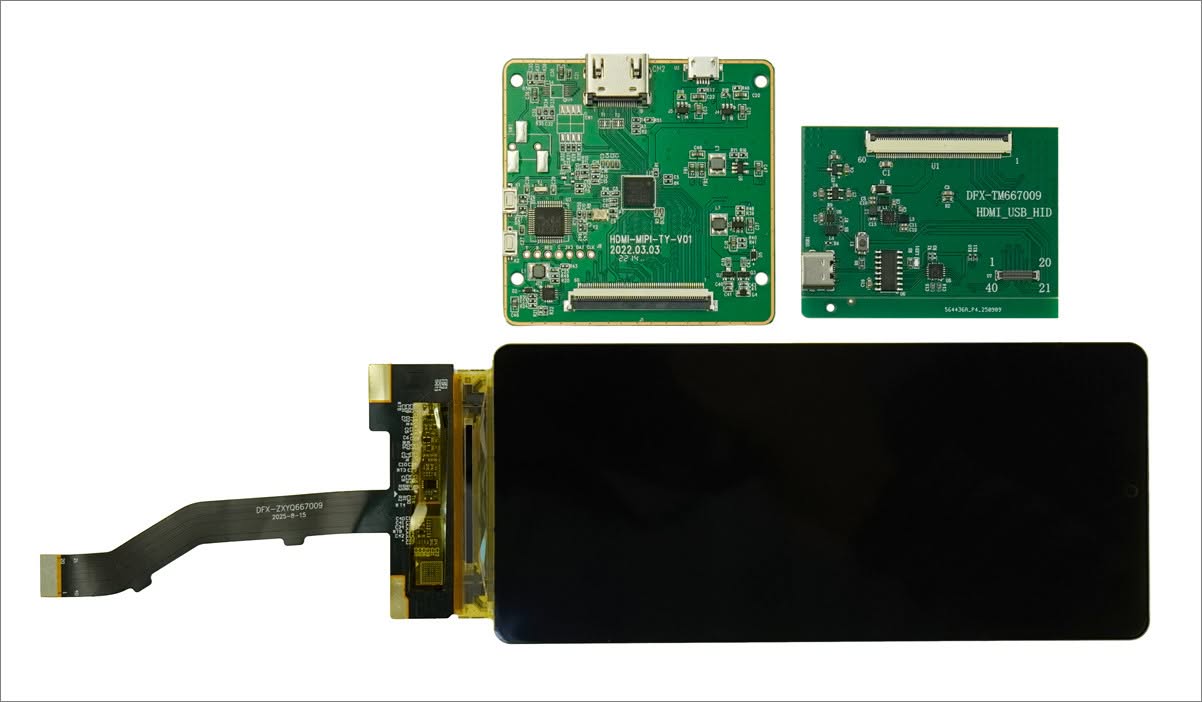
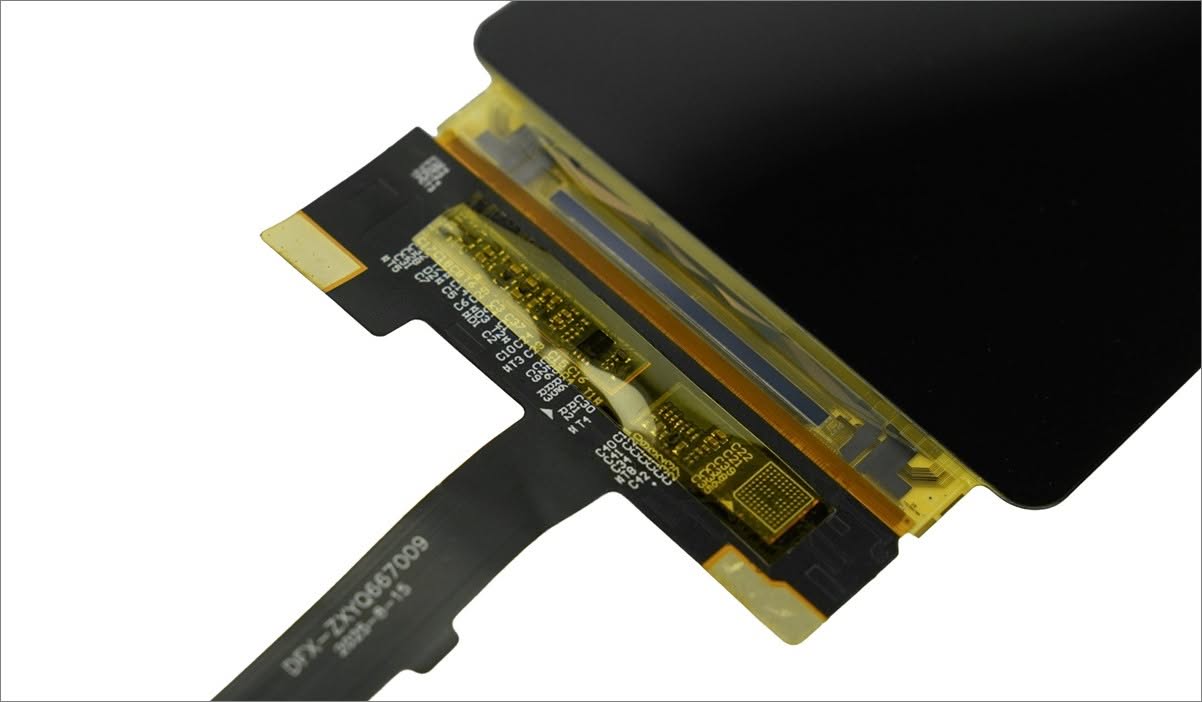
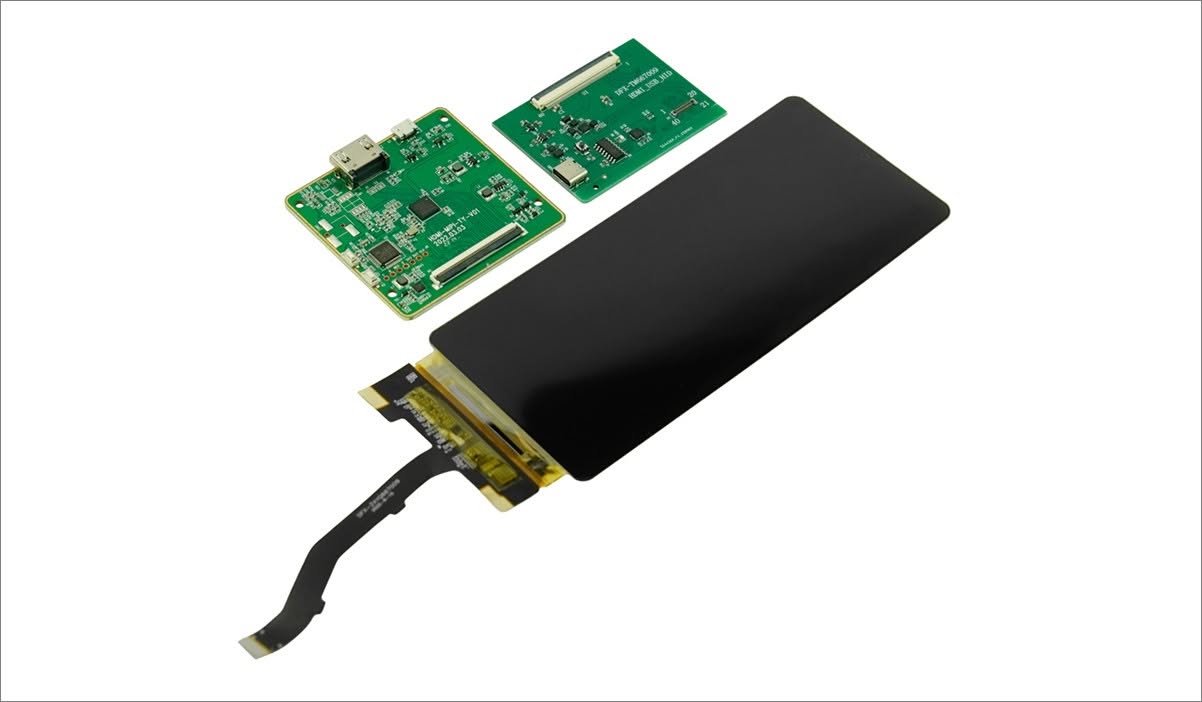
Vivid, High-Resolution AMOLED Visuals
The display features a resolution of 2400×1080 and a typical brightness of 450 cd/m². This AMOLED panel produces sharp text and vibrant images. With 16.7 million colors and an 85° viewing angle, it ensures consistent color accuracy from various perspectives. Whether showcasing complex UI elements, videos, or graphics, this screen delivers well-saturated visuals suitable for both consumer and industrial applications. It also provides a streamlined HDMI setup for SBCs.
The included driver board provides a standard HDMI input, enabling direct connection to SBCs without the need for custom kernel compilation or complicated adapter boards.
Beyond the Flat Dashboard: An Ideal Solution for Embedded Automotive Projects
The days of the blocky, utilitarian car dashboard are officially over. Step inside any modern vehicle, and you are instantly greeted by sweeping, panoramic glass cockpits that curve gracefully around the driver’s line of sight. Carmakers are rapidly moving away from flat, tablet-like screens in favor of organic, flowing digital interfaces.
For automotive engineers, aftermarket modders, and custom overland builders, mimicking this modern aesthetic has been an uphill battle. Until now, prototyping a custom digital dashboard or flight simulator cockpit meant forcing a flat, rigid glass monitor into a naturally contoured dashboard shroud. It looked clunky, out of place, and broke the design rhythm of the interior. This flexible display changes the game entirely, serving as the perfect mechanical and visual missing link for car-embedded projects.
Bending to the Geometry of the Cockpit
The primary reason this display fits automotive projects so perfectly is its structural freedom. At a hyper-thin 1.2 mm, the display completely eliminates brittle glass substrates in favor of a bendable polyimide plastic base.
In automotive prototyping, space behind the instrument cluster is at an absolute premium—it is tightly packed with structural crossbeams, HVAC ducting, and wiring harnesses. Because this panel has no bulky LED backlight assembly, it can be wrapped flush against a curved dashboard bezel or center console housing, requiring virtually zero deep cavity space. Whether you are building an overland navigation cluster that contours seamlessly to an asymmetrical dashboard pod or an avionics panel that wraps around a pilot’s seat, the screen adapts to your design, rather than your design adapting to the screen.
Uncompromising Daytime Visibility and “True Black” Aesthetics
Automotive cabins present one of the harshest environments for electronic displays due to extreme ambient lighting and glare. Traditional LCD panels struggle here; their backlights wash out under indirect sunlight, making map data or crucial engine telemetry difficult to read.
As an AMOLED screen, every individual pixel emits its own light. With a bright 450-nit output and an mathematically infinite contrast ratio, graphics remain razor-sharp and punchy. More importantly for car interiors, when an AMOLED pixel displays black, it turns off entirely. This means when you design a dashboard interface with a pitch-black background, the edges of the display disappear completely into the shadows of the physical dashboard trim. You get a seamless, factory-finish look where the gauges look like they are floating directly on the dashboard surface, rather than sitting trapped inside a glowing grey rectangle.
Furthermore, the display features a wide 85° viewing angle across all axes. Whether the screen is tilted toward the driver or centered in the console for the passenger, there is zero color shifting or contrast degradation—a vital safety feature when monitoring real-time vehicle vitals on the move.
Dead-Simple Integration with In-Car Compute Platforms
Building a custom infotainment layout requires processing power, usually delivered via single-board computers like the Raspberry Pi or x86 platforms like the LattePanda running custom Android, Linux, or Windows dashboard builds.
Ordinarily, hooking up a raw flexible smartphone screen to an embedded computer requires low-level MIPI signal engineering, proprietary drivers, and constant troubleshooting. DFRobot eliminates this entire hurdle by including a hardware-level MIPI-to-HDMI driver board.
The board runs seamlessly on standard 5V power, easily tapped from a vehicle’s accessory wiring or a standard USB port. You simply run a standard HDMI cable from your LattePanda or Raspberry Pi into the driver board, and your custom digital instrument cluster boots instantly as a plug-and-play monitor. By marrying smartphone-tier physical flexibility with standard desktop ease of use, DFRobot has delivered the ultimate tool for shaping the next generation of custom automotive cockpits.
Main Features
| Feature | Description |
|---|---|
| Ultra‑Thin Flexible Profile | 1.2 mm maximum thickness enables integration into tight spaces and curved mechanical designs. |
| Vivid Visuals | 2400×1080 (SPR) resolution, 450 cd/m² brightness, and 16.7M colors deliver high‑contrast, self‑emissive AMOLED output. |
| Plug‑and‑Play Integration | Included MIPI‑to‑HDMI driver board removes the need for complex DSI routing. |
| SBC Compatibility | Works with the following boards: ✔ LattePanda IOTA/MU/Alpha/3 Delta/Sigma ✔ Raspberry Pi 4, and Raspberry Pi 5 via HDMI. |
| Independent Power | Powered through 5 V Micro USB on the driver board (approx. 3 W typical consumption). |
📱 Specification
| Category | Item | Details |
|---|---|---|
| Display Characteristics | Screen Size | 6.67 inches |
| Resolution | 2400×1080 (SPR) | |
| Screen Material | AM‑OLED | |
| Brightness | 450 cd/m² | |
| Frequency | 50 Hz | |
| Aspect Ratio | 20:9 | |
| Viewing Angle | 85° | |
| Display Colors | 16.7M | |
| Display Area | 154.56 × 69.552 mm | |
| Mechanical | Dimensions | 162.56 × 74.46 mm |
| Maximum Thickness | 1.2 mm | |
| Driver & Interface | Driver IC | ICNA3511A |
| Driver Voltage | 3.3–5 V | |
| Interface | MIPI‑40Pin | |
| Operating Temperature | −20°C to 60°C | |
| Package Contents | Included Items | ×1 6.67‑inch AMOLED flexible display ×1 HDMI driver board ×1 MIPI adapter board ×1 FPC cable ×1 HDMI‑to‑HDMI data cable ×1 Micro USB power cable |