
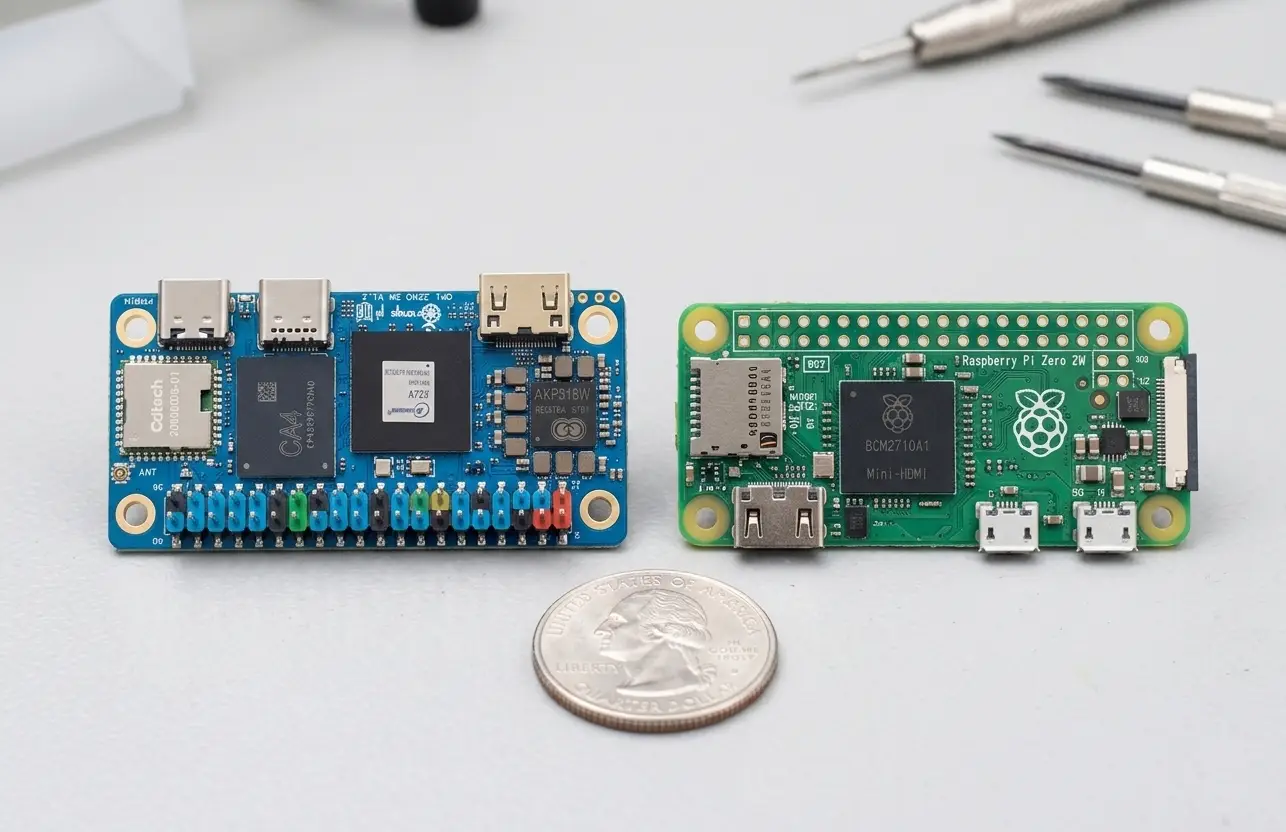
- Part I: introducing the Orange Pi Zero 3W SBC
- The Orange Pi Zero 3W has just been released, offering a compact, budget-friendly development board with multiple interfaces, including dual video outputs.
- Interfaces
- Orange Pi Zero 3W (Design/Interfaces)
- Hardware Specifications
- Applications
- Storage Options
- So, what's truly new about this board?
- How does it stack up against the Radax Zero W3?
- Comparison of tech specs
- Active Cooling and Thermal Performance
- Form factor
- Specs Comparison: Raspberry Pi Zero 2W vs. Orange Pi Zero 3W
- Part II: Orange Pi Zero 3W Review
- The Package (Package Contents)
- All Items
- A Closer Look at the Board
- Cooling the board components
- Installing the active heatsink
- Initial impressions
- Temperatures
- Software
- Storage Space
- Connectivity
- A PCIe 3.0 socket is included as well.
- What You Need
- ✔ Option B — Key‑E → PCIe x1 Riser → NVMe Adapter
- ✔ Option C — Powered NVMe Carrier Board
- Wireless Connectivity Speed
- The option for an external antenna
- Performance Wise
- Single‑Core Performance Breakdown
- Multi‑Core Performance Breakdown
- Comparing the performance of the Zero W 3 board to other popular boards.
- 📊 Geekbench 6 CPU Data Analysis
- Here are the key takeaways from our Geekbench 6 results, presented clearly:
- 📌Bottom Line
- 3 TOPS NPU
- CPU Information
- CPU Governor settings
- 1.simple_ondemand (Default)
- 2. performance
- 3. userspace
- Multimedia
- What about video playback performance?
- GPU Acceleration for video decoding? Not So Fast.
- VLC Medai Player: Video Decoding with GPU Acceleration
- From our testing
- Key takeaways:
- GPU Capabilities Summary (PowerVR BXM‑4‑64 MC1)
- What the GPU Is Actually Useful For?
- The real reason is that hardware decoding is not available in the Linux images.
- What steps should you take if you still need support for hardware video decoding?
- The Android OS experience
- The Kodi experience
- Power consumption
- Compact in size and portable.
- The small form factor advantage: Tiny yet powerful
- Pricing (excluding taxes and shipping fees)
- Final Thoughts
- Price and availability
- Maybe you missed it? Orange Pi 6 Plus Review.
- Orange Pi Zero 3W: A closer look at device specs, features and main interfaces.

Part I: introducing the Orange Pi Zero 3W SBC
The Orange Pi Zero 3W has just been released, offering a compact, budget-friendly development board with multiple interfaces, including dual video outputs.
Shenzhen Xunlong, the company behind the popular Orange Pi brand, has just launched a new product: the Orange Pi Zero 3W development board. This compact board features an Allwinner A733 octa-core processor and a Risc-V E902 core coprocessor, also known as the Alibaba XuanTie E902, which operates as a real-time clock at approximately 150 MHz. The Risc-V core utilizes an open instruction set and is designed for low energy consumption.
The processor includes a dual-core Arm Cortex-A76 and a hexa-core Arm Cortex-A55, all built on a 12nm process and utilizing a big-little architecture. The processor features a maximum clock speed of 2.0GHz and supports a 3 Tops NPU, making it ideal for edge AI acceleration applications.
Additionally, while it currently supports up to 12GB of RAM, this board can accommodate up to 16GB of LPDDR5 memory and is capable of decoding video formats up to 8K at 24fps for H.265, VP9, and AVS2. It also supports video formats up to 4K at 30 frames per second for both H.265 and H.264, which is another significant advantage.
Interfaces
This board features a variety of interfaces, including PCIe 3.0, USB Type-C 3.0, UFS, MIPI-CSI, MIPI-DSI, and a 40-pin expansion interface, along with other commonly used functional interfaces. It is compatible with operating systems such as Ubuntu, Debian, and Android 13.
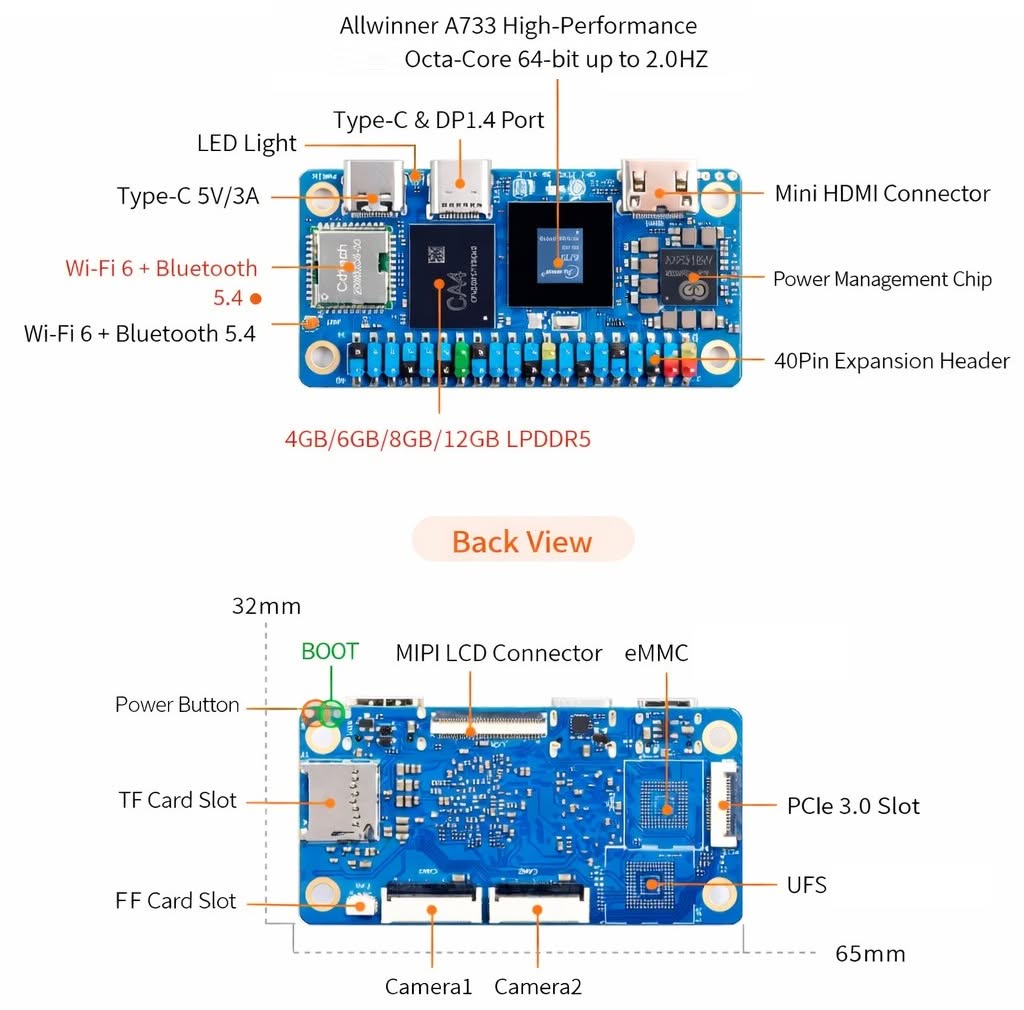
Orange Pi Zero 3W (Design/Interfaces)
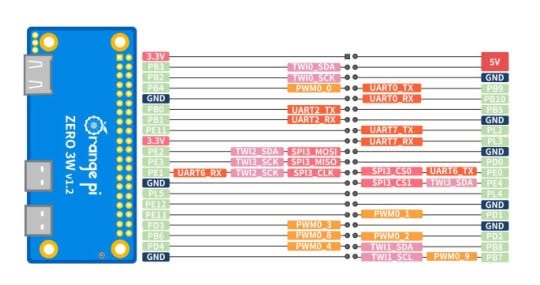
Hardware Specifications
| Category | Specification |
|---|---|
| Processor (CPU) | A733 SoC 2× Cortex‑A76 + 6× Cortex‑A55, up to 2.0 GHz |
| Coprocessor | Xuantie E902 RISC-V Real-Time Coprocessor (up to 200 MHz). |
| GPU | Imagination BXM‑4‑64 |
| NPU | 3 TOPS |
| Memory | Supports up to 16 GB LPDDR5. |
| Storage | Onboard eMMC or UFS (Optional) TF card slot (supports up to 128GB) |
| Wireless | WiFi 6 + Bluetooth 5.4 (BLE), WiFi/BT combo module |
| Display Interfaces | 1× Mini HDMI 2.0 (up to 4K@60fps) 1× MIPI‑DSI (4‑lane) 1× DisplayPort 1.4 |
| Camera Interfaces | 2× MIPI‑CSI (4‑lane each) |
| USB | 1× USB‑C (USB 3.0 Host) 1× USB‑C (USB 2.0, Host & Device) |
| Buttons | BOOT (test point), PWR ON (test point) |
| Expansion Header | 40-pin GPIO header supporting GPIO, UART, I2C, SPI, PWM |
| Debug | 3-pin UART debug port |
| Power Input | USB‑C 5 V / 3 A DC‑IN |
| Supported OS | Ubuntu, Debian, Android 13, OpenHarmony, and others |
| AI development frameworks | ONNX, TensorFlow, PyTorch, and Caffe. |
| Weight | 14g |
| PCB Dimensions | 65 mm x 32 mm |
Applications
The Orange Pi Zero 3W offers a robust hardware foundation for the deployment of generative AI and artificial intelligence algorithms in specific scenarios. It can be applied widely in fields such as smart industrial control, intelligent commercial displays, retail payment systems, smart education, commercial robotics, in-vehicle terminals, vision-assisted driving, edge computing, smart distribution terminals, and more.
Storage Options
For those with a keen eye for details, you may have noticed that the W3 board currently lists flash eMMC and UFS storage as future optional upgrades, likely due to global flash chip shortages. Currently, its primary storage option is a TF card slot that supports up to 128GB, which should be more than enough for running Ubuntu or any lightweight Linux distribution.
So, what’s truly new about this board?
If you are curious about what sets this tiny board apart from previous models, it includes Wi-Fi 6 connectivity with Bluetooth 5.4 support, as well as two video output interfaces: one Mini HDMI and one USB-C (DP) DisplayPort 1.4 output, both capable of decoding video up to 4K at 60 fps. Additionally, this board supports a variety of RAM configurations, with options ranging from 1GB to 8GB, and the potential for 12GB and 16GB.
How does it stack up against the Radax Zero W3?
Comparison of tech specs
| Feature | Radxa Zero W3 | Orange Pi Zero 3W |
|---|---|---|
| SoC / CPU | Rockchip RK3566 — Quad‑core Cortex‑A55 @ up to 1.6 GHz | AllWinner A733 — hybrid octa‑core @ 2.0 GHz |
| GPU | Mali‑G52 (RK3566 family, inferred) | Imagination PowerVR BXM-4-64 |
| NPU | None listed for Zero W3 | 3 TOPS NPU |
| Coprocessor | ❌ | ✔ Xuantie E902 RISC-V Real-Time Coprocessor. |
| RAM | Up to 8GB LPDDR4 | Up to 12GB LPDDR5 (16GB Optional) |
| Storage | ✔ eMMC or microSD (Zero 3 series) | ❌ eMMC or UFS (Optional) |
| Wireless | WiFi 6 + Bluetooth 5.4 | Wi‑Fi 6 + Bluetooth 5.4 |
| Video Output | Micro HDMI (1080p@60 for Zero 3W) | Dual display output through USB‑C DisplayPort and Mini HDMI port. |
| USB Ports | USB 3.0 Host + USB 2.0 OTG (Zero 3W) | USB‑C with DP Alt Mode, up to 4K@60fps. |
| GPIO | 40pin GPIO header | 40pin GPIO header |
| PCIe Interface | ❌ | ✔ 1 x PCIe 3.0 1-Lane FPC socket. |
| MIPI-DSI Interface | ❌ | ✔ 1 x 4-lane MIPI-DSI |
| MIPI CSI interface | 1 x 4-lane MIPI CSI interface. | 2 x 4-lane MIPI CSI interface. |
| Fan interface | ❌ | ✔ 2PIN Fan interface |
| Maskrom Button | ✔ | ❌ |
| Dimensions | 65 × 30 mm | 65 mm x 32 mm |
| Target Use | Compact SBC for IoT, embedded, Linux systems | Higher‑performance AI‑capable SBC with NPU and LPDDR5 |
Active Cooling and Thermal Performance
For approximately $4 to $6, the company provides an active cooler that is accompanied by a heatsink, which surrounds all components except for the accessible GPIO header pins. This configuration guarantees that the board receives adequate cooling while maintaining accessible interfaces.
Form factor
The W3 board’s dimensions are almost a match for the Raspberry Pi Zero W2. The Pi measures 65 mm long and 30 mm wide, while the W3 comes in at 65 x 32 mm (2.56 x 1.26 inches). Both boards share identical hole spacing, making it easy to find semi-open alternative cases that fit.
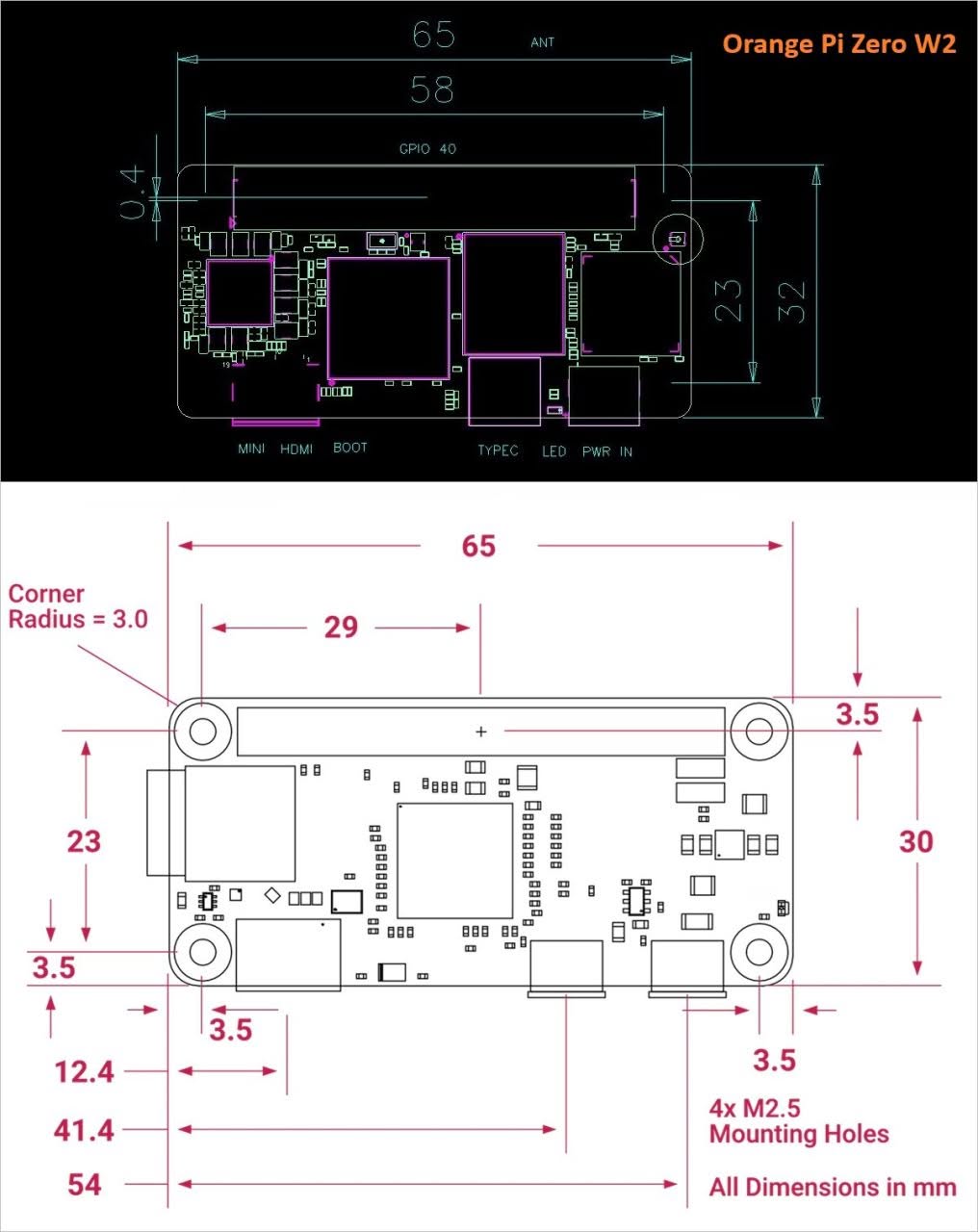
Specs Comparison: Raspberry Pi Zero 2W vs. Orange Pi Zero 3W
While Raspberry Pi offers the best software ‘polish,’ the Allwinner A733 provides raw power that simply didn’t exist in the Zero form factor until now. If you need Android 13 or WiFi 6 on a tiny board, the Orange Pi Zero 3W’s software ecosystem is already ahead of the aging Pi Zero 2W.
| Model | Raspberry Pi Zero 2W | Orange Pi Zero 3W |
| Official Launch Date | October 28, 2021 | April 4, 2026 |
|---|---|---|
| Processor (SoC) | Broadcom BCM2710A1 | Allwinner A733 (Octa-core) |
| CPU Architecture | 4 Cores: 4x Cortex-A53 @ 1GHz | 8 Cores: 2x A76 + 6x A55 @ 2.0GHz |
| RAM (LPDDR) | 512MB (Fixed) | 1GB to 12GB (LPDDR5) (16GB optional) |
| GPU | VideoCore IV | Mali-G310 / PowerVR BXM |
| AI Performance | N/A | 3 TOPS NPU (Integrated) |
| Video Output | 1x Mini HDMI (1080p) | Dual: Mini HDMI + USB-C (DP) |
| Max Resolution | 1080p @ 30fps | 4K @ 60fps |
| Storage | MicroSD only | MicroSD + Optional eMMC |
| Wireless | WiFi 4 + BT 4.2 | WiFi 6 + BT 5.4 |
| Expansion | 40-pin Header | 40-pin + PCIe 3.0 (FPC) |


According to its user manual (PDF created 2026-05-15 11:18:04) GPU and video encoding/decoding units are only supported by “Debian bullseye” – which was released 2021, is in LTS with EOL August 2026 (this month, as of writing). In other words, OrangePI have released a device that had two months (2!) OS support left.
If its that critical, you can always use the Armbian image, or buy a pi board for 140-200$. its not that the software
is useless and cannot be updated.